Archive for the ‘Canada’ Category
Whistler mild and wild
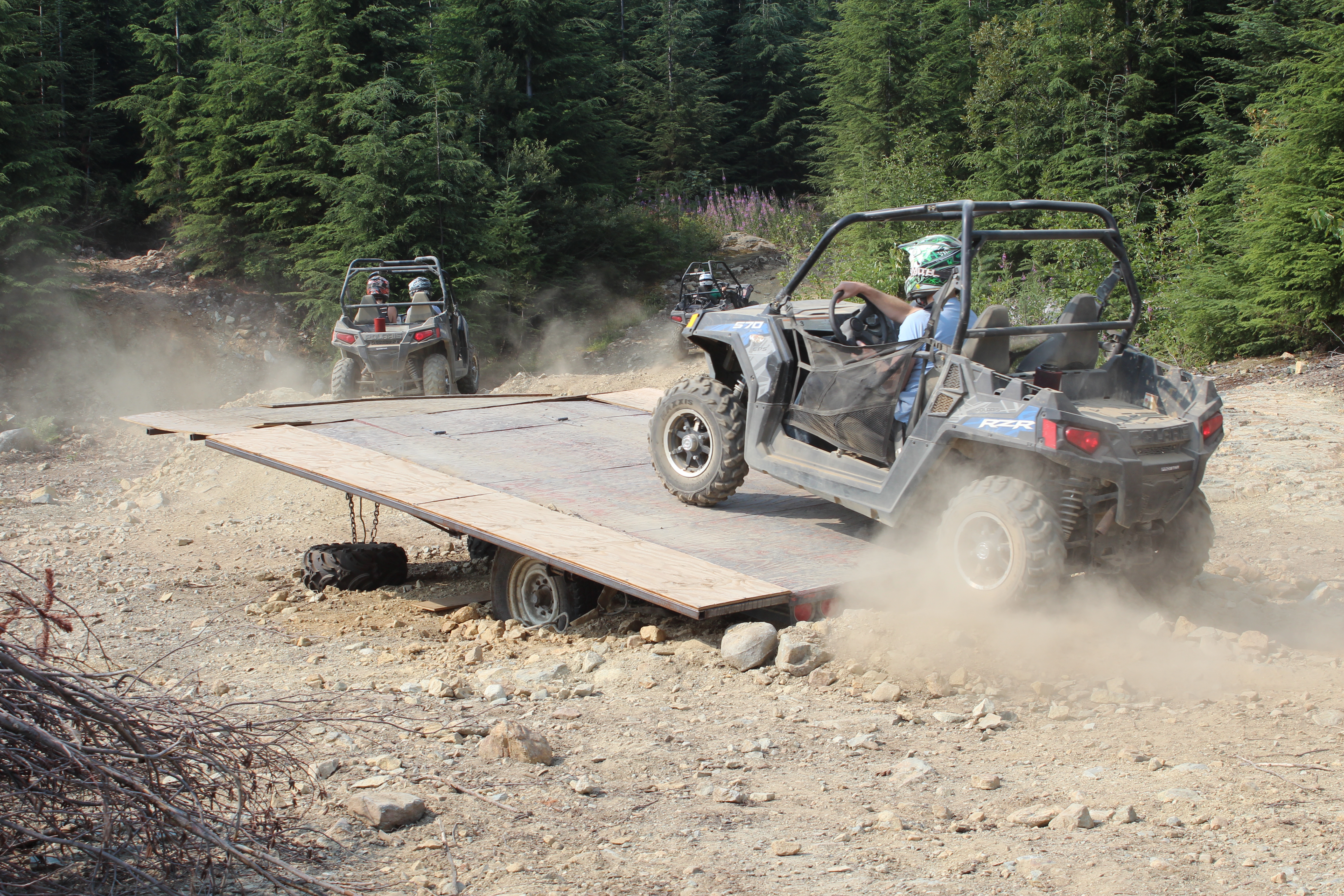
The Polaris 570 cc RZR has never met an obstacle it didn’t like.
Close to the highest point of Fairmont Chateau Whistler Golf Course, the Blackcomb River dissects the manicured greenery and drops the air temperature about 15 degrees. The water’s arrived directly from the Horstman Glacier atop Blackcomb peak, which explains the cold and why this is a popular spot during record-breaking heat.
“It’s like instant air conditioning,” says a friend. It also makes the mosquitoes disappear, I think to myself. At the clubhouse, we’d just finished an indulgent meal, which somehow featured bacon in every course, including the caesar aperitif and the Nanaimo bar dessert. The temperature is still in the 20s and haze from the Pemberton forest fire lingers.
If you like your adventure on the mild side, the Golf Clubhouse Dinner and Nature Tour is right up your fairway. Enjoy dinner as the sun sets behind Rainbow Mountain, then board a golf cart for a nature tour of the course. The carts are equipped with GPS, which seems like overkill to me, (how hard can it be to navigate 18 numbered holes?) but given the 400-foot climb in places, I’m happy not to be walking.

The Fairmont’s Golf Clubhouse Dinner and Nature Tour covers several food groups, especially bacon.
Even for non-golfers like me, there’s much to enjoy about the tour, which traverses creeks and milky-green glacier-fed ponds, ancient Douglas Fir, and granite bluffs. Sadly, the bears aren’t out tonight, but a protective mother grouse is strutting around the 13th hole with her three chicks in tow. The course has erected bat houses close to the 18th green, with more in mind than just encouraging wildlife. A single brown bat eats up to 1,000 mosquitoes in an hour!
If you like your adventure in something more agile than a golf cart, a RZR (that’s “Razor” when you say it out loud) Tour will safely push you a little further beyond your comfort zone. RZRs are four-wheeled, off-road vehicles capable of negotiating the gnarliest of boulder-strewn logging roads and creek beds. The morning after our night at the golf course, we rise early at the Fairmont Chateau Whistler for a RZR Alpine Sunrise Tour by The Adventure Group (TAG). Alongside its ever popular Superfly Ziplines at Cougar Mountain, about 10 minutes’ drive from Whistler, TAG’s RZR tours are an exhilarating way to quickly find yourself in the rarefied air, high up in Whistler’s backcountry.
With a guide driver at the front and ‘spotter’ at the back, we each board a Polaris 570 cc RZR and make final adjustments to dust masks, goggles and helmets. With no rain for weeks, and exposed to the elements but for a roll cage, we’re about to get extremely dusty. And as I turn the ignition key sparking the engine to life, I can’t help thinking a GPS would be better suited to a RZR than a golf cart.
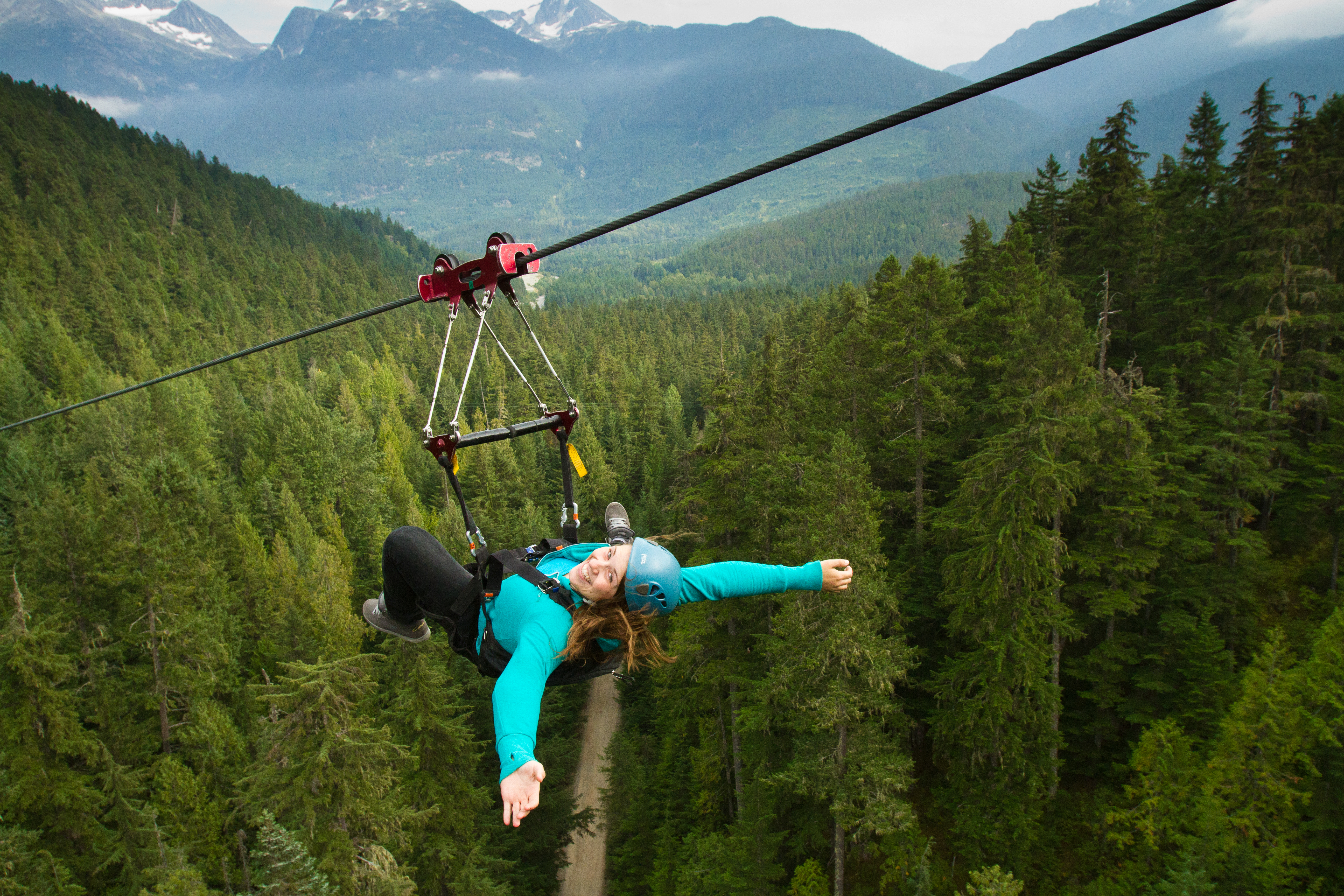
For the ultimate in thrill rides, Superfly Ziplines are hard to beat.
It’s a bumpy ride – extremely bumpy in places – but with one foot firmly applied to the gas, the RZR is capable of clearing anything in its path. The bucket seats absorb most of the jolts and on the steep bits, the brakes respond better to a few taps than to sustained pressure.
Our tour takes us through Ancient Cedars and Showh Lakes, hiking areas known for giant trees and good fishing. Lupins and fireweed are everywhere at about 3,500 feet, where we park to admire hazy views of Mount Currie and the Soo River below. It’s a world away from the bustle of Whistler village, and I begin to think of how much fun it would be to ride a snowmobile up here. Back on this tour, there’s more fun to be had at an obstacle course created in a clearing that features a teeter totter, berms, and steep embankment trails for those who hold their nerve.
During the 15-kilometer, two-and-a-half tour, we rarely exceed 25 km/h, such is the heavy going on Cougar Mountain’s rocky roads. But bouncing around on trails all but impassable to any other vehicle is half the fun. For anyone with $11,000 to spend and a quiet air strip, RZRs can accelerate from 0 to 35 mph in four seconds, and clock over 80 mph!
For similar speeds at less money, you might want to check out the Superfly Ziplines.
If you go
Fairmont Chateau Whistler offers numerous summer packages, including golf vacations and the B.C. resident accommodation offer, which saves 15% off best rates. Visit fairmont.com/whistler
The Adventure Group’s Alpine Sunrise Tour at Cougar Mountain costs $219 (2-seater) or $319 (4-seater). TAG also offers a two-hour Wilderness Ride and a three-hour B.C. Tour. For details, call 1 855 824-9955 or visit tagwhistler.com/
Fairmont’s Golf Clubhouse Dinner and Nature Tour includes a three-course dinner and costs $69 per adult ($35 per child) and is available Mondays, Tuesdays, and Wednesdays. Call 604 938-8000.
Whistler from the saddle

It’s not Roman Holiday, but Green Lake, Whistler, is a good substitute for anyone on a scooter.
When brothers Adam and David Vavrik travelled from their native Czech Republic to Whistler on work visas they quickly noticed something about the mountain resort. Most adventure here requires some kind of physical effort. Five years after the Olympics, Whistler still feels like an Olympic village whatever the season. Aside from the hours between midnight and 4 a.m., people here ooze health. A culture based on outdoor pursuits will do that to visitors and residents.
But suppose your shredding days are behind you, yet you still crave a little speed? Or, like me, you can no longer keep up with your teenagers on the hill, but still want some excitement off-piste. Despite being in their 20s and heavily into snowboards and skateboarding, the Vavrik brothers asked themselves the same question.
The answer was Spitfire Scooters, a fleet of 2014 Yamaha BWs and 2013 Honda Giornos, available to rent from the Vavriks’ base at the Summit Lodge Boutique Hotel on Main Street.

49cc Honda Giornos are sleek, elegant, and run on about $6 of gas a day.
In the interests of full disclosure, I’d come for the second annual Whistler Village Beer Festival – four days of brewmaster dinners, cask showdowns, free tastings, obscenely large hangover-themed breakfasts, (thank-you Dubh Linn Gate) and a glorious Saturday afternoon festival in Whistler Olympic Plaza. Getting around to more than 150 beers from 50 breweries had seemed so exciting. But that was on Thursday. By Sunday morning I’d fallen out of love with beer, if only for a day.
The Summit Lodge offers Norco City Glide bikes for guests to borrow free. But with late-summer temperatures still in the high 20s, we were looking for wind in our hair, not sweat. So for the first time in our 40-something lives, my wife Leah and I rented scooters. Leah’s always had this thing about Audrey Hepburn in Roman Holiday, particularly the scene where she rides a Vespa with Gregory Peck through Rome. So like Audrey, she wore a dress and sunglasses. Unlike Gregory, I wore shorts and T-shirt.
With two hours to spare and David Vavrik as our guide, Whistler beyond the village awaited us. After a brief orientation, we test-drove the 49cc Honda Giornos up and down Main Street. Storage under the seats allowed plenty of room for our backpacks, and we wouldn’t be stopping for gas any time soon. You could drive this model all day for about $6, according to David.

Nothing good can come from Beer Jenga.
They’re elegant, too, with sleek curves and a cherry-red paintjob. The helmets by contrast, are decidedly un-Audrey Hepburn, but mandatory: Pity – but probably for the best. Soon we were buzzing along Blackcomb Way and up the ever-so winding Glacier Drive, past the tube park and onto the Whistler Sliding Centre. The place was deserted and we spent about 10 minutes walking the track and reminiscing about the 2010 Olympics and Jon Montgomery’s skeleton gold. Skeleton experience programs offer the public a chance to go headfirst, 100 km/h, David informed us. Not today, I thought. Riding a scooter at 50 km/h was more our style.
Riding the Sea-to-Sky Highway to our next stop, Green Lake lookout, allowed us to open up the throttle and push close to the bike’s top speed of 60 km/h. We stopped to admire the view and right on cue, a float plane took off from across the lake and into the cloudless blue sky.
I was glad to be off the highway and onto Alta Lake Road where traffic was scarcer. We passed Rainbow Park on Alta Lake and then on past Nita Lake and Alpha Lake, stopping when we felt the urge to take photos. The advantage of a scooter became more obvious with every kilometer clocked. For an afternoon or day of sightseeing beyond the village, this ride offers great freedom to see so much more of Whistler and its parks and lakes.
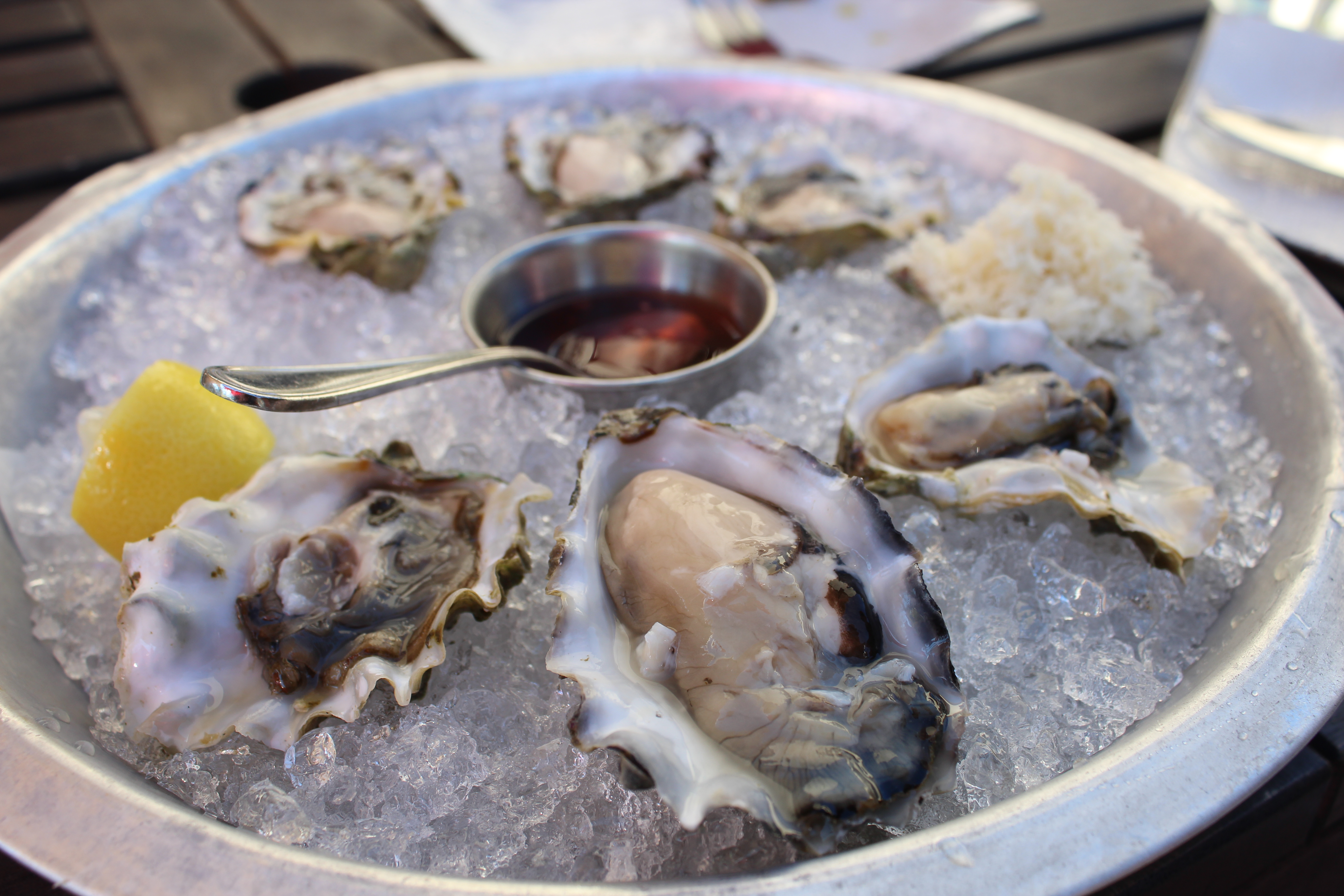
The oysters disappeared moments after this photo at Bearfoot Bistro, Whistler.
The highway with its fast-moving traffic and sketchy hard shoulder can be a little nerve-racking when you’re on a scooter. On the ride back from Alpha Lake through Whistler Creekside I realized my mid-life crisis – when it inevitably hits – will not feature a Harley Davidson. But I’d rent a scooter again in a heartbeat.
Back in the village, energized by equal parts adrenaline and fresh air, we made like Audrey and Greg and went for cocktails on the patio at the Bearfoot Bistro. A half dozen oysters led to a dozen more, accompanied by Pimm’s Royale for Audrey and a Whistler Grapefruit Ale for Greg.
Turned out Greg wasn’t through with beer after all.
If you go:
Starting May 1, Spitfire rents scooters for $25 an hour; or $120 for 24 hours. Guided tours are $120 (single), $100 (two or three riders), or $80 for four or more riders. Visit spitfirerentals.ca or call 604 938-3686.
Besides being a great, centrally located place to stay, Summit Lodge offers some handy, complimentary extras, such as snowshoes in the winter; bikes in the summer. There’s hot chocolate happy hour, plus smores and roast chestnuts by the pool. The free beer tasting in the lobby during the beer festival was most welcome, too! Visit summitlodge.com or call 1 888-913-8811.
The Bearfoot Bistro can justifiably claim to offer more than just a meal. Learn the fine art of Champagne sabering in the Bearfoot’s wine cellar surrounded by more than 20,000 bottles; brave minus 32 Celsius in a $1,400 Canada Goose, Arctic-ready parka and taste vodkas in the restaurant’s Belvedere Ice Room; or enjoy the Bearfoot’s $68 five-course menu. Details at bearfootbistro.com
This year’s Whistler Village Beer Festival will be from Sept. 17 to 20. Bookmark wvbf.ca for updates.
It takes a village to raise a beer festival
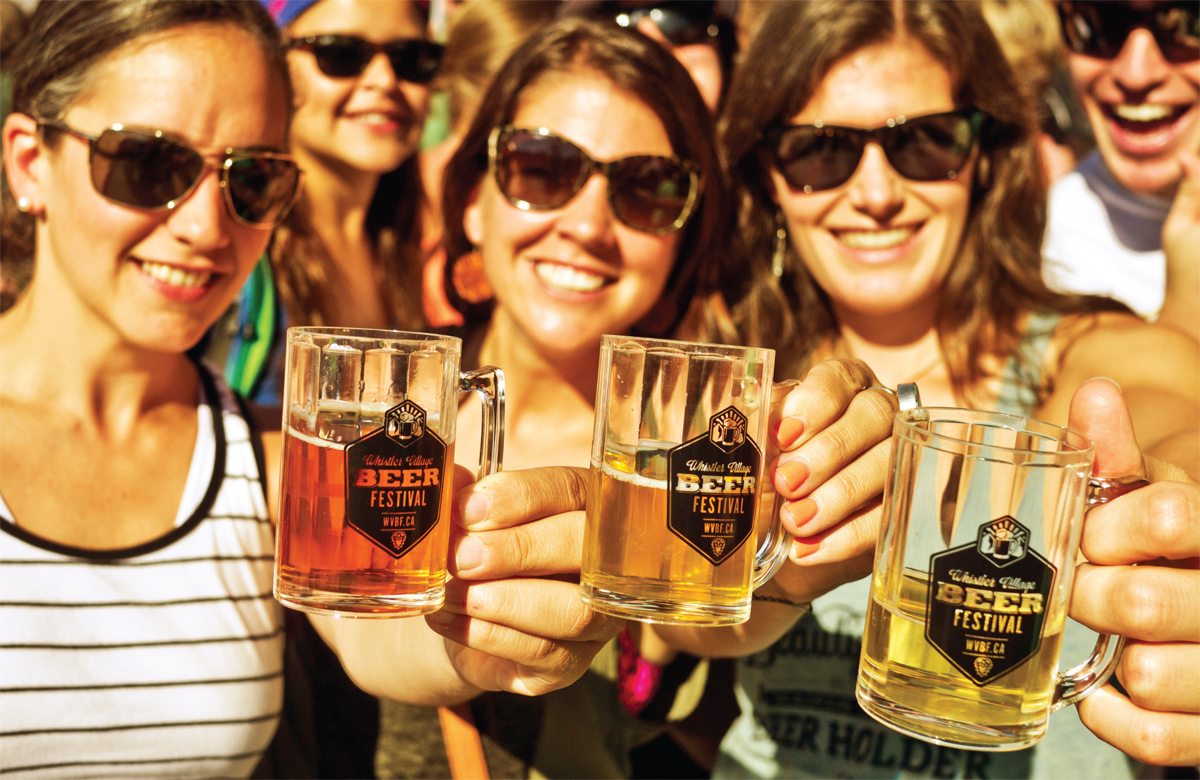
According to Benjamin Franklin, beer is proof that God loves us and wants us to be happy. Benjamin may have been on to something.
A cultural experience, not a chug fest, is how Liam Peyton describes this weekend’s second annual Whistler Village Beer Festival (Sept. 11-14). That’s not to say the four-day celebration is solely for purists: Far from it.
“There’s something for everyone,” says Peyton, who organizes the festival, which features more than 150 beers from 50 breweries in Canada, the U.S. and Europe. Along with Saturday’s main tasting showcase from 1 till 5 p.m. at Whistler Olympic Plaza, there are a broad range of events to immerse guests into beer culture, including beer dinners, seminars, parties and cask showdowns.
The latter particularly appeals to the expat Brit, who hopes his responsibilities hosting more than 4,000 visitors still allow him to attend a showdown or two.

Saturday’s tasting showcase at Whistler Olympic Plaza features more than 150 beers from 50 breweries.
“The cask showdowns feature one-offs, rare brews created for the event,” says Peyton. “You meet the brewmasters, sample the ales and vote on what you like.” The festival hosts three showdowns – Best of the Island, Best of the Mainland, and Best in West (U.S. West Coast breweries).
Cask showdowns are among several new additions to the festival, which is significantly bigger than the 2013 edition.
“Last year we had six events between four venues. This year there are 31 events spread over 11 venues,” says Peyton. He credits several reasons for the growth. “Last year we went from scratch to a sold-out festival in 10 weeks. Some people were skeptical to begin with but then participating venues saw their revenues jump 40 per cent and the 31-degree weather didn’t hurt either.”
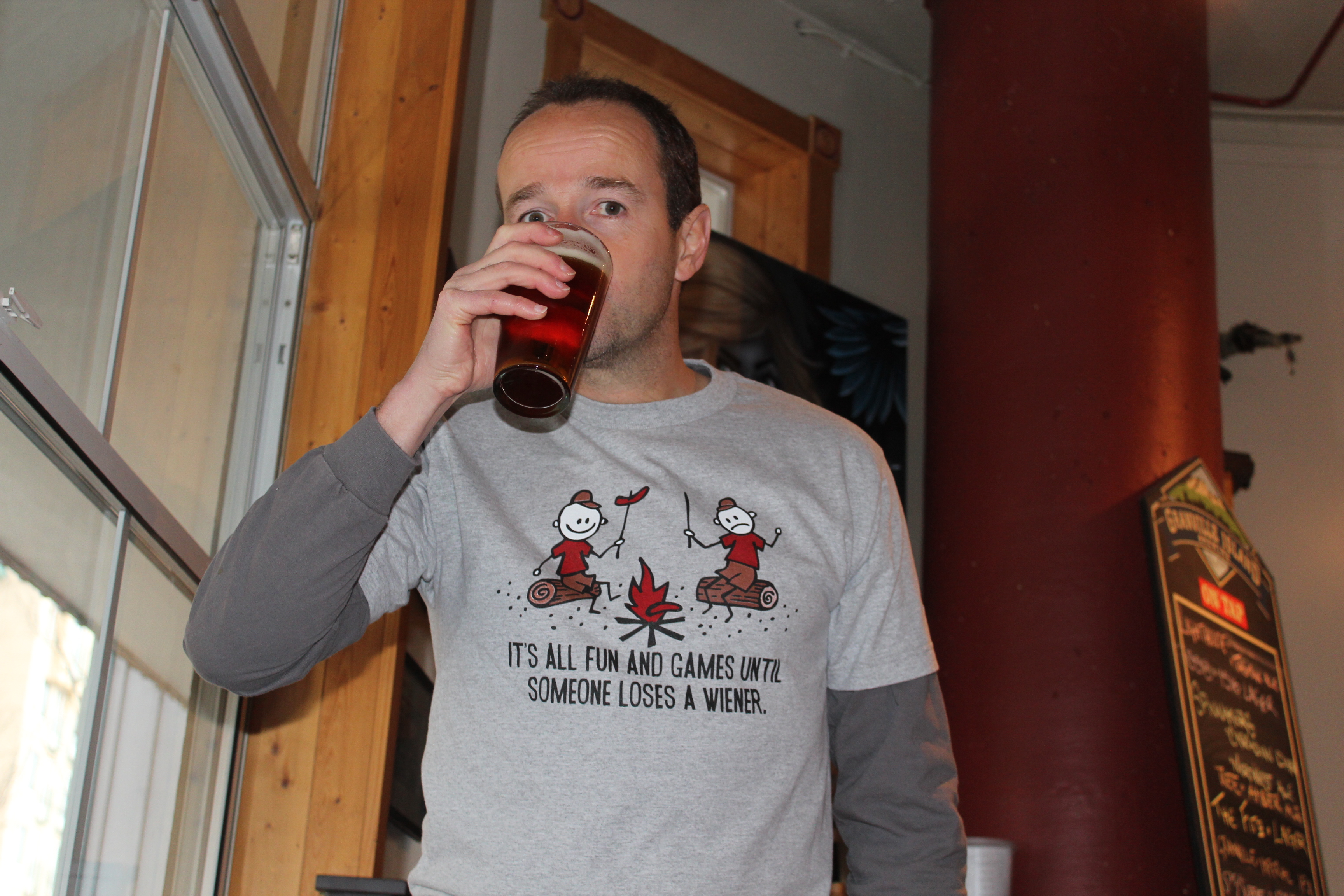
Just one of the many interesting T-shirts I’ll be wearing at the Whistler Village Beer Festival.
Now familiar with navigating B.C.’s quirky liquor laws and with 12 months to organize this year’s festival, Peyton says he’s confident he’s ahead of the curve. “It’s a little unnerving at times, but we’re far ahead in organization and in ticket sales now compared to where we were this time last year.”
At 27, the transplanted Birmingham native comes by his love of both Whistler and beer honestly, having worked as doorman, barman and manager of The Longhorn Pub before joining Gibbons Hospitality Group in 2009.
The company represents many of Whistler’s best-known pubs and created the annual beer festival to drive more business to the area, as well as forge new partnerships. Top placing breweries in Saturday afternoon’s Best in Fest voting, for instance, win one-year draught contracts to supply local venues. Local hotels are participating, including the Westin Hotel, (westinwhistler.com) which is hosting beer seminars and the Summit Lodge and Spa, (summitlodge.com) which presents nightly beer tastings. The festival also offers a food voucher program, allowing festival-goers to get $5 off meals in local restaurants.
As for Peyton’s favourite brews, IPAs are a good start. After a birthday pilgrimage in April-May to brewing hot spots in Washington, Oregon and northern California, he returned a dedicated fan of Deschutes, Lagunitas and Pyramid breweries.
“For my 27th birthday we stopped at Deschutes Brewery in Portland,” recalls Peyton. “They made me a Black Butte Porter ice cream float as a birthday cake!”
You’ll find all three breweries at the second annual Whistler Village Beer Festival, Sept. 11-14.
- For festival tickets and a full schedule of events, visit wvbf.ca

Stay thirsty my friends.
Summer in Whistler begins at the lake
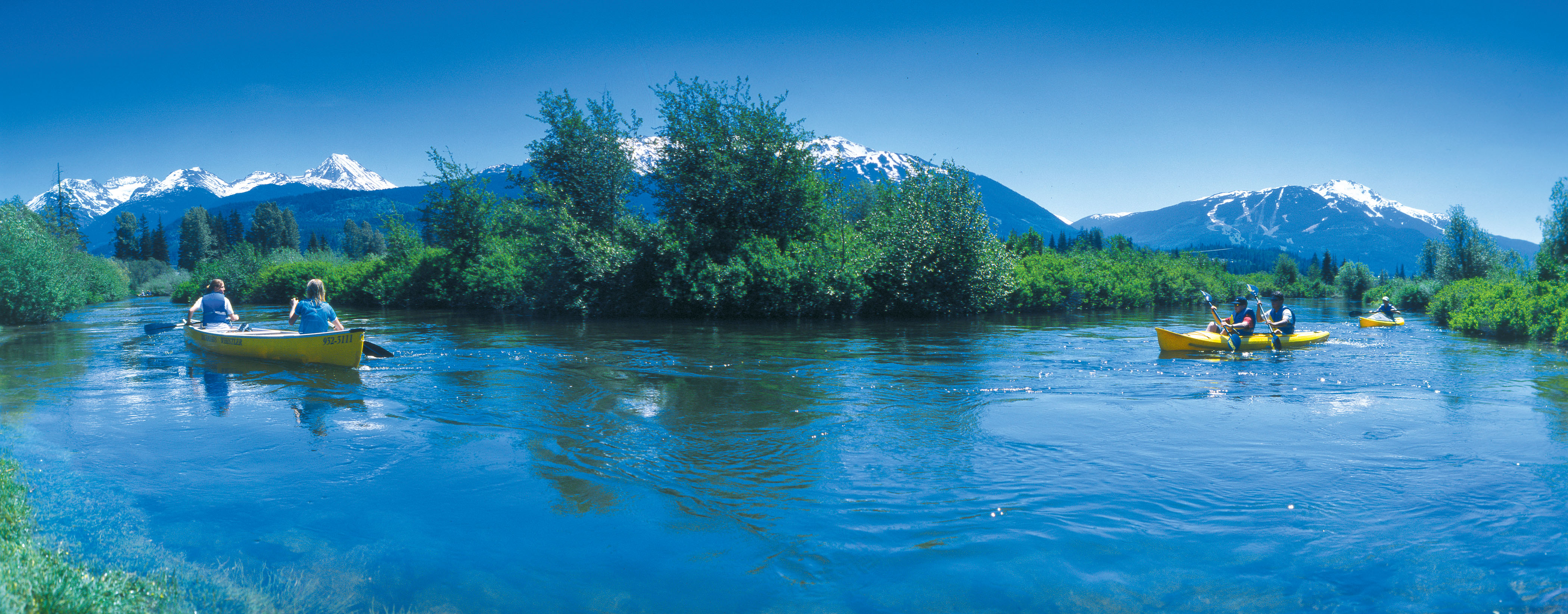
The River of Golden Dreams is an idyllic waterway for a quiet paddle … unless you find yourself in the middle of Whistler’s annual Go Fest and the Great Snow-Earth-Water Race. riverofgoldendreams.com photo
A quiet meander down the River of Golden Dreams, I’d promised my wife. After 36 hours of skiing, cycling, trail running, stand-up paddle boarding, dancing, eating and drinking, this would be a relaxing canoe cruise in the sunshine, a chance to mellow ourselves from weekend warriors to weekend wanderers.
It didn’t work out that way.
We’d come for Whistler’s Great Outdoors Festival, aka GO Fest. Held on the Victoria Day long weekend, GO Fest was the chance to cram an entire Whistler summer of activities into four days. A packed schedule had offered everything from fly-fishing to disc golf, river rafting to yoga, and much in between that involved wearing a silly costume.
By Sunday, my legs were aching from Saturday-night’s AlpenGlow Fun Run, a six-kilometre jog around Lost Lake, while wearing glow sticks. Or they might have ached from skiing Blackcomb’s Seventh Heaven all day; or from jumping up and down to The Sheepdogs during Friday night’s concert in the village.

The River of Golden Dreams connects Alta Lake and Green Lake. riverofgoldendreams.com photo
Cycling Whistler’s Valley Trail on Sunday morning, we stopped at Lakeside Park where we met Eric White of Backroads Whistler. When he told us about paddling the River of Golden Dreams, the timing seemed perfect: No pressure to perform; tranquility now. Backroads Whistler even picks you up at the end of the two- to three-hour paddle.
“People were coming here for the lakes long before the skiing,” Eric pointed out. “I think you’ll really enjoy it.”
To get our sea legs we warmed up with a stand-up paddle boarding session. Stand-up paddle boarding, or SUP, has taken off in recent years and it’s easy to see why. Not unlike snowshoeing, SUP offers a short learning curve and gets you closer to the elements. It can be as relaxing or as strenuous as you want. Eric gave us a quick tutorial on the dock and we were off.

Pasty Englishman attempts balance feat on stand-up paddle board!
The Kahuna boards designed by Whistler local, Steve Legge, were exceptionally stable, despite my initial fears of falling. (The lake ice broke just a month before!) It only took a couple of lengths between Lakeside’s docks for it to begin to feel like a core workout.
Now acclimatized to the occasional gusts picking up on Alta Lake, we paddled to shore for a new vessel.
Backroads offers kayaks and double kayaks but we opted for a two-person canoe. The canoe requires smooth communication between paddlers to navigate the notoriously tight corners of the River of Golden Dreams.
It’s also known as “The Divorce Boat,” according to Eric.
“We’ve only been married 23 years, what could possibly go wrong?” I asked my wife.
The River of Golden Dreams connects Alta Lake with Green Lake about three kilometres north. Because of its stubborn refusal to follow a straight line, the river’s full length is closer to five kilometres. In places, the river is barely wider than a canoe and portaging is sometimes necessary, depending on water levels, which can fluctuate rapidly depending on rain and snow melt.
After a quick paddling tutorial, we donned our lifejackets and set sail. Within 15 minutes we’d crossed Alta Lake and were nearing the mouth of the river. That’s when I noticed people waving at us from a bridge. Seconds later we heard a siren – the kind that’s normally accompanied by a loud voice shouting “release the hounds”.
“Why are those people waving at us?” asked my wife from the bow.

riverofgoldendreams.com photo
The answer appeared over our left shoulders: canoeists, two to a boat and wearing helmets and numbered pinnies, launching from a nearby beach and paddling straight for us. Unsure whether the people on the bridge were waving us in or away, we opted to paddle for the river, full steam ahead.
At the bridge we made two discoveries. The first was that we’d need to portage a few yards because we’d arrived at a weir. The second was that we’d unwittingly joined a pivotal leg in GO Fest’s Great Snow-Earth-Water Race – a grueling six-stage competition involving skiing, biking, running and canoeing.
“We’re expecting two dozen canoes through here,” a young man with a radio told us. “You might want to sit out and let them through.”
It occurred to me that on a narrow, winding river with few passing lanes and a head start, we could actually try and win the race. Then my wife reminded me that this was supposed to be a cruise. She also said something about ethics.
So for 20 minutes we perched at a picnic table and watched contestants portage their canoes around the weir and back into the river, cheered on by locals. When everyone had passed us, we re-launched and quickly learned to adapt to the river’s ever-changing moods: turn too tightly and fast eddies would pull us into the reeds; lose concentration and we’d find ourselves turning sideways to the current.
But the lush wetlands and snowy peaks beyond the banks made up for the occasional brushes with low branches. Better yet, during the course of our 90-minute paddle we became minor celebrities to those who had turned out to cheer on the racers. Everyone loves plucky losers and despite not wearing race pinnies, we were assumed by many to be the last-place finishers in the canoe stage of the Great Snow-Earth-Water Race.
I still think we probably could have won it!
The River of Golden of Golden Dreams (Backroads Whistler – riverofgoldendreams.com or 604 932-3111) is just one of a multitude of adventures awaiting visitors to Whistler this summer. Here are five more.

Several runs atop Blackcomb and the Horstman Glacier are open for skiing and boarding until late July.
Hit the Valley Trail: For a better perspective on Whistler’s surroundings get out of the village and onto the Whistler Valley Trail. More than 40 kilometres of paved trail and boardwalks connect Whistler’s lakes, parks and neighbourhoods. The trail is suitable for bikes, rollerbladers, joggers, walkers and well-behaved pets. Whistler.com offers more information on making the most of the Valley Trail, including a blog on the trail’s “six perfect spots”.
Shred the Park: Valley Trail offers a benign cycling experience and cross-country cyclists will find more than 500 kilometres miles of single track around Whistler. The Whistler Bike Park though condenses the best of Whistler’s downhill for all levels of mountain biker. Ride the lift up and take your pick of alpine view trails, banked cruisers through the forest, tight, winding single track and – for the experts – steep rock faces. Whistler Bike Park offers numerous ticket deals, including some with rentals, and accommodation packages. More information is at whistlerblackcomb.com.

Buckle up and ride the Elaho! Eric Beckstead photo
Ride the river(s): If paddling the River of Golden Dreams is too tame for you, consider whitewater rafting either of the Green, Lower Cheakamus, Elaho or Squamish rivers. A range of half-day and full-day tours are available from Whistler, (whistler.com/rafting) or from the Sunwolf Centre in Brackendale near Squamish (sunwolf.net/rafting).
Fly by the seat of your pants! The most exciting thing I’ve ever done in Whistler is ziplining at Cougar Mountain, just north of Whistler. Superfly Ziplines (superflyziplines.com) runs Canada’s longest, fastest, highest ziplines where speeds of more than 100 km/h are made possible by runs well over a kilometer long, 200 metres off the ground. Strap into a paragliding-style harness, attach to half an inch of galvanized steel with a trolley rig and prepare to fly! Ziptrek Ecotours (ziptrek.com) combines similar thrills above Fitzsimmons Creek with a strong environmental ethos.

Ziplining at Cougar Mountain, just north of Whistler.
Ski in a T-shirt: For all the great winter skiing at Whistler, the novelty of descending Horstman Glacier while wearing a T-shirt in July is hard to beat. Until late July, two or three runs, plus the terrain park remain open atop Blackcomb where lunch on the deck of the Horstman Hut is a must.
* For details of summer accommodation packages, visit fourseasonswhistler.com

Creature comforters
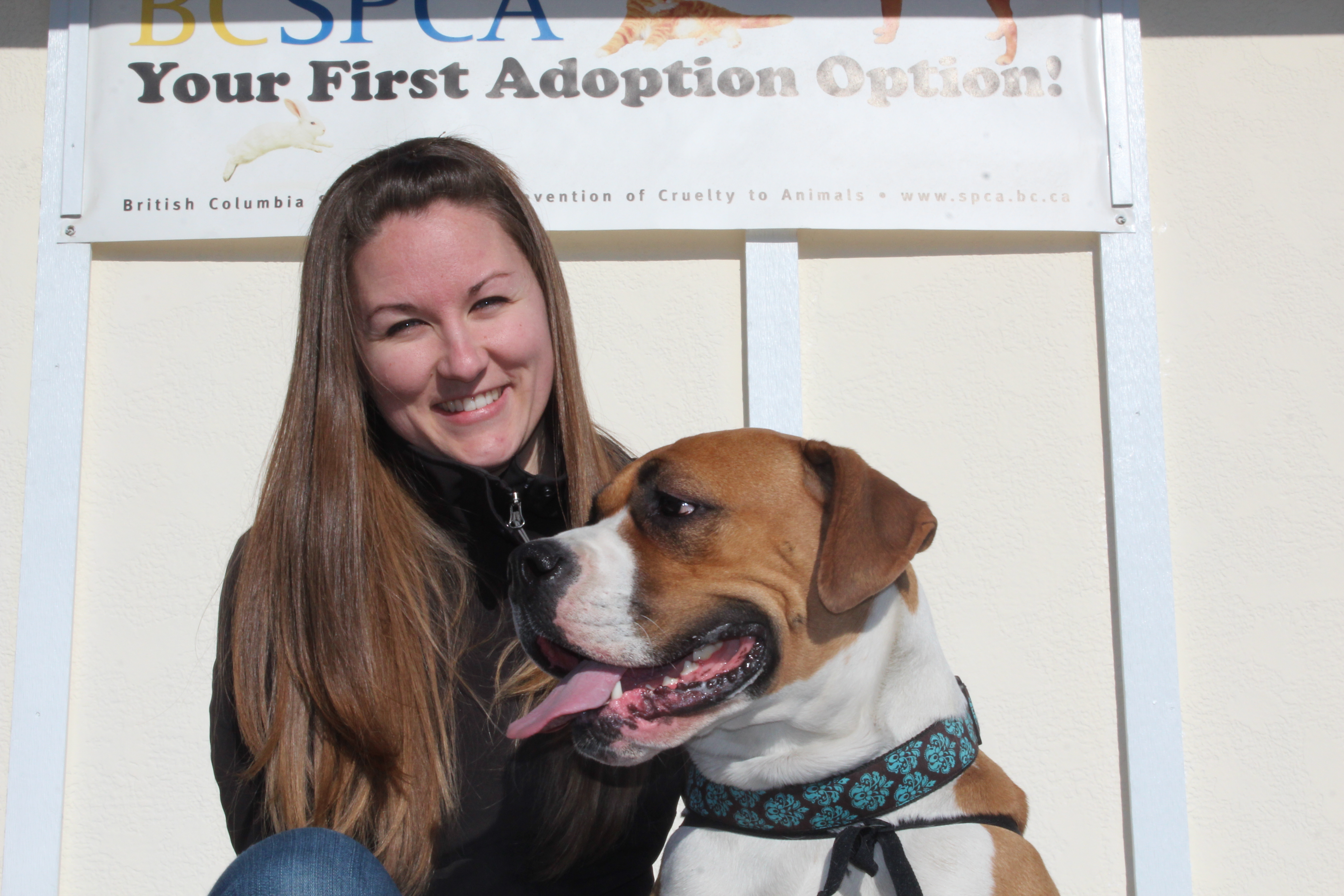
SPCA branch manager, Cindy Krapiec, with Chicklet.
“The greatness of a nation and its moral progress can be judged by the way its animals are treated.”
– Mahatma Gandhi
At three feet tall and 200 pounds, Jiggy is hard to ignore: especially when he’s hungry. He’ll nudge you if you’re in his way and he’ll wag his tail when he’s happy. Only a cruel person would say he waddled. He sashays.
Jiggy is a Vietnamese pot-bellied pig, formerly known as Jerry. A while back, Jiggy achieved local notoriety on the Sunshine Coast when the SPCA sought a permanent home for him. That search ended in West Sechelt where Jeri Patterson provides a home for some of the Coast’s unwanted animals.
“Two Jerrys would have been too weird so I renamed him Jiggy, but a lot of people remember him as Jerry,” says Patterson. “He’s considered a farm animal and most rescue properties prohibit farm animals – chickens, pigs, etc. My property is part of the Agricultural Land Reserve so after several foster homes, he came here. Now he’s home!
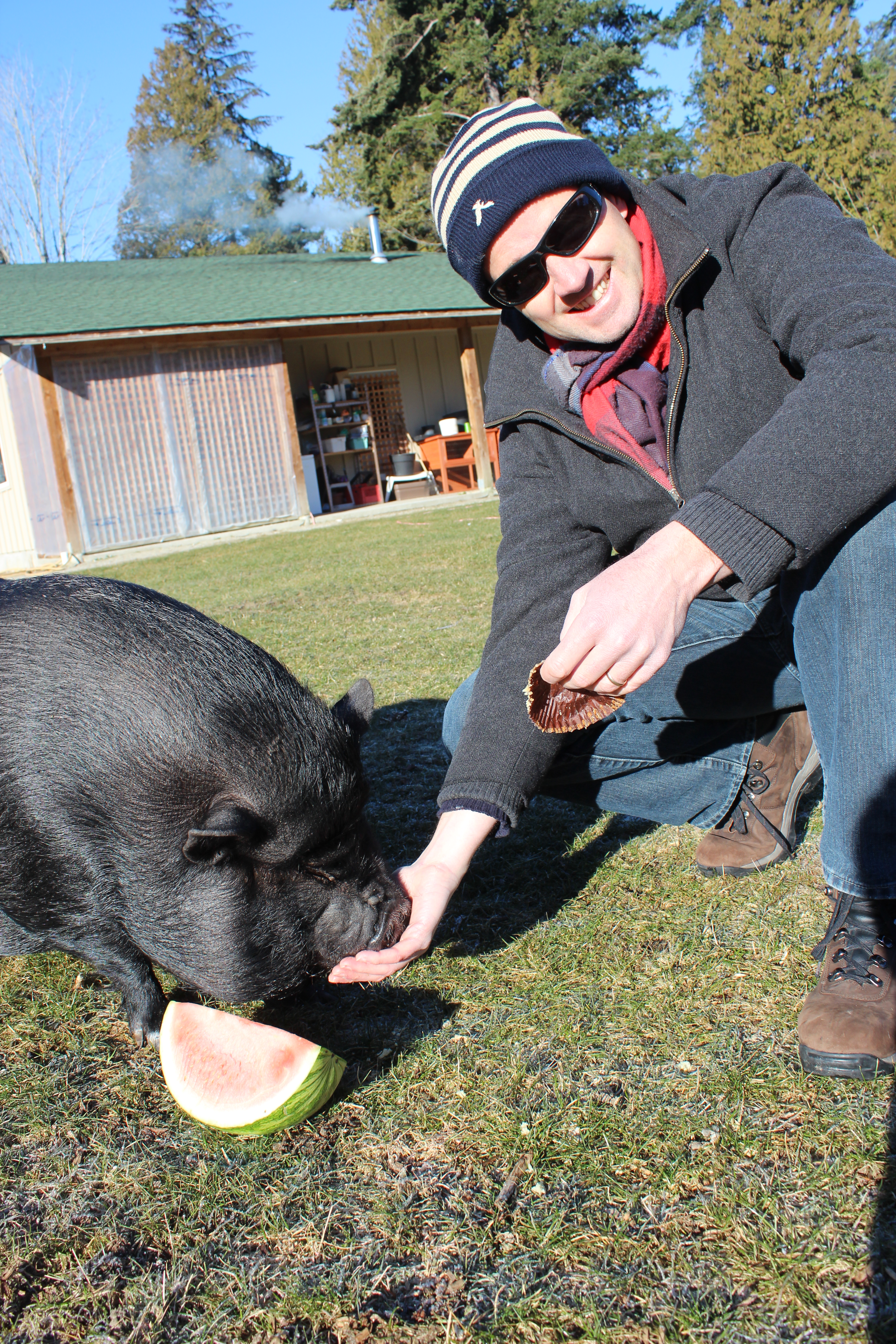
Jiggy – a hungry pig not to be truffled with.
“All of us want to be made to feel special. Animals are no different.”
Patterson loves animals. Thankfully she’s not the only one who cares. Volunteers up and down the Sunshine Coast care for unwanted animals. Some open their homes, taking in abandoned cats, dogs, bunnies and the like. Others help by knitting toy mice or by raising money via yard sales, recycling, trivia nights and sponsored dog walks. Their work is essential because on the Sunshine Coast, the number of abandoned pets is rising.
It’s a pattern repeated during economic downturns, says Patterson. “When you see food banks so busy you realize that some people are barely able to feed themselves, let alone their animals,” she says. “It’s cheaper to help people keep their pets than to care for them in a shelter.”
In 2013, the local SPCA attended more than 50 investigations of possible animal cruelty, many of them requiring multiple visits. January 2014 has already been record-setting with 13 cruelty investigations. In Gibsons the same month, 37 stray dogs were reported by the district’s animal control officer.
“Thirty-seven strays is a massive amount for a community of 5,000 people,” says SPCA manager Cindy Krapiec. “I think most animal lovers and pet owners are aware of the extent of the problem with unwanted pets, especial through social media, but otherwise people have no idea.”
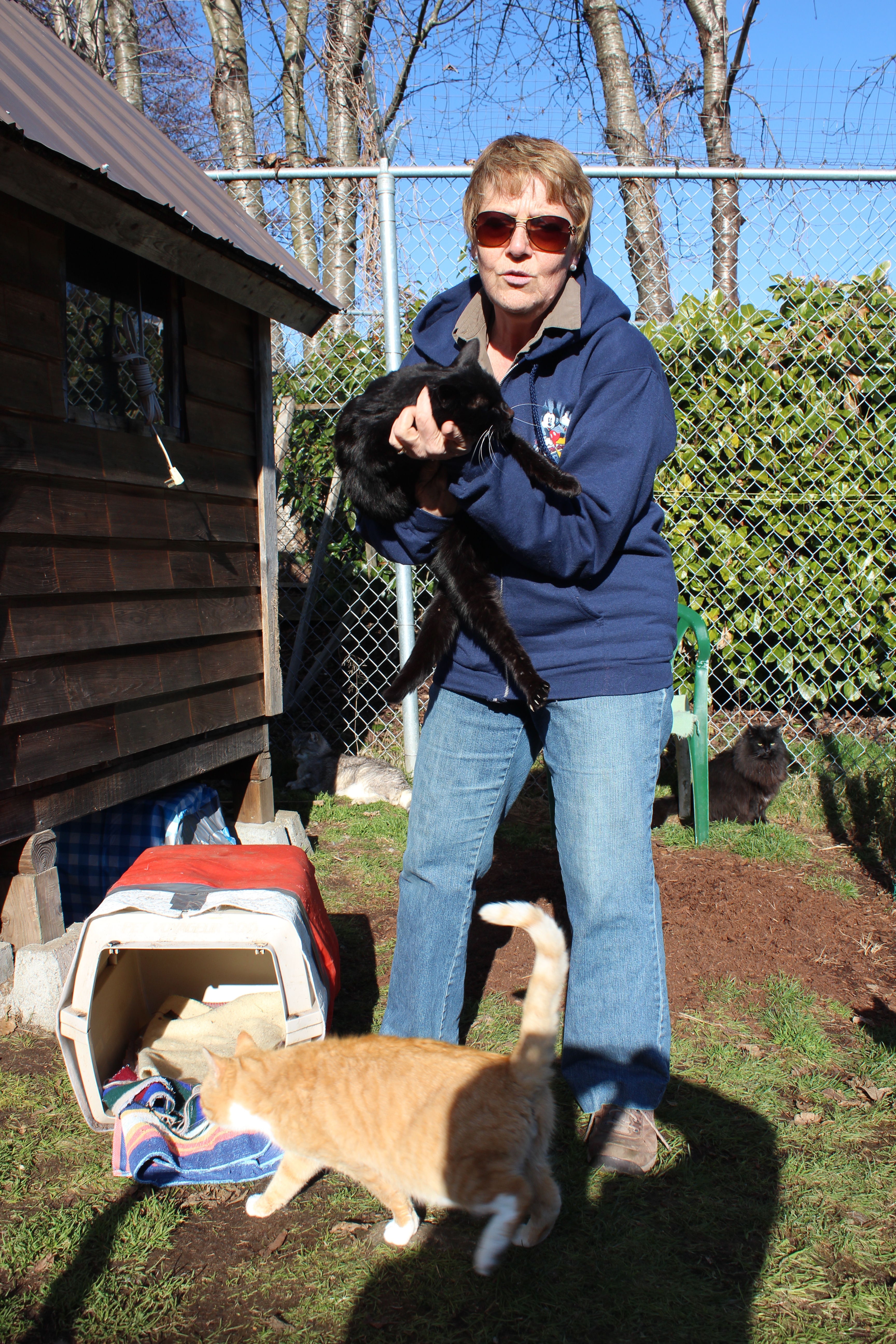
Happy Cat Haven volunteer, Marcia Timbers – aka The Cat Whisperer.
Together with her three staff, Krapiec run the SPCA in Wilson Creek, fulfilling the organization’s mandate of ‘speaking for animals’ by caring for abandoned creatures, investigating possible cases of cruelty, and educating the public about spaying, neutering and animal care. They receive no money from the government and rely almost entirely on fundraising. Far from being beleaguered though, Krapiec considers herself lucky to have “stumbled into” a job that brings something different every day.
“Even after three years, the learning curve is massive,” she says. “We spend a lot of time speaking with potential adopters, meeting animal owners and following up on cruelty cases. We try to educate first to find a solution. Litigation is a last resort.
“There’s a lot of science-based research to provide the best care for animals and that’s constantly changing, too.”
And then there’s the “never-ending” cleaning at the Solar Road facility, which last year handled 447 animals, including 196 dogs, 178 cats, 17 puppies, 36 kittens and 11 rabbits.
Krapiec acknowledges the extraordinary network of volunteers working alongside the SPCA, from business and community fundraisers to front-line animal rescuers like Clint Davy and the Gibsons Wildlife Rehab Centre, Violet Winegarden and the Happy Cat Haven, and Pam Albers of Pawprints Animal Rescue.

Violet Winegarden in her element at the Happy Cat Haven.
Then there are the veterinarians. “Local vets absorb a ton of cost,” says Krapiec. They are also among the first places she calls when homes are needed for abandoned pets. At the end of the line are people like Meghan Graves.
“I have no shame about calling Meg with a litter of animals,” laughs Krapiec.
Graves is a registered animal health technologist and the office manager at Sechelt Animal Hospital. She’s also vice-chair of the SPCA’s community council, which meets monthly to organize fundraising, community relations, and advocacy. At home with her husband and two young children, she’s fostering two rabbits (in addition to one she owns) in her living room, along with two dogs, Winnie and Gunnar, plus five cats – all abandoned at some point.
“You end up doing stuff like that,” says Graves. “All staff at the clinic fosters or have fostered. It gets very personal. It’s never ending.
“There are not many jobs where you take this kind of work home with you. You stay up all night long. It’s like having a newborn, or multiple newborns.”
As for the family dynamic, Graves admits that Winnie and Gunnar don’t get quite so many walks now she has two young children. “But they get story time now, which they both seem to really enjoy!”

Smooshie refuses to say ‘cheese’.
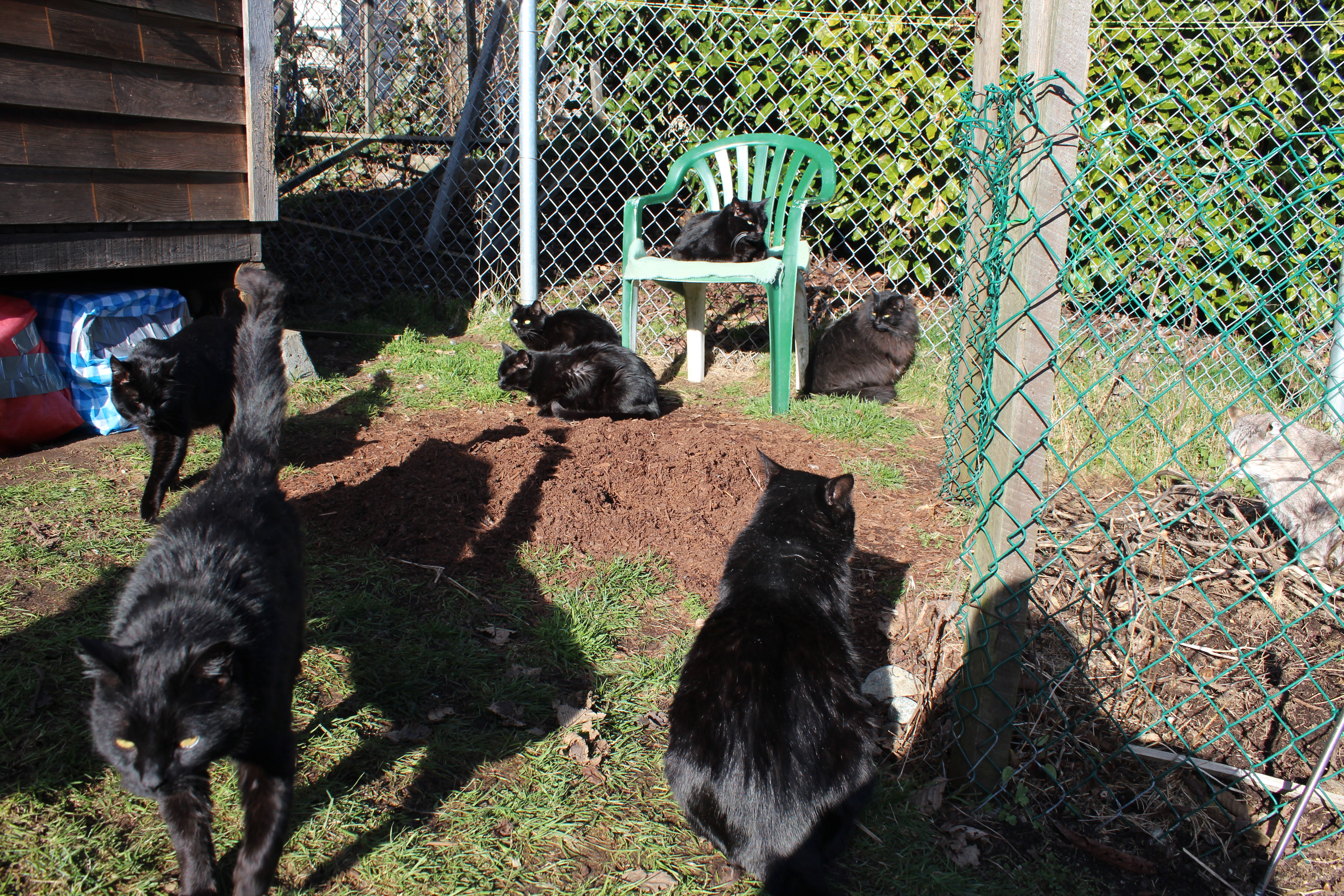
Violet Winegarden can surely relate to a home full of animals. On a tour of her Gibsons home I lose count of the number of cats but Winegarden – who knows them all by name – estimates there are 55 to 60. Outside there’s an HIV pen for Laredo, Clancy, Blue and Rebecca. In a neighbouring pen are Chamberlain, Whiskers, Tiger and half a dozen more all crowding around Marcia Timbers, a Happy Cat volunteer to whom Winegarden refers as “the cat whisperer”.
“Violet works harder than anyone I know,” says Timbers. “Her phone never stops ringing from people asking advice about spaying or neutering.
“So many people say they just want their cat to have a litter. There’s no reason for a cat to have a litter,” Timbers adds, exasperated.
Inside the home, Winegarden shows me the Seniors Room for cats as old as 26; the Forever Room for sick cats like Bijou, (“27 pounds, fat and happy,” says Winegarden) who are in their final days; and the Adoption Room for healthier cats. In between is the kitchen where two cats take up residence in my camera bag as other cats wander in and out.
Amid the clean litter boxes, medical equipment and bags of cat food I notice a Governor General’s Award hanging on the wall. Since 1992, Winegarden and her band of volunteers have cared for more than 7,000 animals. During that time she’s witnessed the effects of unspeakable acts of cruelty. She’s bonded with countless cats, including one that used to play the piano with her. And with the help of Dr. Justin McLash of the Sunshine Coast Pet Hospital, she’s ensured that cats are spared unnecessary suffering.
“I can tell when cats are going to die,” she says. “We shouldn’t have to suffer to die.”
At 85, Winegarden continues to rise at 5 each morning for long days of cleaning, caring, fundraising and managing a sanctuary with monthly expenses of $12,000. I’m tempted to ask why, but during the course of a long conversation that afternoon, I don’t have to.
“I think I was born this way,” she laughs. “I’ve been in trouble over animals all my life. I just don’t see animals as any different from us. We’re all the same beings on earth. We’re here to be together.”
It’s hard to imagine one person taking over Violet’s work, just as it’s difficult to contemplate the Sunshine Coast without the SPCA and other pet-rescue organizations. Jeri Patterson knows as well as anyone that SPCAs do close down. After Chilliwack SPCA closed, Patterson, once a resident of Agassiz, got involved with cat and rabbit rescue at her licensed kennel at the request of the municipality’s animal control officer. (Surrey’s SPCA has also closed.) She continues to look after animals from that jurisdiction.
“People need to know this about the SPCA: If you don’t value it, you may lose it.”
- There are numerous ways to help those helping abandoned animals. Visiting http://www.spca.bc.ca/branches/sunshine-coast/ is a good place to start. So is spaying and neutering your pets. If you witness animal cruelty, call 1-855-622-7722
 1-855-622-7722.
 - Drop off grocery receipts and Canadian Tire money at Happy Cat Haven collection boxes at IGA, Super-Valu and Clayton’s stores. Or drop off cans and bottles for recycling at Happy Cat Haven, 760 School Road, Gibsons, between 7 a.m. and 3 p.m. Yard sale items can also be dropped off. To volunteer, call 604 886-2407604 886-2407.

Urine Review

It’s fair to say that the coffee kicked in early on the Pemberton slow food cycle this summer.
Twas a month before Christmas
When Leah turned and said
“Here are the cards for your poem
Now I’m off to bed”
-

- Senator Mike Duffy, in happier times.
-

- Mayor Rob Ford: Never met a microphone he didn’t like.
So I searched for a highlight
Picking just one is a toughie
Like hugging Rob Ford
Or trusting Mike Duffy

Good kids, all of them.
Our year was terrific
With adventures galore
Life by the Pacific
Is exciting for sure
Ryan turned 16
And started to drive
Each night we thank God
We’re all still alive



Emma hit 14
An important milestone
Becoming the last teen on Earth
To own an iPhone


In the summer we cycled
In Canada Back East
The sights were amazing
The heat was a beast
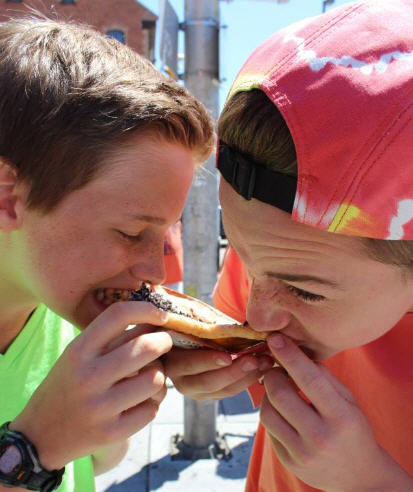
Ryan and Jordan … on a budget.
We visited the Marshalls
In Hunstville so scenic
And confirmed that they’re still
Irritatingly photogenic

Sickeningly photogenic. Again.
Through Quebec City we pedalled
Up hills steep and cobbled
The sweat was intense
My groin somewhat troubled
Toronto was flatter
Cycling old railway track
It’s a cosmopolitan city
Except for the mayor, who smokes crack

Good kids … all of them.
Ziplining above Whistler
In fear and in dread
Is how Leah and I marked
22 years wed

You wouldn’t believe how hard it is to photograph this on self-timer.
We had visitors, too
Cousin Steve and his clan
We all hit the beach
And worked on our tan

Turns out there’s another Leah!
Brother Keith arrived next
So nice he could stay
I leant him my coat
Cos it rained every day
We went to Osoyoos
And drank lots of wine
The rain turned to snow
But we got home on time

Queasy riders.
Nan and Grandad came to visit
For three weeks this Fall
With cards we slipped pressies
In Grandad’s holdall

HE’S GOT A KNIFE!
And now we look forward
To a promising New Year
England in Rio
And Three Lions to cheer

God bless Wayne.
I wish you the best
For a year full of light
God Bless Wayne Rooney
And to all a good night




Toronto on two wheels
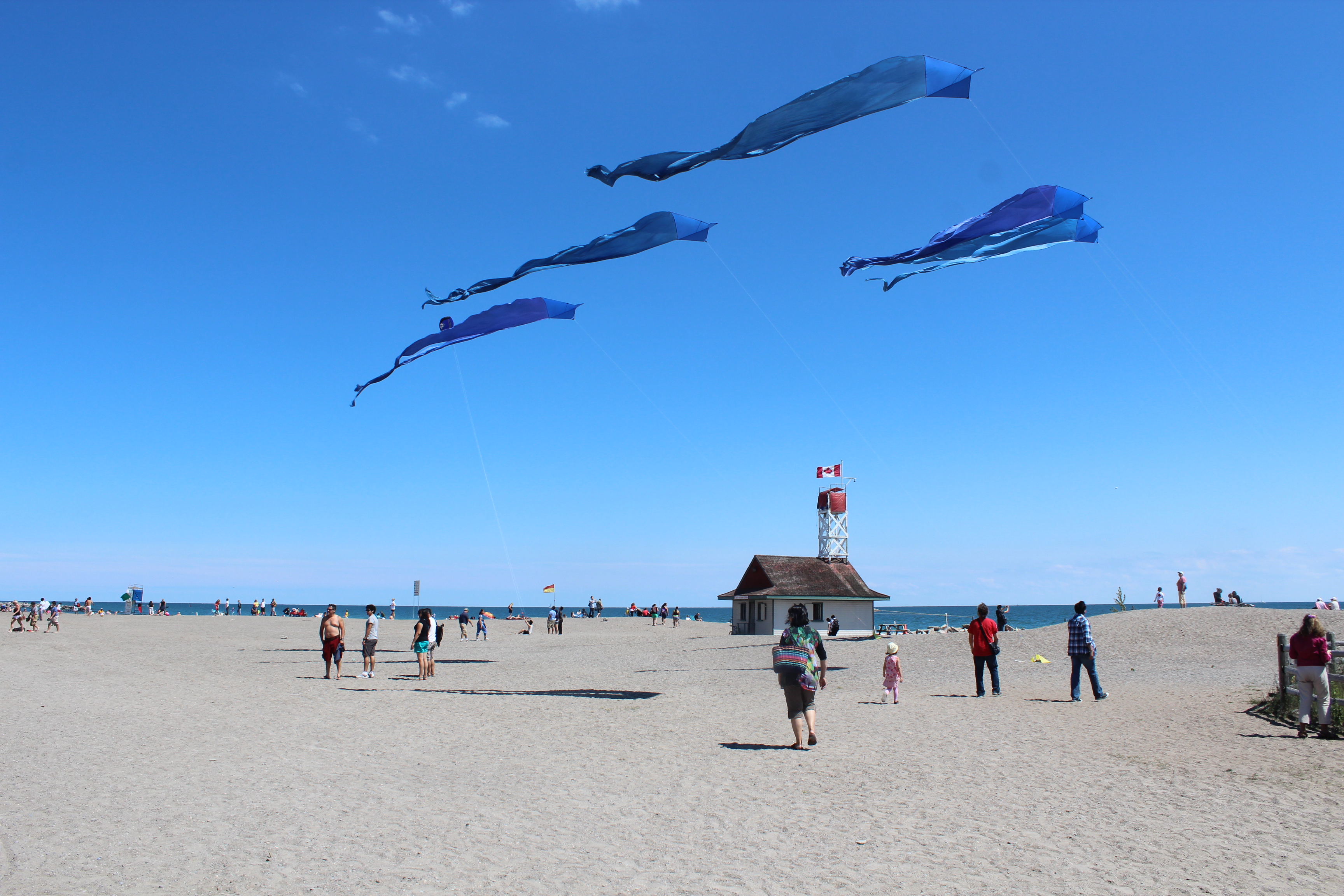
The Beaches neighbourhood in eastern Toronto is a rarity: homes, not a freeway, still line the lakeshore.
I can remember the moment Toronto began to win me over. It was at BMO Field, an hour after arriving in the city, in the waning minutes of Toronto FC’s MLS game versus the Columbus Crew.
Losing 1-0, many Toronto fans upped and left when a storm swept in from Lake Ontario. Soaked to the skin, my son and I took advantage of space behind the Columbus goal just as Toronto equalized.
We’d barely finished high-fiving the locals when Toronto scored the winner in injury time, sparking more sodden pandemonium. We saw ourselves on TV highlights that night. Just as well we hadn’t worn our Whitecaps jerseys!
Like many west coasters, I harbored some instinctive disdain for Canada’s biggest city. I’d heard about its swagger, its summer humidity, and, of course, the Maple Leafs. Yet riding the bus full of fans back to the Fairmont Royal York, past the CN Tower and Rogers Centre (aka SkyDome), I was warming to Toronto.
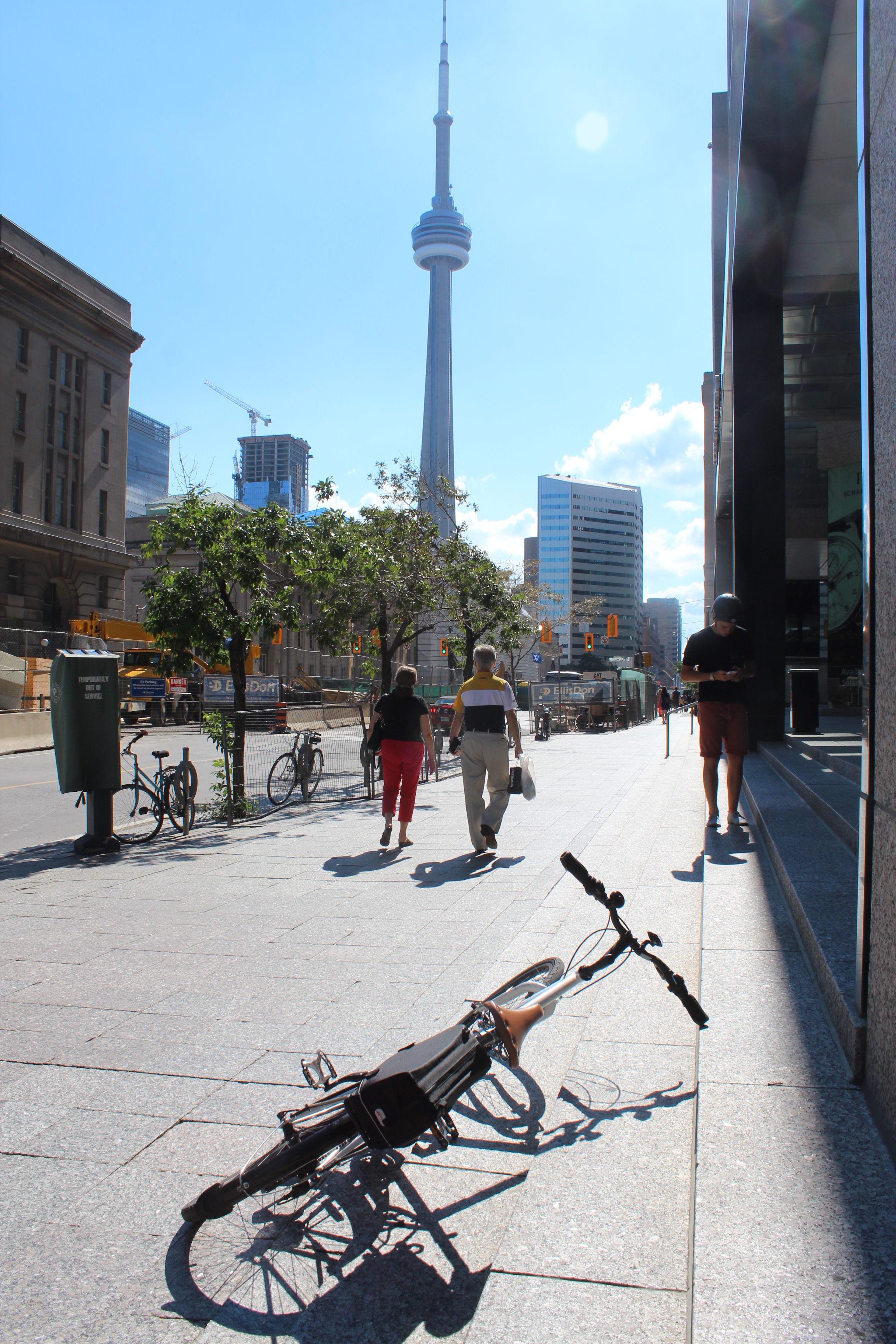
No cyclists were hurt while taking this photo.
Some of that big-city swagger must surely have originated in the Fairmont Royal York, once the biggest hotel in the British Empire and still oozing opulence from every one of its 1,600 rooms. The hotel of choice for royalty and rock stars is down to earth enough to grow its own herbs, vegetables and flowers on a rooftop terrace, as well as maintain three beehives.
The hotel will also store your bikes for you, a bonus in a city that’s expanding its bike lane network. With only two days in Toronto, we rented bikes at Segway Ontario, a short tram ride away in the Distillery District. The endless roadworks and construction across downtown made us glad of the two-wheeled escape.
Once home to the Gooderham and Worts Distillery (said to be the world’s largest distillery by the mid-19th century) the Distillery District today is a well preserved pedestrian village. Upmarket stores, bars and restaurants have taken up residence in the red-brick Victorian buildings and Vancouverites might see some similarities with parts of Yaletown and Gastown. The Mill Street Brew Pub is a great spot for local beers and great food – especially when you’re finished bike riding for the day.
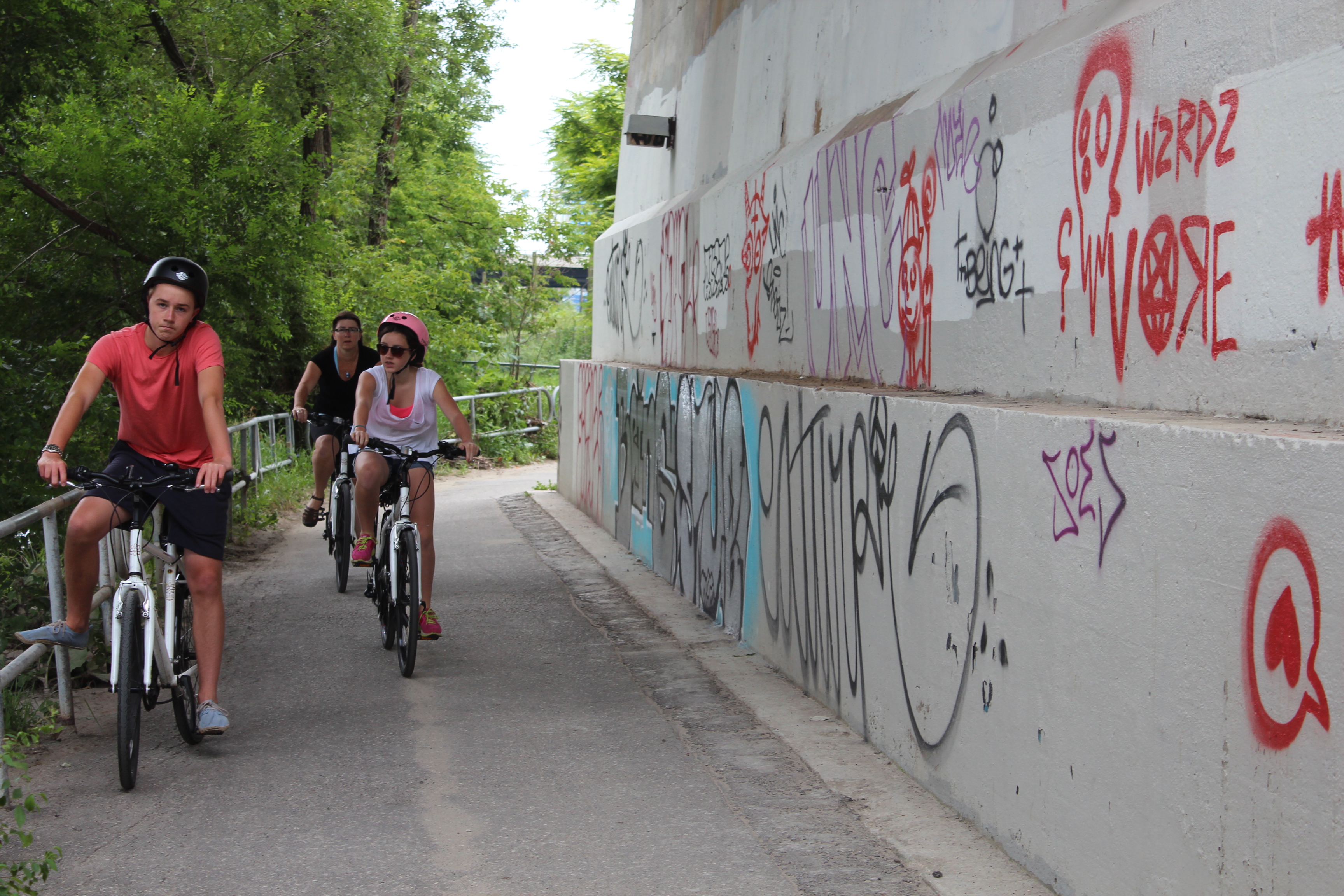
The Lower Don Trail, where graffiti is prolific as wildflowers.
We left the Distillery District’s cobblestones behind and headed for Toronto’s Waterfront Trail. The trail is part of a series of bike and pedestrian paths that connect 31 communities along Lake Ontario’s shores. About 450 kilometers of the trail is signposted and the few kilometers we biked transported us to beaches seemingly a million miles removed from downtown Toronto.
Known as The Beaches, this eastern Toronto neighbourhood is a rarity in that homes and not a freeway still line the lakeshore. The feeling of community is palpable at the beach where seniors and toddlers were dancing to a live Cuban salsa band and dozens of beach volleyball games were in progress. Just a week before, Toronto had sweltered in the upper 30s. Now in the mid-20s it seemed that every dog-walker, kite-flyer, roller-blader and cyclist in the city had descended on The Beaches and its boardwalk. Like proper tourists, we dismounted, bought ice creams and watched the world go by.
Toronto’s weather gods weren’t quite so kind the following day. Under leaden skies and with drizzle in the air, we headed inland on the Lower Don Trail. Whereas much of the cycling in Toronto is on routes shared with cars, the Lower Don Trail is blissfully free of vehicle traffic. More than that, it’s a slice of downtown Toronto far removed from the city’s more popular tourist attractions.
The Lower Don River is only about eight kilometers long but it flows through one of the most densely populated communities in Canada. So it’s odd to cycle by rusting and abandoned footbridges, beneath concrete express ramps, and yet still spot a heron presiding over a river bank that resembles a healthy wetland. In places the graffiti is as dense as the wildflowers and the proliferation of the latter is due in part to the efforts of volunteer groups.

The Fairmont Royal York, once the biggest hotel in the British Empire and still oozing opulence from every one of its 1,600 rooms. The lobby’s nice, too.
We dried off from the rain at the Evergreen Brick Works, known for almost a century as the Don Valley Brick Works. Evergreen is a national charity and one of the groups involved in reviving the Lower Don. It runs the brick works as a community environmental centre, nurturing the disused quarry as a park, naturalizing ponds and restoring the brick works’ old buildings. On any given day you’ll find a farmers’ market, cooking workshops and family pizza nights at the site which once supplied the bricks for most of Toronto’s major landmarks.
From Evergreen Brick Works we cycled through Beltline Trail and the racy-sounding Milkman’s Run (Couldn’t help thinking of Benny Hill) before zig-zagging our way through quiet residential streets to Sherbourne Street. Sherbourne was the first of Toronto’s separated bike lanes and from Bloor Street to King Street, biking is a breeze.
Even after we’d returned our rental bikes we noticed signs of cycling’s growing popularity in Toronto. After ascending the CN Tower on our last night we walked across historic Roundhouse Park to Steam Whistle Brewing. There outside the brewery on Bremner Boulevard, not far from a BIXI bike-sharing stand, was an urban bike repair station complete with pump and tethered bike tools: free for anyone wanting a tune-up!
nevjudd.com
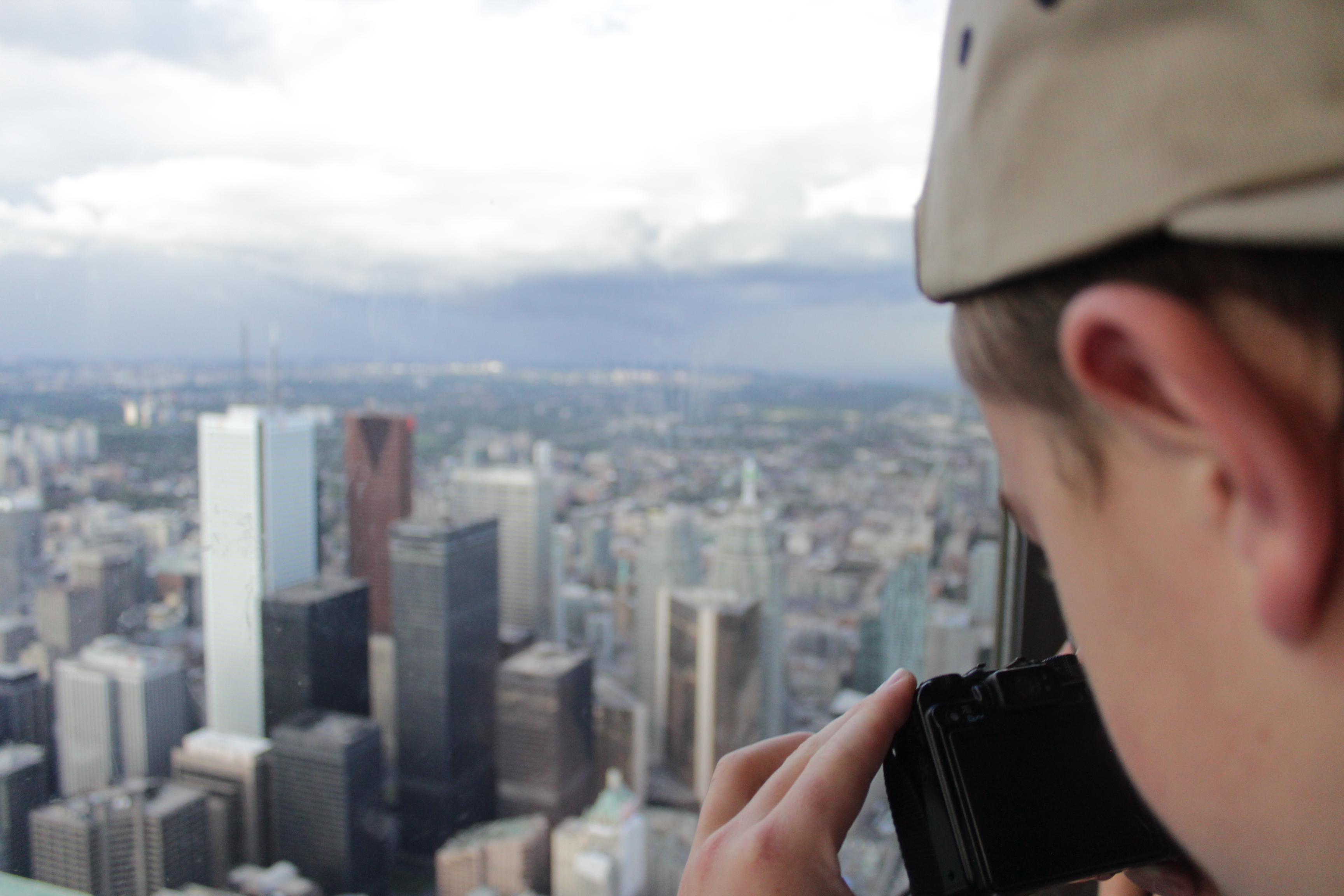
On a clear day you can see Saskatchewan.
If you go:
Segway Ontario in Toronto’s Distillery District rents a wide variety of bicycles for $35 a day, as well as offering walking and Segway tours. Visit segwayofontario.com
Toronto grew up around the historic Fairmont Royal York, which features several bars and restaurants and offers numerous accommodation packages. They will also store your bikes. Visit fairmont.com/royal-york-toronto
Evergreen Brick Works is a hive of activity, combining history, education, and environmental activism. It also serves great food! Visit ebw.evergreen.ca
For all other travel matters Toronto, visit seetorontonow.com
-

- Whitecaps in the house!
-
- Then came the storm.
-

- Old and new.
-

- Pedal power.
-
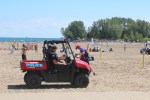
- Beach volleyball patrol. Tough assignment for the OPP.
-

- Evergreen Brick Works.
-

- Photobomber strikes again.
-

- Maybe next year, Blue Jays.
-

- Great lake.
-

- View from the top.
-

- Thirsty pug.
Quebec City by bike
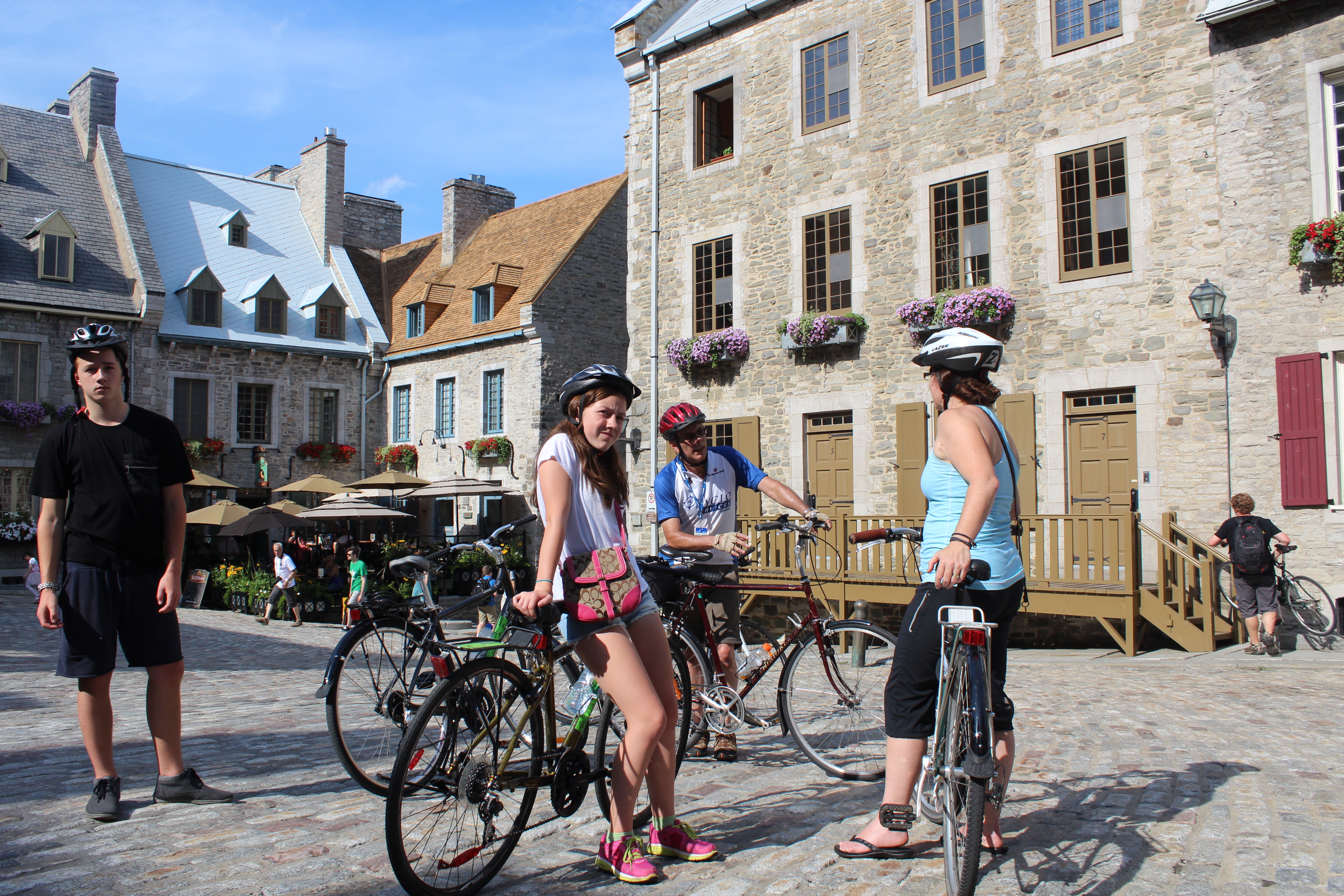
Resting in Quebec City at Place Royale, site of Samuel de Champlain’s first permanent settlement in New France.
The older my children get, the more discerning they become about holiday activities. My teenagers Ryan and Emma are not big on cycling, history or museums. And like most people they don’t like rain much either.
So there we were with our bikes in the rain, standing outside The Museum of Civilization in old Quebec City.
“Well at least it’s dry in the museum,” I reasoned.
“Can’t we just find somewhere to eat?” asked Ryan.
It wasn’t the first time Quebec had witnessed a clash of wills – what military historians might call an impasse. After a three-month siege in 1759, it took General Wolfe and the British about 15 minutes to beat Montcalm and the French in the Battle of the Plains of Abraham.
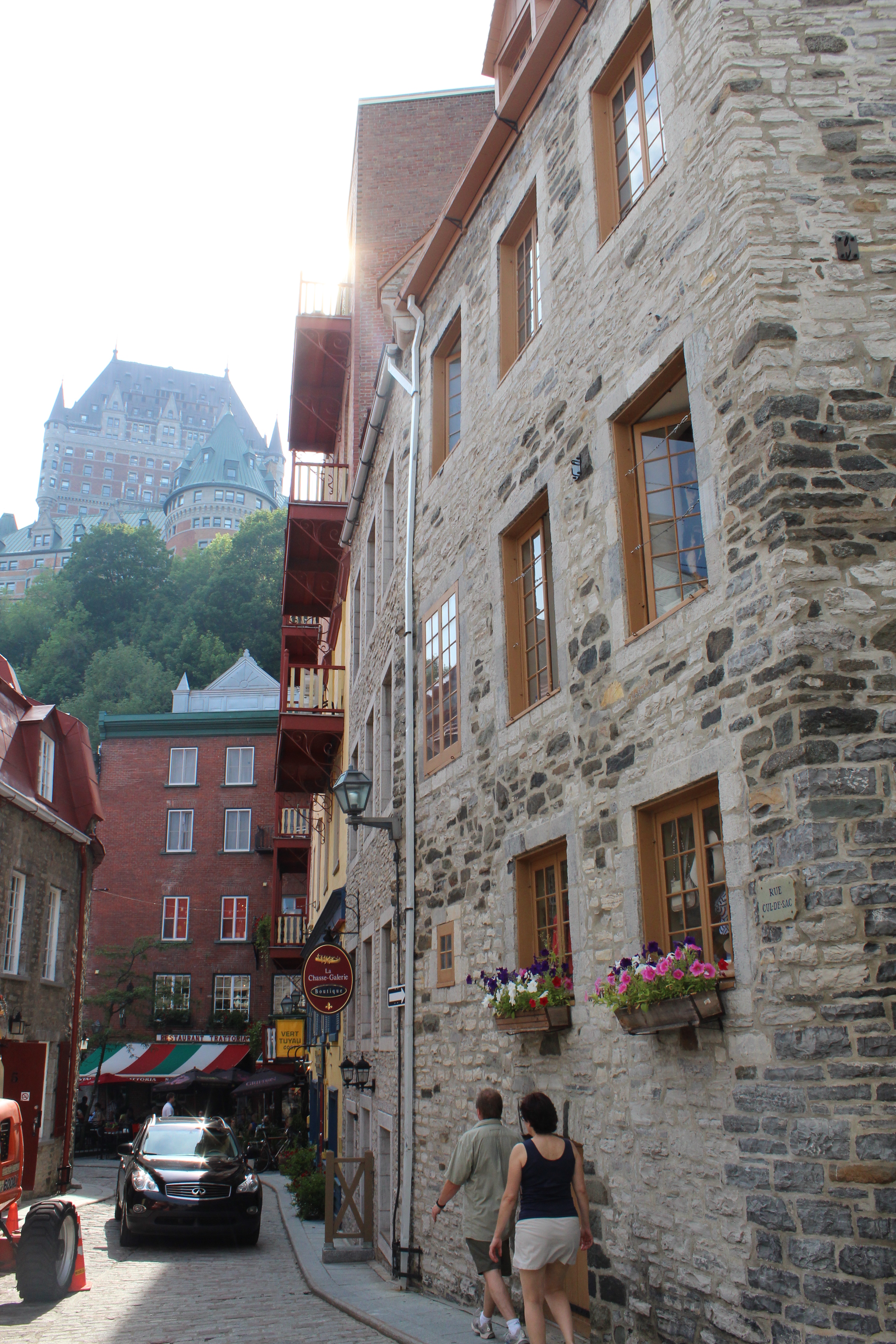
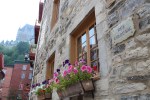
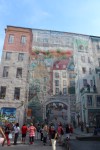
Keep your head up riding through crowds of shoppers in the narrow, cobblestoned lanes of Quartier Petit Champlain. Once a fur-trading portside village, it’s now full of boutiques, bistros and frescoes.
It took the Judds about the same time to finish arguing, lock their bikes and enter the museum. Then something remarkable happened. “Game Story, the exhibition you play,” read the sign in the lobby. Yes, besides first-rate exhibitions about Quebec history and a showcase of Paris between 1889 and 1914, The Museum of Civilization was hosting a video game exhibition, featuring 450 artifacts and 88 video games to play. Everything from World of Warcraft to Pong was available.
We were still in the museum long after the rain had stopped and the sun had returned. It was just the first of several surprising events during our two-night stay in Quebec City. That night we cycled our bikes to the Port of Quebec Agora, an amphitheatre hosting Cirque du Soleil’s Les Chemin Invisibles. Quebec City might just be the only place where Cirque du Soleil is free! Had they been charging, our floor tickets would have cost a fortune because most of the show unfolded just a few yards from where we stood.
The Harbour of Lost Souls is the fifth chapter of Les Chemin Invisibles. The employees of an old customs officer decide to put on a show for his birthday in the hopes of helping him to find purpose in his life. The show is spectacular in its conception with performers suspended from cranes just a few feet above the audience and on moving stages that spring up in the crowd.

Just across from the National Assembly is the Fountaine de Tourny, built for the city’s 400th birthday. It’s a popular spot for wedding photos and knackered cyclists.
Cirque du Soleil is a tough act to follow, but the Image Mill is timed to follow it and succeeds if only for its epic setting. A legacy of Quebec City’s 400th birthday in 2008, the Image Mill is a sound and image show projected onto massive grain silos in Quebec’s harbour. We joined the hordes lining the harbour to watch this summer’s show, a tribute to Scottish-born, Canadian filmmaker, Norman McLaren. A pioneer in synchronizing animation with music, McLaren, who died in 1987, would surely have approved of his work being presented on the biggest ‘big screen’ ever conceived.
Back at the Hotel Royal William in Quebec City’s trendy New St. Roch neighbourhood, we locked up our bikes and I ventured out for a nightcap on Boulevard Charest Est. The Mo Resto Bar had one more surprise in store for me; beer pumps at the table! The beer is metered of course (it’s not heaven) at 35 cents an ounce. But for my wife, I might still be there pouring modest amounts of Belle Gueule Blonde or Red ale.
Thanks to the success of Day 1, we sold the kids on a guided bike tour the following day.
At first glance, Quebec City doesn’t appear built for bicycles. Narrow lanes, cobblestones and hills usually look good in postcards, not from a saddle. But first impressions can be deceiving. A few bumps and the occasional grind are a small price to pay for a two-wheeled tour of North America’s only walled city and UNESCO World Heritage site. For visitors with more time, there are several hundred kilometres of bike trails to ride beyond the fortress walls.
Our guide, Marc Lupien of Cyclo Services, has been riding the same Nishiki road bike for 35 years (“I changed the brake cable once or twice – and the seat!”) and has seen the growth of bike culture here.
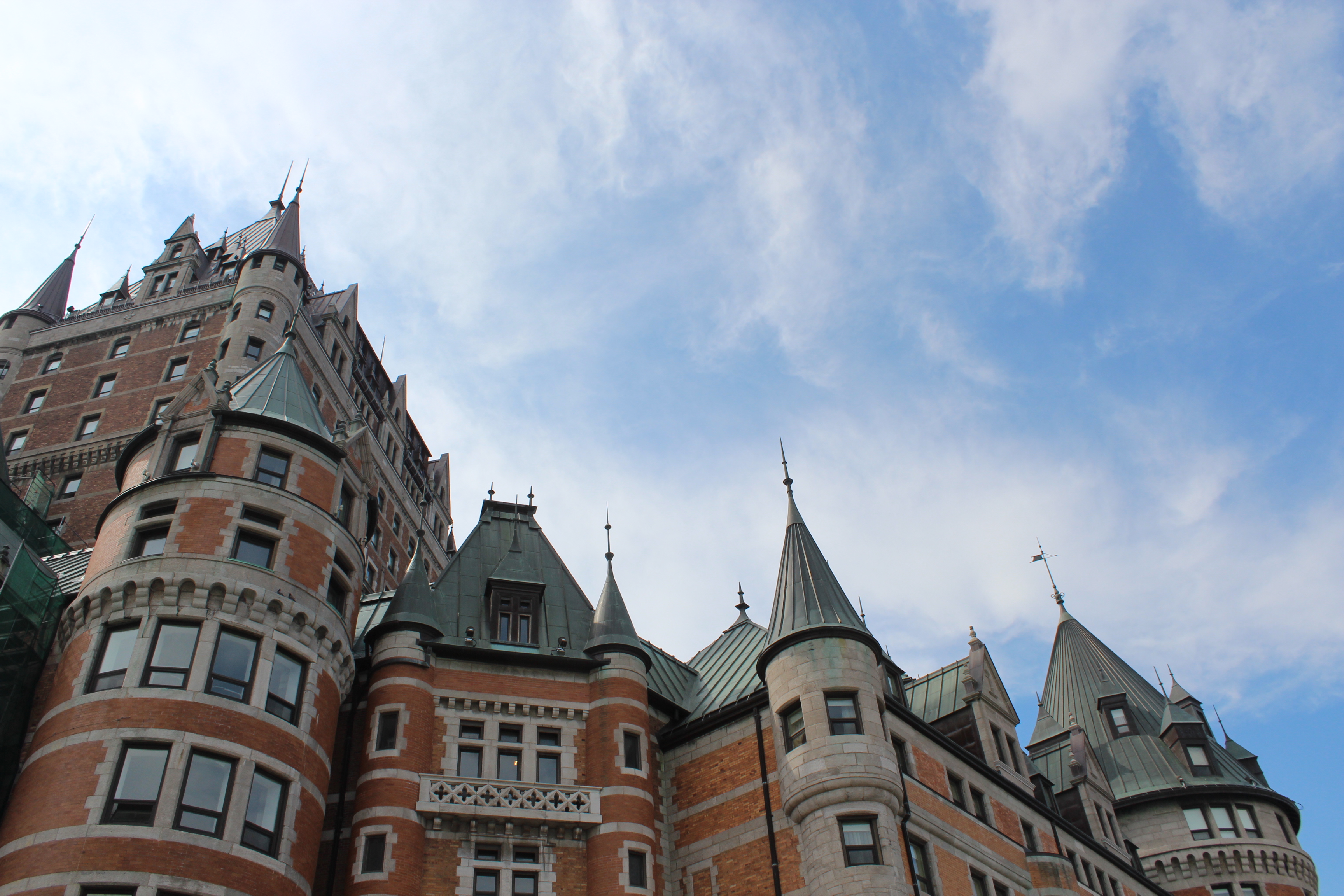
Chateau Frontenac, the most photographed hotel in the world and surely the inspiration for Hogwarts.
“It’s not uncommon to see people buying $10,000 bikes in Quebec City,” said Marc. “It’s a relatively short season, but cycling is growing faster than golf here.”
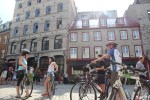
While bike lanes line the edge of the St. Lawrence River and part of the escarpment above, cycling through Vieux Quebec itself takes some improvisation. In summer the streets are busy with pedestrians preoccupied with their centuries-old surroundings. Fortunately, it’s legal to ride the sidewalk and we were soon slaloming on either side of the kerb.
Marc’s tour skirted Laval University, formerly the Seminaire de Quebec and the oldest centre of education in Canada; the Citadelle atop Cap Diamant, adjoining the Plains of Abraham; Quebec’s National Assembly and Chateau Frontenac, said to be the most photographed hotel in the world. (I’d swear it was the inspiration for Harry Potter’s Hogwarts.)
Just across from the National Assembly we stopped at the Fountaine de Tourny, built for the city’s 400th birthday and a popular spot for wedding photos. It was hard not to notice the monolithic Hilton and Delta hotels, whose desperately unimaginative architecture is in dramatic contrast to most buildings in Vieux Quebec.
We lingered in Place Royale, site of Samuel de Champlain’s first permanent settlement in New France. Grey stones mark the footings of where Champlain’s home once stood, right outside Notre Dame des Victories, the oldest stone church in North America, dating back to 1687. There are similar grey stone markers all over Old Quebec, said Marc, signalling other historic sites that would be impossible to excavate now.
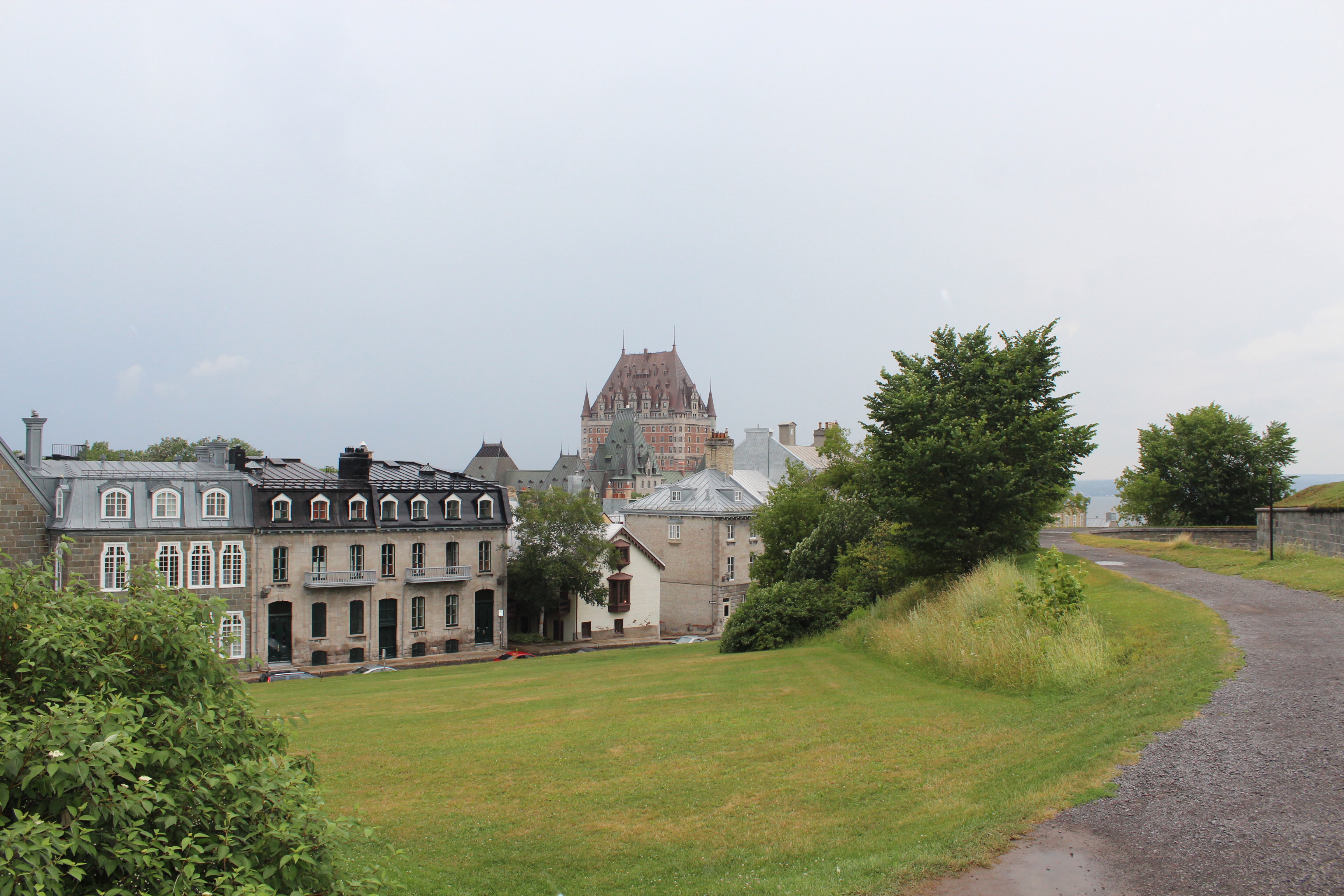
Near the Citadelle atop Cap Diamant, adjoining the Plains of Abraham.
We rode the waterfront and part of the old port of Quebec before an adventurous ride through crowds of shoppers in the narrow, cobblestoned lanes of Quartier Petit Champlain. Once a fur-trading portside village, it’s now full of boutiques, bistros and frescoes. A funicular railway connects the area to Dufferin Terrace, a beautifully landscaped boardwalk with the best view of the St. Lawrence River. It seemed like a fitting place to stop for an ice cream and consider the view Champlain enjoyed in 1608.
People had told me that Quebec would remind me of an old European city. Aside from medieval Bruges in Belgium, I don’t know of another place as beautiful as Quebec City. Even Ryan and Emma liked it!
If you go:
In the heart of old Quebec City since 1995, Cyclo Services offers bike rentals and a variety of guided bike tours. Visit http://www.cycloservices.net or call 1 877 692-4050.
The Hotel Royal William is in the heart of New St. Roch, a neighbourhood full of great bars, coffee shops, restaurants and independent stores. It’s a few minutes bike ride from the old city and the train station. Packages start at $99 per person. Visit http://www.hotelroyalwilliam.com/en/
Free shows by Cirque du Soleil and the Image Mill are known collectively as Rendezvous sous les Etoiles and run Tuesday to Saturday, concluding with a Sunday performance Sept. 1.
For more on Quebec’s Museum of Civilization, visit www.mcq.org/en/mcq
For all other travel information about Quebec City, visit www.quebecregion.com/en




 Nev Judd: Online and out there