Archive for the ‘family travel’ Category
Splendor in the snow

Skiing takes on a surreal quality when it’s 28 degrees and you’re wearing a T-shirt. That’s part of the appeal when it comes to skiing Blackcomb Glacier, a time-honoured summer tradition at Whistler.
Most of the shale atop Blackcomb started as mud on the seafloor about 100 million years ago. The place still resembles a beach in July. That’s when summer skiing is in full swing and public displays of nudity are commonplace. OK, not full-on nudity like Whistler in the 60s, but there’s plenty of flesh visible 7,500 feet up on the Horstman Glacier.
I’ve never been summer skiing before and I pack with excited anticipation bordering on paranoia: neck-warmer, gloves, fleece jacket, Under Armour and longjohns compete for space in my backpack with water, emergency chocolate and a camera.
It’s too heavy so I ditch the longjohns and eat my emergency chocolate.
It’s 11 a.m. when I upload on the Wizard Express at the base of Blackcomb. The temperature in the village is about 25 degrees. (Thank goodness I ate the chocolate.)
The first thing I enjoy about glacier skiing is the journey. My skis are stowed on the chair in front; I’m wearing a T-shirt and enjoying the warm mountain breeze. Compared to the winter experience, it’s liberating.

Another tough assignment – but someone has to do it.
Above Merlin’s run I spot two deer and on Upper Main Line a solitary bear appears from the bushes. We switch to another quad chair – Solar Coaster Express. The first snow comes into view moments later above a black diamond run called Sorcerer, and there are more banks of white where the Nintendo Super Pipe used to be.
Solar Coaster takes us to the Rendezvous Lodge and the Peak 2 Peak Gondola where a bus awaits to ferry us the short ride to 7th Heaven Express and the last chairlift to the Horstman Glacier. Two T-bars, terrain parks and endless blue skies await.
At the top I find every kind of tourist: adventurous seniors hiking on the shale, international students up for lunch at the Horstman Hut, couples posing for photos at the inukshuk, and parents watching their kids play in the snow. Then there are the skiers and boarders – mostly half my age and seemingly unencumbered by back packs full of winter gear.
Undeterred, I spend the next hour skiing numerous variations of what are essentially two runs to the Horstman T-Bar. It’s where most of the skiers and boarders are funneling and the lineups are surprisingly long. But it’s warm, the views are spectacular and everyone’s happy. Not surprisingly the snow is soft and slushy in places, but I’ve skied on worse in January.
For a while I perch beside the public terrain park and photograph the jumpers whose attempts to defy gravity mostly end in wipeouts. I tell myself I’d try it, but what with the backpack and all; I don’t want to land on my camera, right?

Half-pipe or jump? Photographer Javier Carranza mulls his next move.
I stop for lunch at the Horstman Hut and lather on yet more sunscreen, putting extra under my chin and nose – the most vulnerable spots for snow-reflected sunburn. I order a beer and a deli platter of bread, meats, cheese and pickles. From the deck, Black Tusk’s ominous spire is hard to miss in the distance – it’s the kind of day photographers set aside for brochure assignments.
With some effort I step into my skis again and prepare for another run to the Horstman T-Bar. That’s when I notice the Showcase T-Bar has largely emptied. It’s normally reserved for private lessons, like the Dave Murray Ski and Snowboard Camps. With an hour of skiing left till downloading at 3 p.m., I ski across and get the green light from a liftie to ascend.

The only way is down to the Horstman T-Bar and the Showcase T-Bar.
It’s only about a 500-foot climb, but the Showcase T-Bar takes me to one of my favourite winter skiing spots, the entrance to Blackcomb Glacier. I seem to have this side of the mountain mostly to myself for the final hour and take full advantage, picking my routes beside the jumps, the half pipe and the inflatable landing spots for aerial gymnasts in training. With a bouncy castle to land on I’d almost consider attempting a jump. Almost.
I leave myself a little time to ski out on Green Line, a narrow strip of snow left among the rocks and the wildflowers beginning to bloom. Twice I almost fall while mesmerized by the epic landscape before me and it’s a relief on my legs to finally board Solar Coaster for the download. A mum and cub are basking on one of Blackcomb’s lower runs. At the bottom, a dozen horse-riders are wending their way uphill.
Within an hour I’ve revived sore muscles in the pools and hot tubs at the nearby Chateau Fairmont Whistler where – as luck would have it – the Mallard Lounge is serving $5 happy hour drinks and free appies. Somehow on reflection, those terrain park jumps don’t seem so daunting.
Maybe next time.

The thin white line. Almost time for apres!
If you go:
Weather-permitting, glacier skiing on Blackcomb is one of a multitude of summer activities on offer in Whistler. The Whistler Mountain Bike Park is in full swing and the Alpine Wonder Routes – a vast network of hiking and running routes – is becoming more accessible with every day the snow melts.
The Peak 2 Peak Viewing Gallery is a new series of videos showcasing construction of the gondola linking Whistler and Blackcomb. It’s on a raised walkway in the Peak 2 Peak Terminal on Whistler Mountain. Also new is the Alpine Theatre at the Roundhouse Lodge on Whistler Mountain. Movies with an alpine theme air every 30 minutes.
During our weekend in Whistler, I got to relive my adolescence dancing to The English Beat, part of the free Whistler Presents Concert series. Whistler Olympic Plaza hosts free weekend concerts throughout the summer.
Details of all these activities are at www.whistlerblackcomb.com/
The Fairmont Chateau Whistler is a few seconds’ walk from the Wizard Express chair and offers numerous summer accommodation packages. For more details, visit www.fairmont.com/whistler/ or call 1 800 606-8244.
The Trail Collector

Creator of sunshine-coast-trails.com Becky Wayte is probably the Sunshine Coast’s most avid nature bather.
You might call Becky Wayte a wanderer. Almost every day for the last 20 years, Becky has hiked or biked a trail somewhere on the Sunshine Coast. It wasn’t until a couple of years ago though, that she became a collector.
Some people collect stamps; others baseball cards. Becky collects trails, maps them with a GPS, and documents them on sunshine-coast-trails.com, a website she created for outdoor enthusiasts. The site lists hundreds of trails, from Langdale to Earl’s Cove, with descriptions, maps, difficulty ratings and useful links. She has her favourites – three of which she describes in her own words in a sidebar to this story.
In 2011, hiking three to four hours a day, almost every day, Becky managed to map almost all of the Sunshine Coast’s trails in six months. She’s been updating her collection ever since. The Coast is home to some prolific trail builders, it seems.
“I actually thought it would take me a couple of years,” she tells me. “But I quickly realized that I’m a little obsessive. When I start something, I need to see it through to the end.”
But the truth is, collecting trails never ends. New trails are always springing up and some remain well-guarded secrets. In a recent interview with pinkbike.com, local mountain-bike phenom, Holly Feniak, describes the Coast’s trails as: “Dreamy. Loamy, mossy, bouncy, incredibly green, and in the secret spots … all that and steep.”
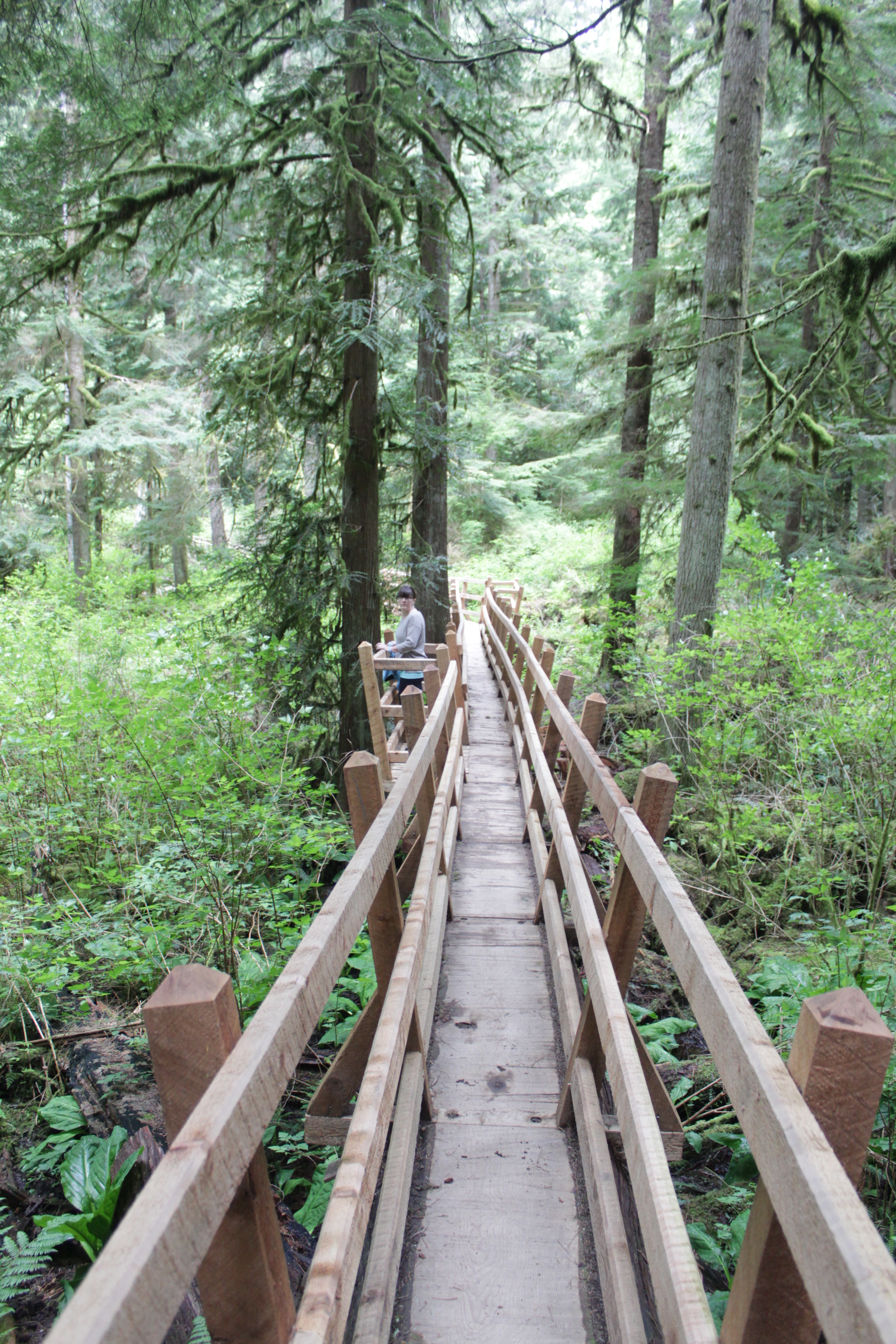
Cliff Gilker Park, Roberts Creek.
She might have added ‘never-ending’!
“For heaven’s sake, stop building trails,” Becky laughs, when I ask her about the Coast’s trail builders. “I actually love finding new trails and I admit, there might be the odd one I don’t know about. I’m always trying to keep up!”
For a moment, we think we may have found a new one. It’s an unusually hot day in May and we’re walking through a dusty trail off Field Road in Wilson Creek. We’re accompanied by Cody, a large, lovable dog from the nearby SPCA where Becky volunteers each week as a dog-walker. The path veers past someone’s back yard and into the forest.
“Let’s take a look,” says Becky, in her element. A few minutes later we come to a dead-end. Cody looks at us expectantly and we return the way we came. So what inspired Becky to take on this labour of love?
“I have three dogs and one has issues with other dogs, so I wanted to find new trails to hike where there weren’t so many people,” she says. “There were few websites, but they only featured the most popular hikes, places like Mount Daniel, so I decided I’d do it myself.”
Becky’s well qualified. Not only does she love the outdoors, but she learned to build websites through her work teaching computer courses in the Adult Basic Education Program at Capilano University in Sechelt. With the website established, Ryan Robertson, a Squamish-based app developer, who specializes in creating trail applications for iPhones and Androids, contacted Becky. Becky provided the GPS (Global Positioning System – the satellite navigation application) data and Ryan created the app. Trailmapps: Sunshine Coast costs $10 and is available at the Apple Store and Google Play.
For old-school trail lovers, she’s also created waterproof trail maps that are available in Gibsons at Spin Cycles, and in Sechelt at Source for Sports, the Sechelt Visitors’ Centre, and Off The Edge Adventure Sports.
Outdoors, technology couldn’t be further from Becky’s mind. While she’s always hiked to combat weight gain, she’s also convinced of nature’s therapeutic benefits. The Japanese have a name for it: shinrin-yoku, or forest bathing. Becky cites Japanese research, which points to the many benefits of simply being in nature – lower blood pressure, higher creative aptitude and boosted immune systems.
“I prefer the term ‘nature-bathing’ because I find just being out in nature makes me feel better. I always come home feeling better than when I left.”
Well, almost always.
Becky sheepishly recalls one particular hike that went awry, much to her husband’s despair. “I was hiking up Elphinstone and I’d let people know where I was going and what time I’d return. It took a lot longer than I’d expected though and my phone died.
“I got back around 7:45 p.m. – not the 5 p.m. I’d told my husband. He was pretty mad.”
The experience didn’t sour Becky’s love of Mount Elphinstone. In fact, the Mount Elphinstone Summit Trail ranks in her three favourite hikes and bikes. (See below.)

Kinnikinnick Park, West Sechelt.
Sidebar
My Three Favourite Hikes & Bikes, by Becky Wayte
Mount Elphinstone Summit Trail (hike only)
This is a long, fairly difficult climb, but the view at the very top is worth it. The trail to the top can be accessed from the top of Sprockids or via some feeder trails off B & K logging road in Roberts Creek. If you take your time and enjoy a picnic and rest at the top, this hike will likely take you five or six hours. Make lots of noise or wear a bell so the bears hear you coming.
Ruby Klein Traverse – Suncoaster Trail (hike or bike)
Beautiful views of Ruby Lake and a hand carved bench greet you at the highest point along the trail. Easy to make a whole day trip out of this even though the hike itself will probably only take you a couple of hours. You can visit the Iris Griffiths Centre, take a swim in Klein Lake and there is even a feeder trail down to the Ruby Lake restaurant (Trattoria Italiano).
McNeill Lake Circle Route (hike or bike)
This is one of my favourite destinations in the summer months because I always combine a bike ride with a swim. The lake itself is not that well known so often no one else is there, especially on weekdays. There are several trails that connect to create a loop around the lake, with access to the lake from a couple of spots. I park on Middlepoint Forest Service Road and take Copper Head, Dry Feet, a logging road, Old Pole Road and back to Copper Head. There is a short trail off the logging road just north of Dry Feet that takes you into the lake. This is an excellent place to ride your mountain bike if you have pre-teen kids or you just want a fairly flat ride (we don’t have many flat rides on the Coast). Hiking it probably takes about 1.5 hours and by bike about an hour, unless you stop to enjoy a swim.
For the definitive web guide to the Sunshine Coast’s trails, visit http://www.sunshine-coast-trails.com.
Heart of green
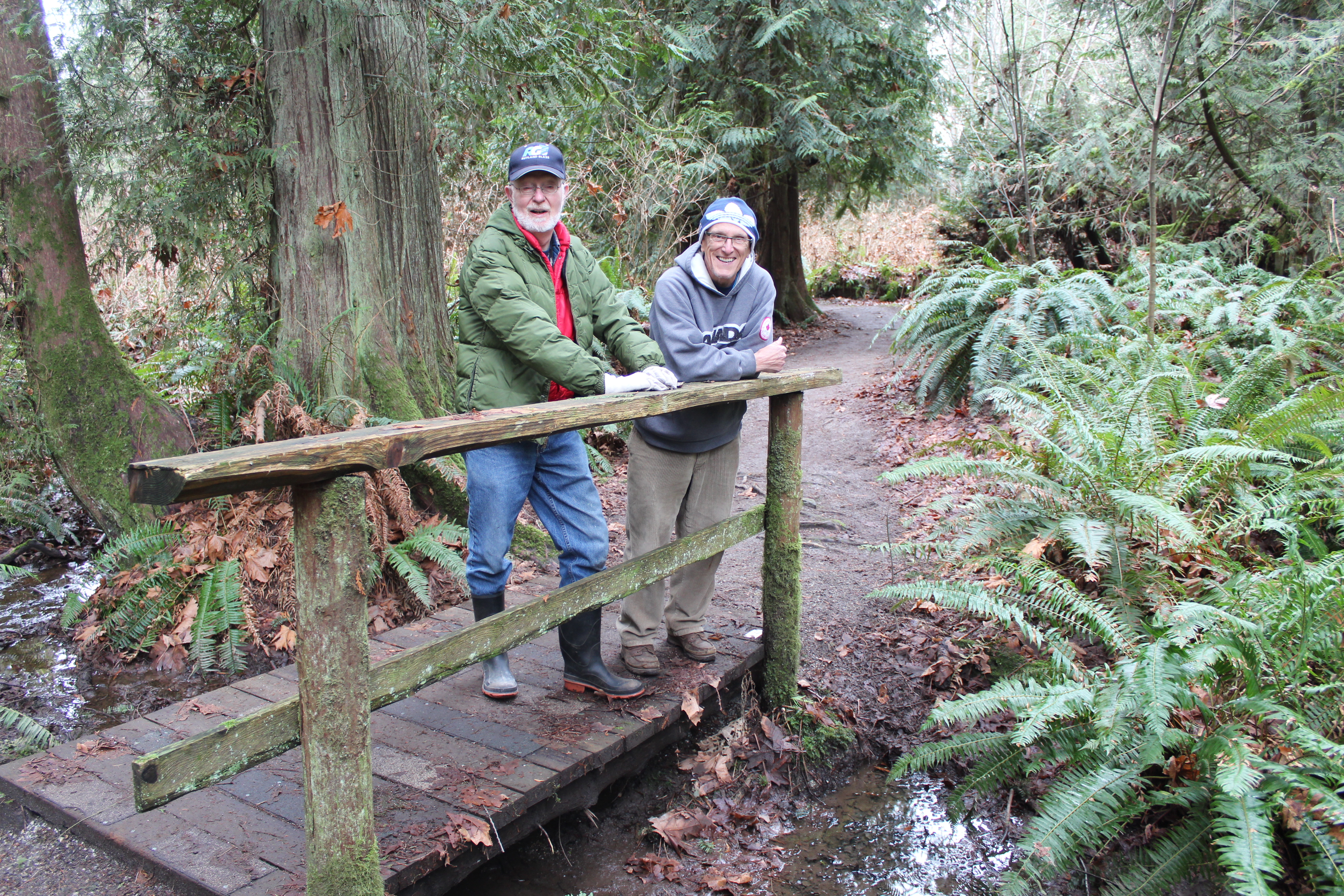
Sechelt Rotarians, Tom Pinfold (right) and Mick van Zandt on the trails of Kinnikinnick.
Shirley Macey didn’t have time to waste. When she wasn’t coaching kids, she was raising a family, working as a Gibsons RCMP dispatcher, and lobbying local government for more recreational space.
Somehow she found time every week to climb Soames Hill with a garbage bag to pick up other people’s litter.
“She was pretty amazing,” remembers her son Darin. “I didn’t think much of it growing up; now I don’t know how she did it.”
At the southern end of the Coast, 14 hectares of Soames Hill Regional Park are named after Shirley Macey. No doubt she would be proud of the soccer fields, the wheelchair-accessible playground and Frisbee golf course. Shirley – or Sam (an acronym of her full name, Shirley Amelia Macey) to her friends – was a dedicated volunteer whose legacy is by no means unique.
Shirley Macey, Maryanne West, Ted Dixon, Cliff Gilker and Hackett are – to name a few – venues so familiar to most of us that it’s easy to forget that they were also people. Ted Dixon, for example, worked tirelessly for self-government for the Sechelt Indian Band before dying in a car crash in 1981. Maryanne West was the backbone of community TV and so many volunteer projects before dying at age 90 in 2008.
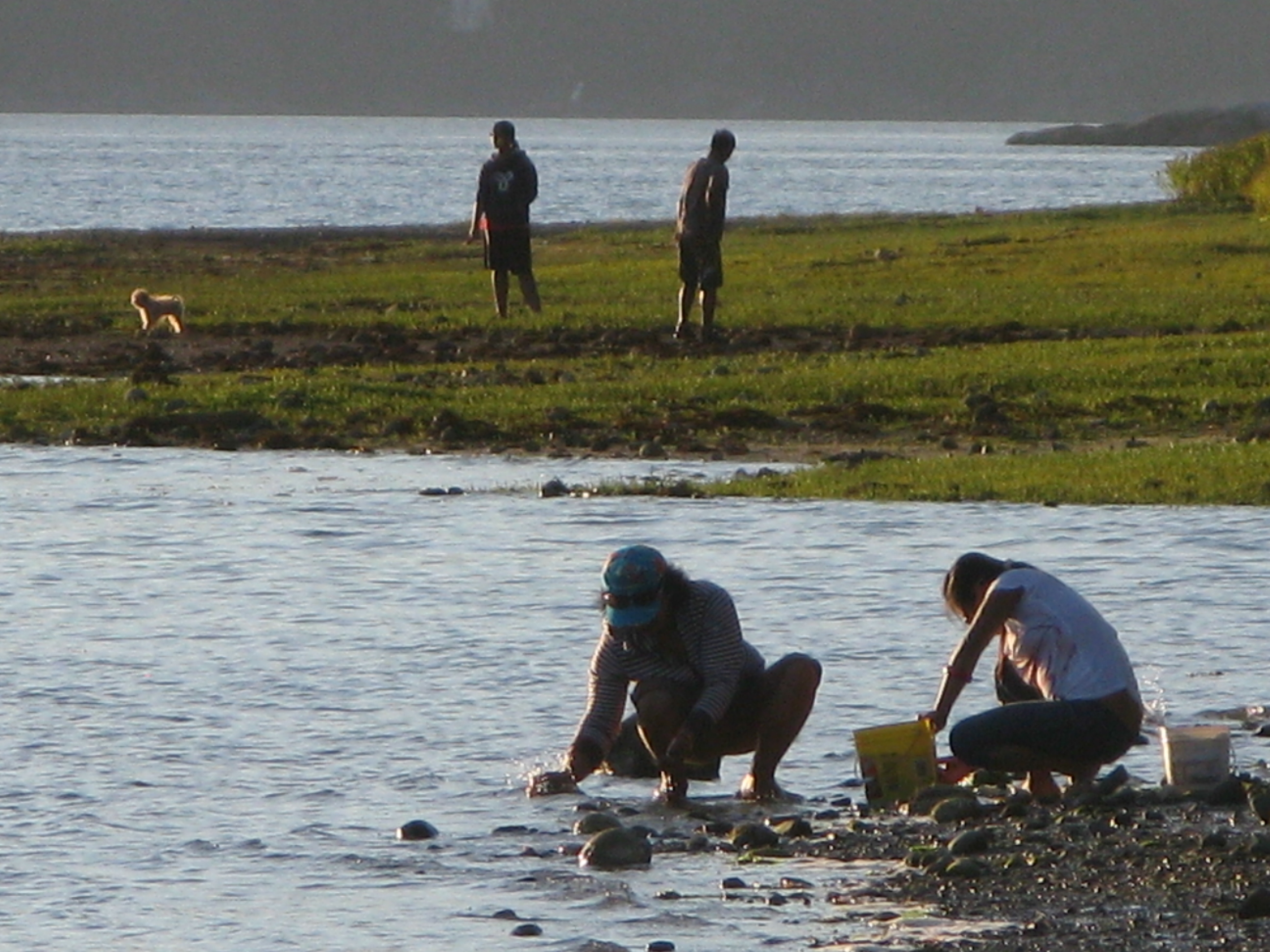
Scavenging the shoreline at Porpoise Bay. For parks and beaches, Sunshine Coasters are spoiled for choice.
And not all parks bear a family name. Brothers Memorial Park in Gibsons was named for logging contractors, Al and George Jackson who donated the land.
Today, volunteers continue to be the lifeblood of the Sunshine Coast’s parks and trails. In fact, the parks system wouldn’t work without them.
“We totally rely on volunteerism,” says Sunshine Coast Regional District parks planning coordinator, Sam Adams. “We wouldn’t be able to do what we do without it.”
For the SCRD that means mobilizing volunteer help in bigger parks like Dakota Ridge, where members of the Dakota Ridge Advisory Committee have been particularly helpful. Volunteers also help the SCRD maintain trails at Soames Hill, most recently working to improve the wooden stairs. Now the regional district is hoping to cultivate more volunteer assistance with an adopt-a-trail program.
“Part of our work plan for 2013 is to develop a more robust volunteer program,” says SCRD parks planning coordinator, Susan Mason. “We have kilometres and kilometres of trails to maintain, so people willing to document changes on a regular basis are helpful to us.”
The government-volunteer relationship is similar elsewhere on the Coast. District of Sechelt parks supervisor Perry Schmitt is grateful for the work of several trail building groups, as well as established service clubs.

Sunshine Coast Lions Club president Len Schollen at the site of the Lions’ next project, an accessible viewing deck in the corner of Mission Point Park where the beach and Chapman Creek meet.
“The Lions Club has been instrumental in making improvements to Mission Point park and the Sechelt Rotary Club has been assisting in rebuilding decks throughout Kinnikinnick forest trails,” says Schmitt. He also cites the work of the Sechelt Groves Society at the Heritage Forest trails, and the Sunshine Coast Natural History Society, which tends to Sechelt Marsh.
On a cold blustery day, Sunshine Coast Lions Club president Len Schollen shows me work completed on the Mission House deck and the next project – an accessible viewing deck in the corner of Mission Point Park where the beach and Chapman Creek meet.
“We’re basically waiting for some decent spring weather to build the viewing platform and a hard-surface ramp leading up to it,” says Schollen, surveying the footings already in place. “There’ll be a railing around it and hopefully some signs with information about the salmon run and pointing out places like Mount Arrowsmith.”
Why are Schollen and other Lions members involved in the project? “We serve, is the Lions’ motto,” says Schollen simply. “We try to make this a better place to live.”
It’s a sentiment shared by Sechelt Rotarians, Tom Pinfold and Mick van Zandt, when I meet them on the trails of Kinnikinnick park.
“We wanted to work on small projects where a few people could work for a few hours on something with lasting benefit,” says Pinfold. “We’d much prefer to let the District allocate their resources to new things instead of maintenance.”
With other Rotarians, the pair has replaced and built cedar bridges and decks throughout Kinnikinnick’s trails during the last three years. Topped with roofing tiles, the decks are essential given the drainage issues on multi-use trails in a popular park. The new bridges should be good for at least 10 years, reckons Pinfold. (Elsewhere in Kinnikinnick park and at Sprockids park in Langdale, Capilano University students hone their trail-building skills as part of the Mountain Bike Operations Certificate curriculum.)
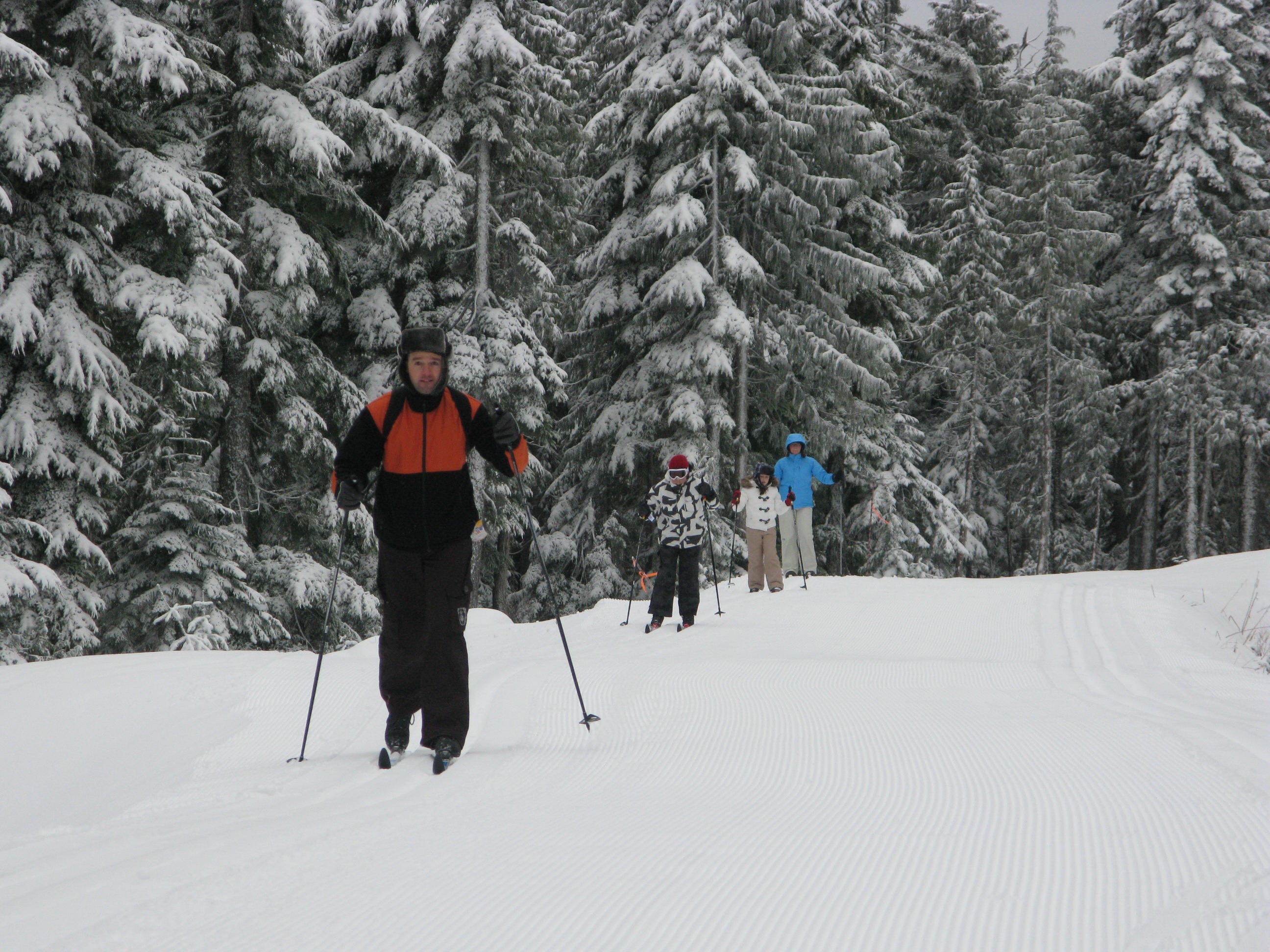
There are 13 kms of groomed trails for cross-country skiers on Dakota Ridge, yet another Coast playground.
Pinfold and van Zandt have also worked on a wheelchair accessible deck at Halfmoon Bay’s Trout Lake and a viewing platform and trail in Roberts Creek’s Cliff Gilker park.
Elsewhere, volunteers continue to make the Sunshine Coast a great place to play. If you’re searching for the heart of the Sunshine Coast you’ll find it in any park or trail. From Pender Harbour’s Lions Park (the best soccer field on the Coast) to the mountain bike trails of Sprockids Park in Langdale, outdoor recreation thrives because people care enough to make it happen.
People like Shirley Macey.
Shirley didn’t live to see the park she’d fought for named in her honour. Just months after retiring from the RCMP and paying off her mortgage, she died of cancer in 1998.
“I didn’t realize until I was older that quite a few people called her mom,” recalls Darin, who has four kids of his own now. “I met all these people I knew at her service who thought of her as a surrogate mother.
“My kids are certainly proud of the park’s name. It’s too bad she died so young.”
Trail Mix
There are numerous opportunities to get involved in outdoor volunteering. Here are a few websites where you’ll find more information.
http://secheltlionsbc.lionwap.org/
email tony@whiskeyjacknaturetours.com for the Sunshine Coast Natural History Society
Thanks to the Sechelt Community Archives and the Sunshine Coast Museum and Archives for their help in researching this feature.
Party on in Whistler
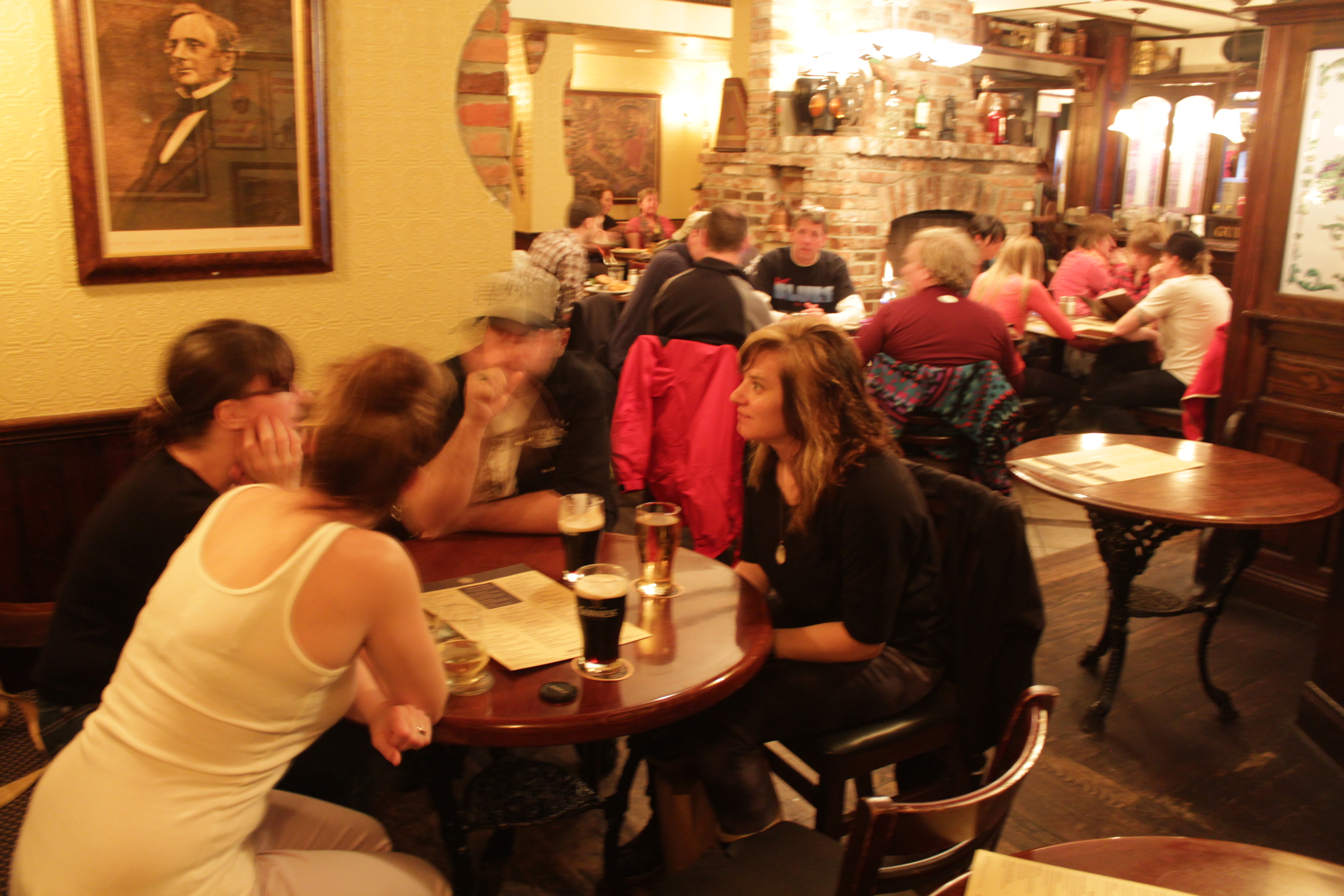
The Dubh Linn Gate begins to fill up at the World Ski and Snowboard Festival.
It’s 4:20 p.m. on 4/20 in Whistler and the aroma wafting through the village is unmistakeable: Axe body spray with just a hint of beef jerky. It smells like a high school locker room, which is probably why my 15-year-old son Ryan doesn’t seem to notice. Either that or he’s carrying too much Axe and beef jerky to notice.
The final weekend of Whistler’s ski season is also the final weekend of the World Ski and Snowboard Festival. That means all manner of free arts, music, and sports events. It also means free giveaways – Axe, beef jerky, Monster Energy drinks and yoghurt. It’s an odd combination, but a popular one among teens nonetheless.
It makes for an eclectic scene: Sweet-smelling kids amped on caffeine. (Monster drinks are for over-18s, but plenty of parents were indulging their under-18s.) Bandana-wearing dogs fresh from Whistler DogFest, mingling with toddlers and locals mingling with visitors to the beat of G. Love and Special Sauce, (they’re a band). Somehow it all works.
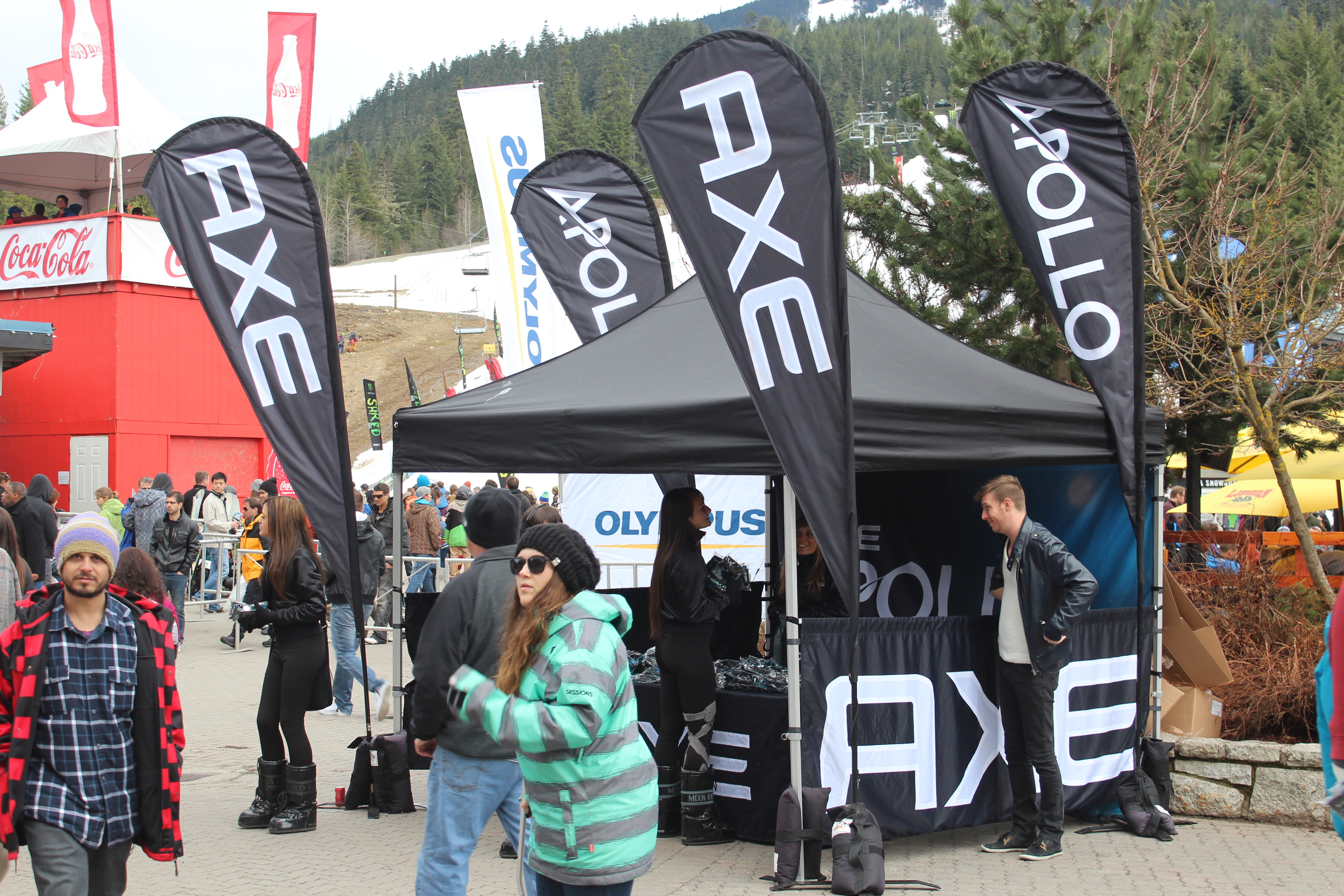
You want some Axe with that beef jerky?
We’ve skied out to the village just in time for Fashion EXPOSED, a fast-paced, high-energy show on a catwalk set up by the main stage. Macklemore’s infectious hit, Thrift Store is booming over the speakers as models come and go every few seconds. G. Love and Special Sauce, the day’s first live act, are up next and pretty soon everyone from the decks of the Garibaldi Lift Company to The Longhorn to the crowd in between are swaying to bluesy hip hop. The lead singer looks like Justin Timberlake and plays a mean harmonica.
Aside from abundant yoghurt and beef jerky, our immediate après options look sparse with lineups at almost all the bars fronting the main stage. Thank goodness for the Dubh Linn Gate where there’s room at the back. Pints of Guinness and a poutine and fries later, we’re back outside for Vancouver’s very own enduring hip hop band, the Swollen Members. They’re a more than capable warm-up act for the ever-popular Big Air event and Monster Energy Shred Show. (Try saying “Shred Show” fast! It’s easier after a Monster Energy drink.)
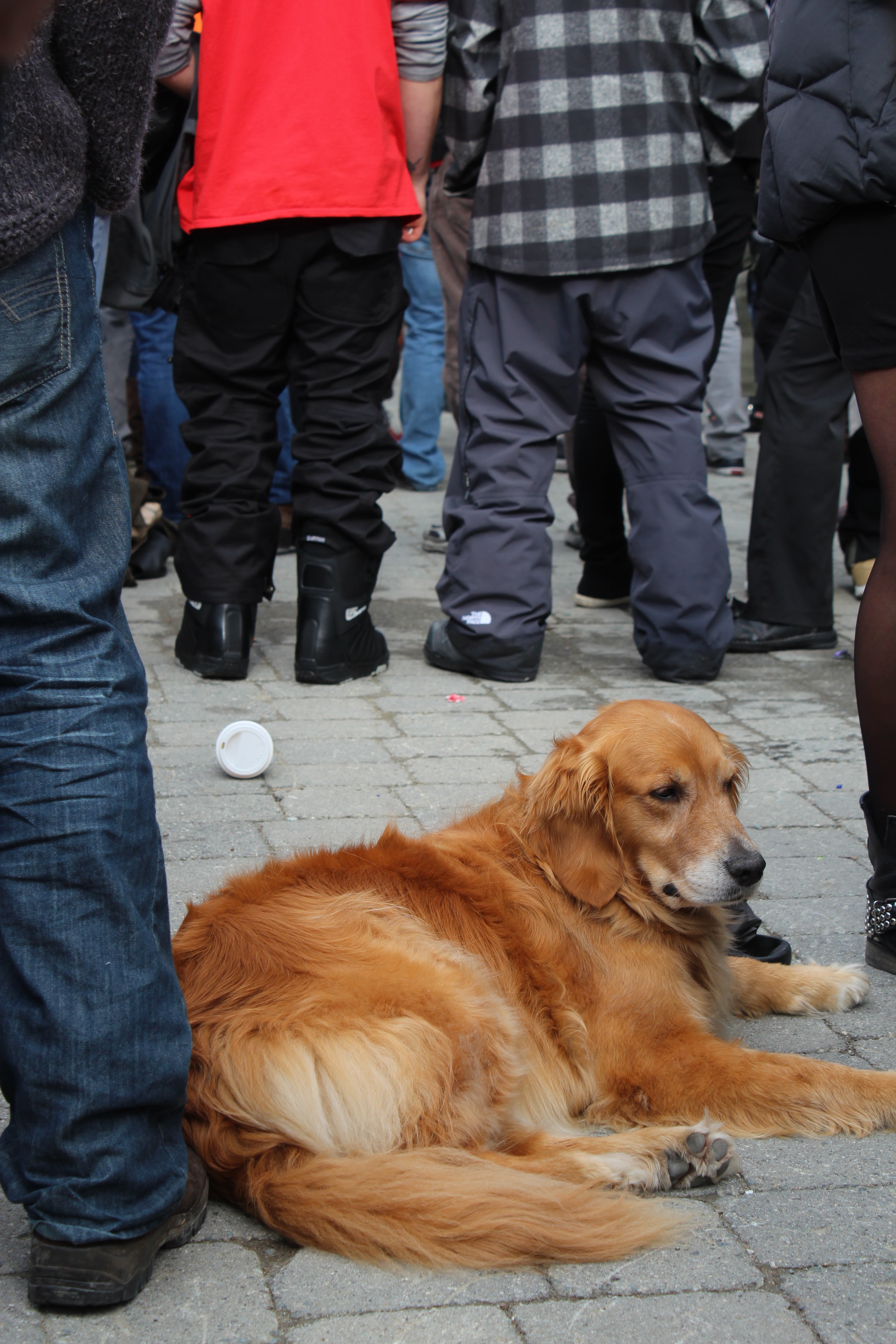
Lab chills out to G. Love and Special Sauce.
As darkness and temperatures fall, pro snowboard riders soar upwards of 70 feet in competition for a $15,000 cheque and the 2013 Big Air title. It’s an impressive finale made all the sweeter by 18-year-old Canadian Maxence Parrot landing a Triple Cork to beat a Norwegian and an American for the victory. As the lineups to the village’s bars and clubs grow ever-longer, we head back to the Fairmont Chateau Whistler and find refuge in the Fitzsimmons Pub (The Fitz, as it’s known to locals) opposite the hotel. No lineups, great food and a solid beer list. ($13.75 a pitcher!)
Telus no longer sponsors the World Ski and Snowboard Festival, but that has not diminished the event’s appeal. On the contrary, organizers expanded the WSSF’s arts and culture scene this year. Open daily at the Whistler Conference Centre, State of the Art celebrated the mountain community in a variety of media. Storytelling and improv were the themes of the Mountain Multiplicity Show and the Chairlift Revue. And Vengeance in the Valley, the resort’s inaugural roller derby bout, sold out.
Skiing on Blackcomb continues until late May. Meanwhile golf season starts May 4. Visit fairmont.com/whistler for details of Whistler golf packages, starting at $139 per person.
For everything else Whistler, visit whistlerblackcomb.com.
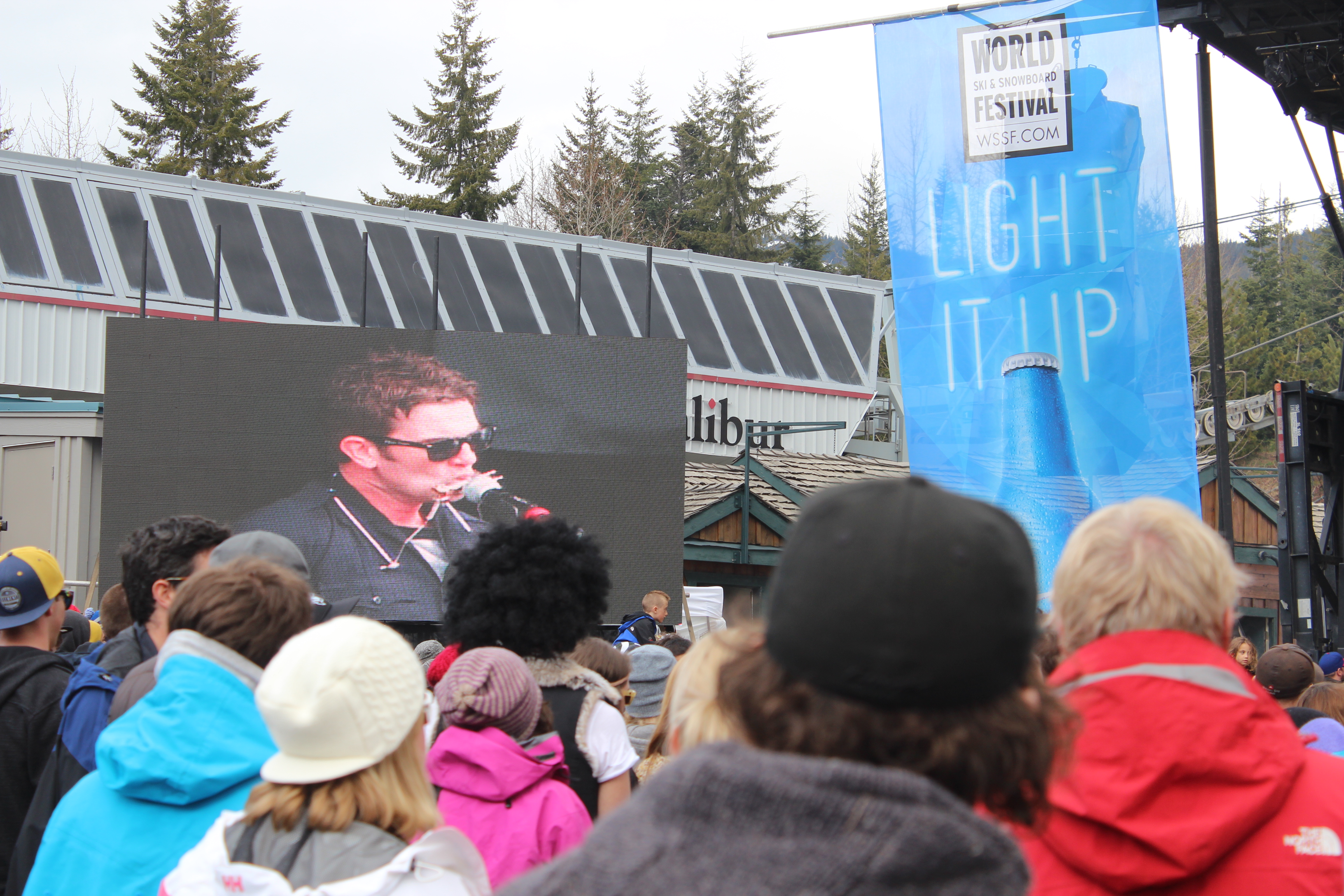
G. Love’s Garrett Dutton breaks from ‘Booty Call’ to harmonica.
Bright lights, big city
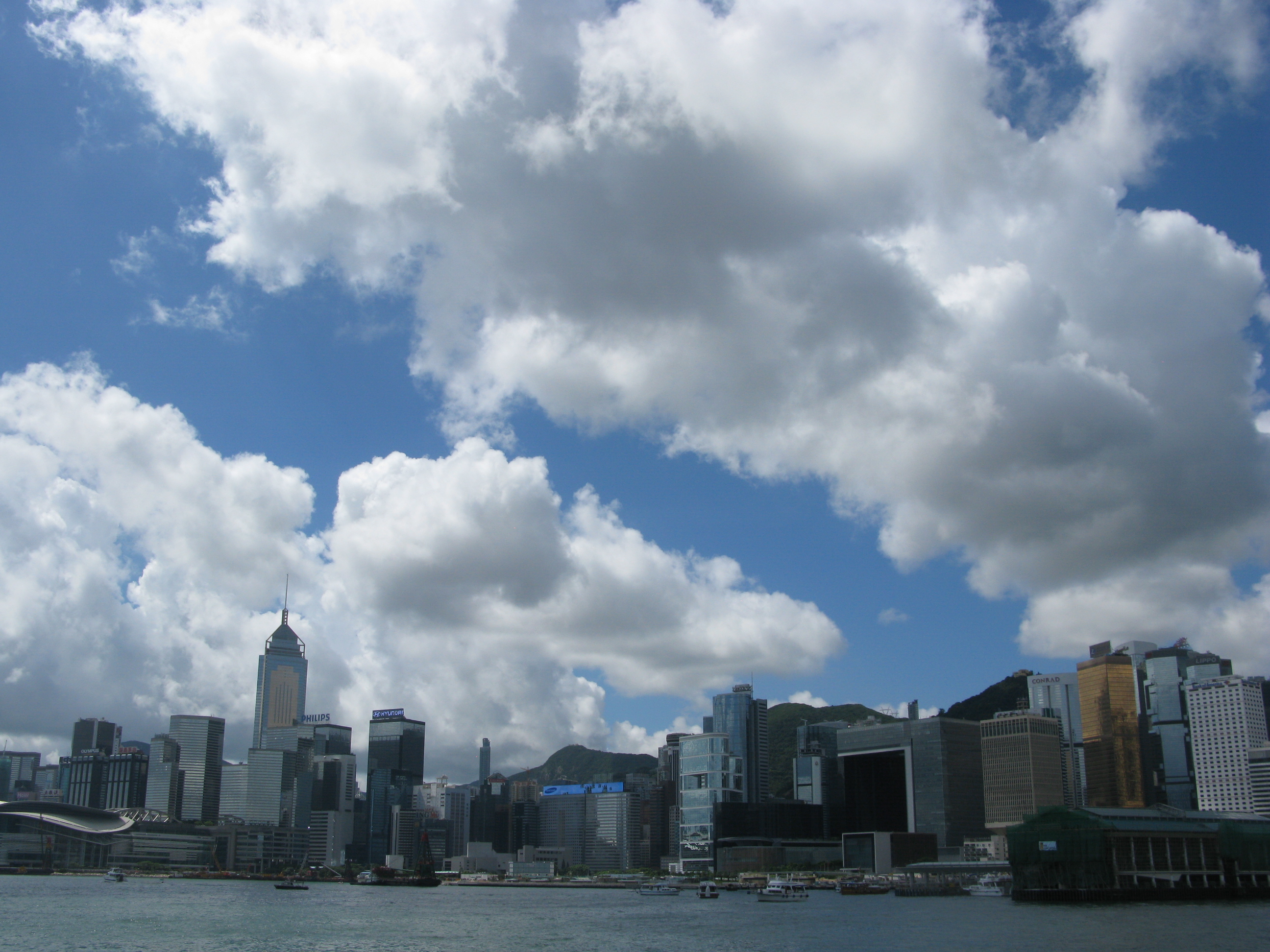
Hong Kong can feel like a science fiction movie: From the airport, set adrift from Lantau Island on a strip of man-made land, to the steep condo blocks that sprout like weeds on even steeper hillsides.
Rush hour in Mongkok starts at about 4 a.m. Or maybe that’s when it finishes.
It’s hard to tell in this Hong Kong neighbourhood, which has the dubious distinction of being the most densely populated place on earth.
With 130,000 people for company in one square kilometre, you stop saying “excuse me” after a while. You also learn that outside of Mongkok’s air conditioned malls and hotels, deodorant is a waste of time. So is sleep. There’s far too much to see.
Langham Place in Mongkok stands as a bridge between two very different worlds. From the rooftop pool, 42 storeys up, to its spas, bars and restaurants, the hotel exudes opulence. But within a block you’ll find markets selling everything from snakes and frogs, freshly skinned and dismembered, to sea cucumbers and dried pig skin.
Such extremes are everywhere in Hong Kong.

Mongkok’s street markets cater to a wide variety of tastes, including freshly skinned snakes.
From the moment we landed, everything about the place felt like a science fiction movie: From the airport, set adrift from Lantau Island on a strip of man-made land, to the steep condo blocks that sprout like weeds on even steeper hillsides.
Before Mongkok, we stayed two nights in Central on Hong Kong Island, which faces Kowloon from across Victoria Harbour. As our cab driver raced from the airport through a blur of neon and thundershowers, 13 hours aboard Cathay Pacific suddenly didn’t seem so gruelling.
Especially when we arrived at 38 Elgin Street, a third-storey condo we’d booked through airbnb.com. (See sidebar.) After driving on such modern highways and tree lined city boulevards, Elgin Street was a shock. Steep and winding, it barely fit one-way traffic between sidewalks buzzing with bars, restaurants and late-night shoppers.
Within 50 yards we could choose from Thai, Japanese, Moroccan, and Italian, yet we fought off fatigue at The Globe, a pub with as extensive a beer list as I’ve ever seen. With a pint of Old Speckled Hen, a scotch egg and tandoori chicken skewers, midnight came and went.
Aided by jet lag and adrenaline, we were up six hours later on Hollywood Road, eating breakfast at the Tsui Wah 24-hour restaurant. Fried beef in noodles with scrambled eggs and buttered bun set us back about $2 each and set us up for a morning of walking through cobbled streets as chaotic as the numerous signs competing for space above us.
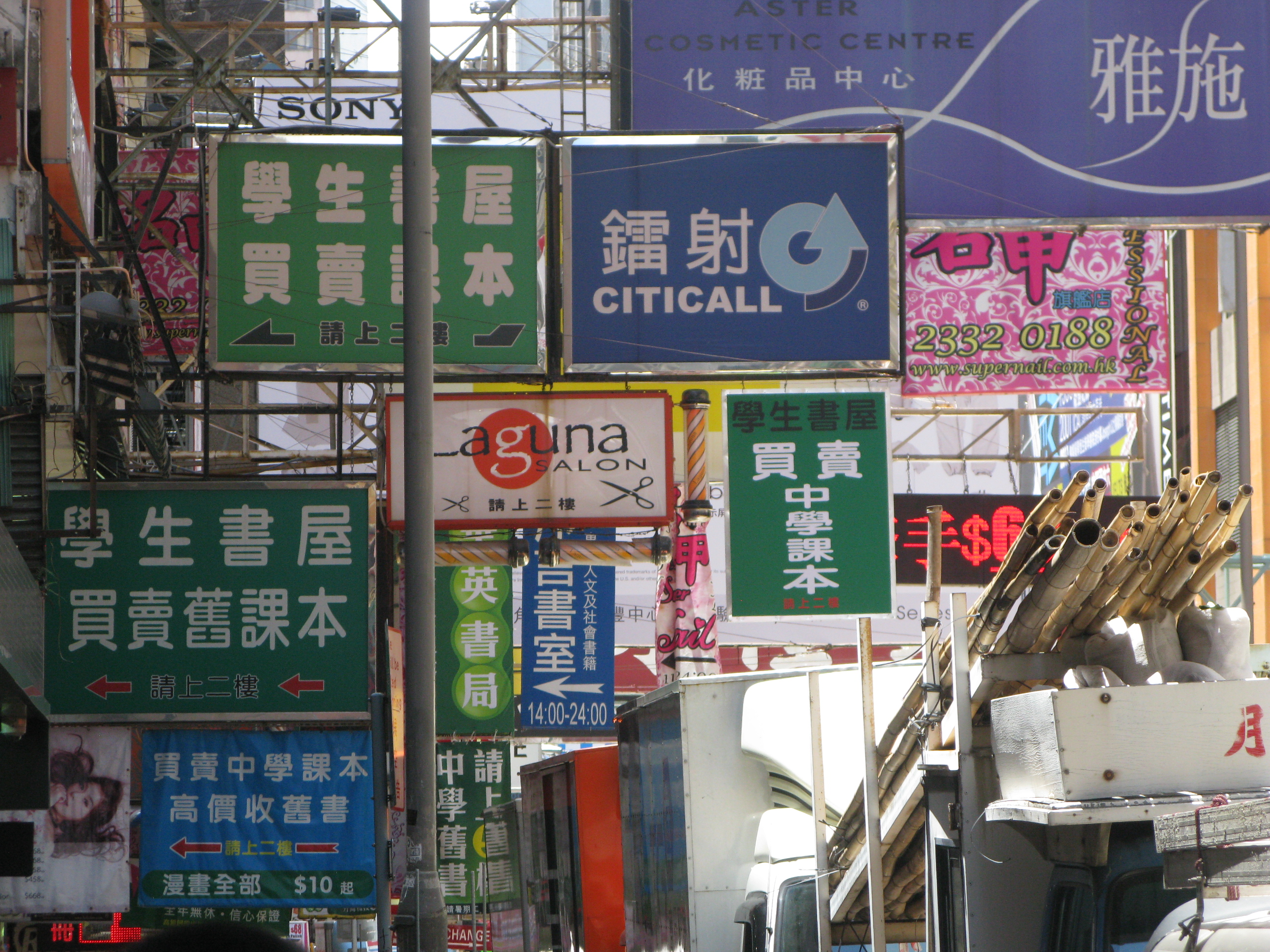
It’s not just people jostling for space in Hong Kong: signs are everywhere!
With 150 square feet to call home, the average Hong Kong resident clearly prefers to live life outside. On first impressions, shopping, socializing and worshipping all seem to shape those lives. At the Wong Tai Sin Temple, we found respite from Hong Kong’s hustle. Dwarfed by high-rise apartments to the south and hills to the north, the temple’s pools and waterfalls consoled us in the 35-degree heat and 100 per cent humidity. Followers of Taoism, Buddhism and Confucianism worship at the temple where they pray for spiritual answers beneath hundreds of hanging lanterns in a haze of incense.
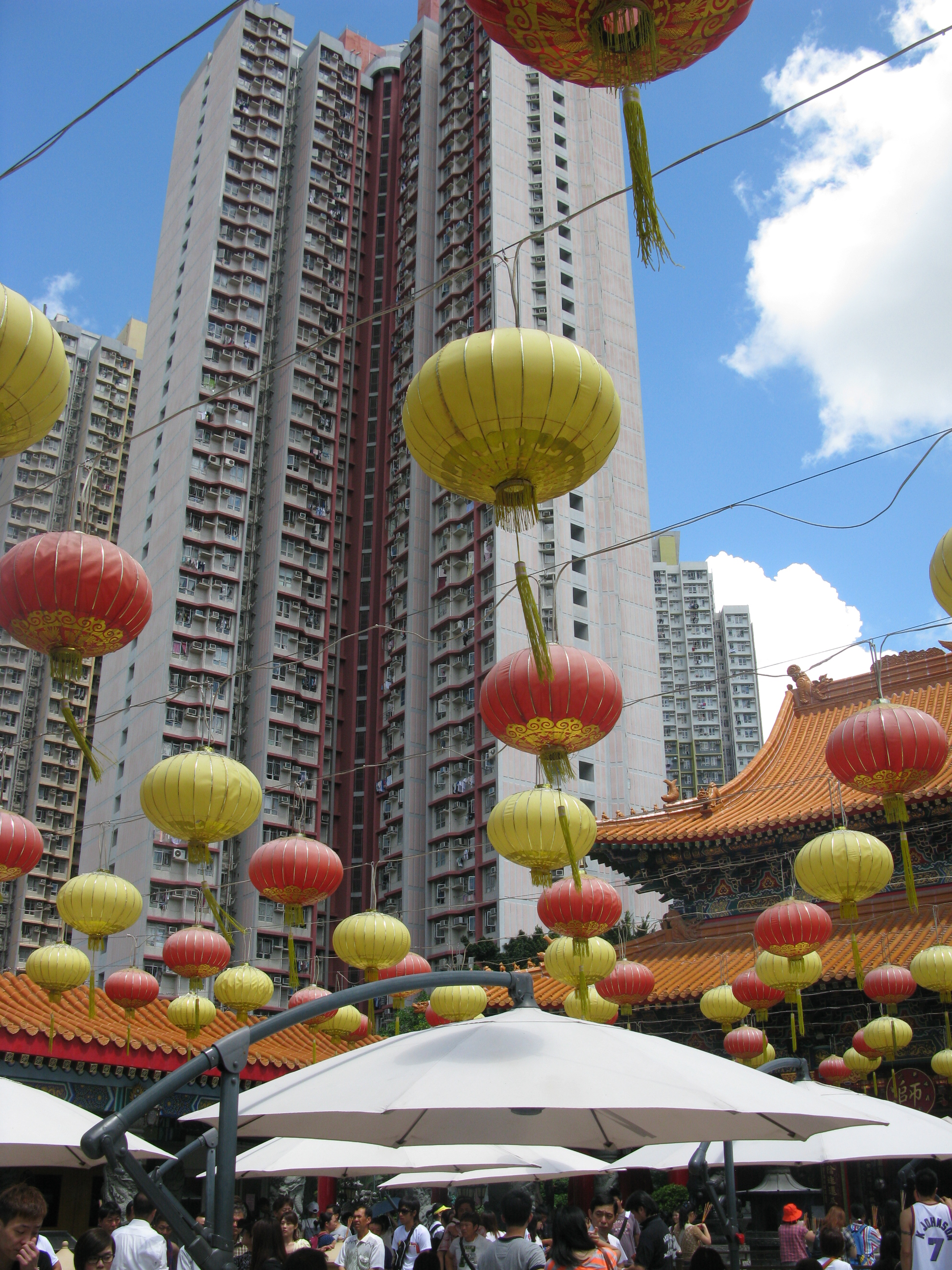
Dwarfed by high-rise apartments to the south and hills to the north, Wong Tai Sin Temple’s pools and waterfalls consoled us in the 35-degree heat and 100 % humidity.
One temple for three different religions and open to all sums up tolerance in Hong Kong. During five sweltering, crowded days and nights in Hong Kong, I did not witness even a hint of anti-social behavior – even during an afternoon at Hong Kong Disneyland! And this is an exceptionally easy place to get around quickly. On Hong Kong’s MTR (Mass Transit Railway System), we didn’t wait longer than two minutes for a train and above ground, less than five minutes for a bus. Star Ferries across Victoria Harbour operate about every 10 minutes and are a cheap way to see Hong Kong’s skylines up close.
To see those skylines from above, we rode the 124-year-old funicular Peak Tram to the top of Victoria Peak – at 552 meters, the highest point of Hong Kong Island. It’s the best place to definitively gauge your bearings of Hong Kong and witness the magnitude of its growth. Forty years ago, few buildings here rose more than six storeys. Today, legions of skyscrapers bounded by ocean, islands, and forested hills stretch to the horizon.
If you can’t catch a breeze atop Victoria Peak, you should get one on the 30-minute ferry ride to Lamma Island. With quiet walking trails, sandy beaches and a coal-fired power station, Lamma is a surreal escape from the city. Within sight of the power station’s towers, we swam at Hung Shing Ye, a beach with life guards, changing rooms and cabbages floating in the ocean. A thunderstorm chased us from the waves and we took cover at the Bookworm Café in the village of Yung Shue Wan – one of two ferry stops on Lamma. The Bookworm epitomizes the village’s bohemian vibe, with good vegan food and indifferent service.
There’s a surreal air about the Ngong Ping 360 experience on Lantau Island, too. From the MTR’s Tung Chung Station, Ngong Ping’s cable cars ferried us 5.7 kilometres over Tung Chung Bay, past Hong Kong International Airport and high above the Lantau North Country Park – all with a glass bottom to look through. The 25-minute cable car ride alone is worth the price of admission, but so too is what awaits at Ngong Ping village, the Tian Tan Buddha, otherwise known as the Big Buddha. Despite being a popular tourist attraction, it’s possible to find a little serenity at the 34-metre bronze statue, or on any of the 240 steps to its base. And it’s not all tourists here. I watched an elderly lady stop and pray on every single step.
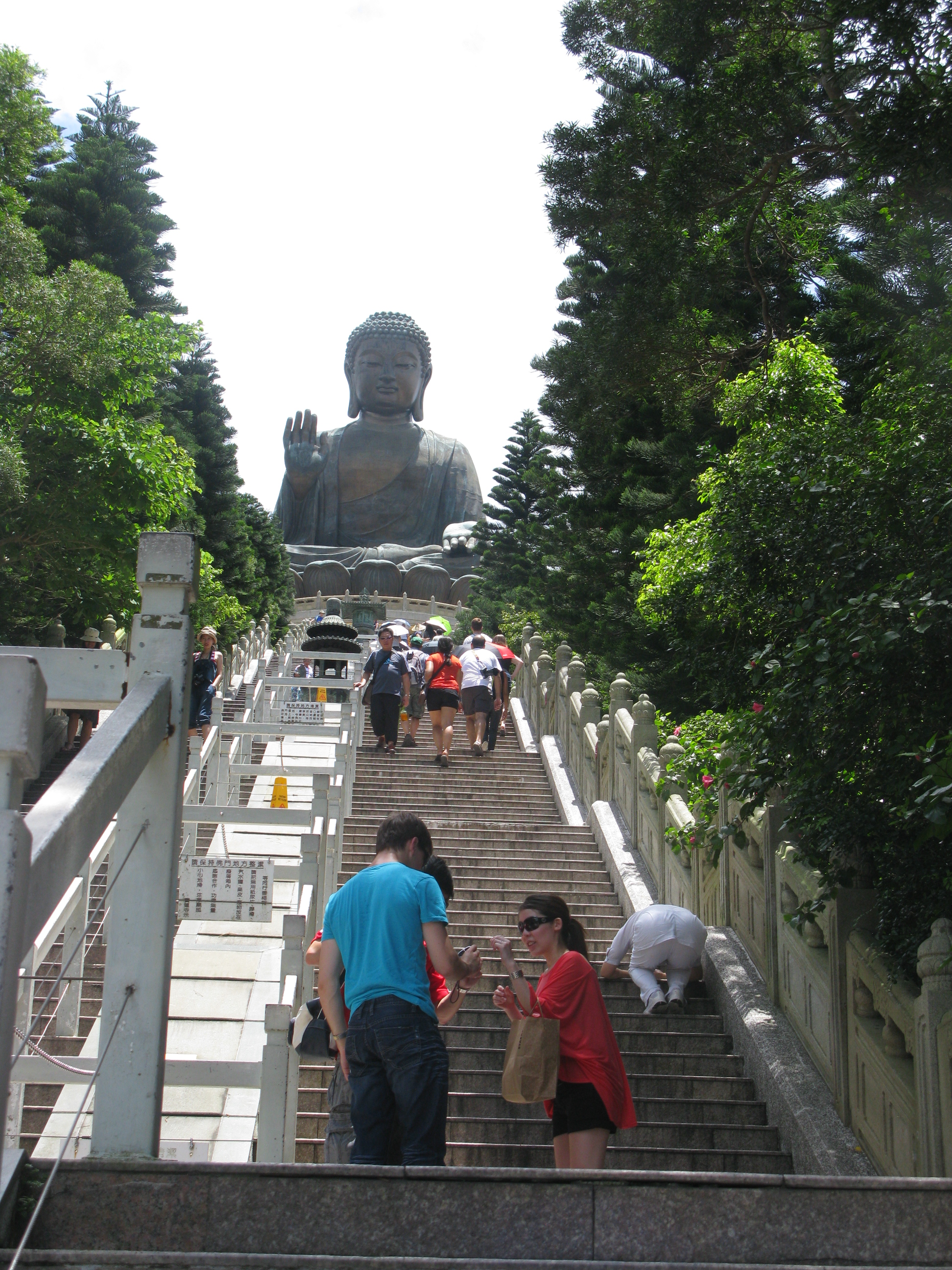
Take it one step at a time to the base of Tian Tan Buddha, otherwise known as the Big Buddha
Ngong Ping’s ‘Chinese-themed’ village, complete with fast food and souvenir stores, were of little distraction. All the consumerism we could handle was back in Mongkok. By mornings we’d shop the markets close to the Langham for fresh oranges, bananas, persimmons, mango, pears, lychees and cherries. By night, we immersed ourselves in Mongkok’s night markets. Nothing quite prepares you for the human tide that flows back and forth down Mongkok’s streets full of merchandise and vendors waiting to haggle: unless you’re a teenager with cash burning a hole in your pocket.
While my wife and daughter disappeared into Tung Choi Street (aka Ladies Street for its clothing and cosmetics), I watched my 15-year-old son Ryan buy soccer cleats and a Liverpool jersey on Fa Yuen Street (aka Sneakers Street, where you’ll find all sporting goods), Dre Beats headphones and iPod case on Sai Yeung Choi Street (an electronics mecca) and two watches on Temple Street (men’s fashions).
“You should buy something,” Ryan told me.
He was right. About 50 cents later I was eating fried squid and spicy fish balls from a food stand. And I didn’t haggle.
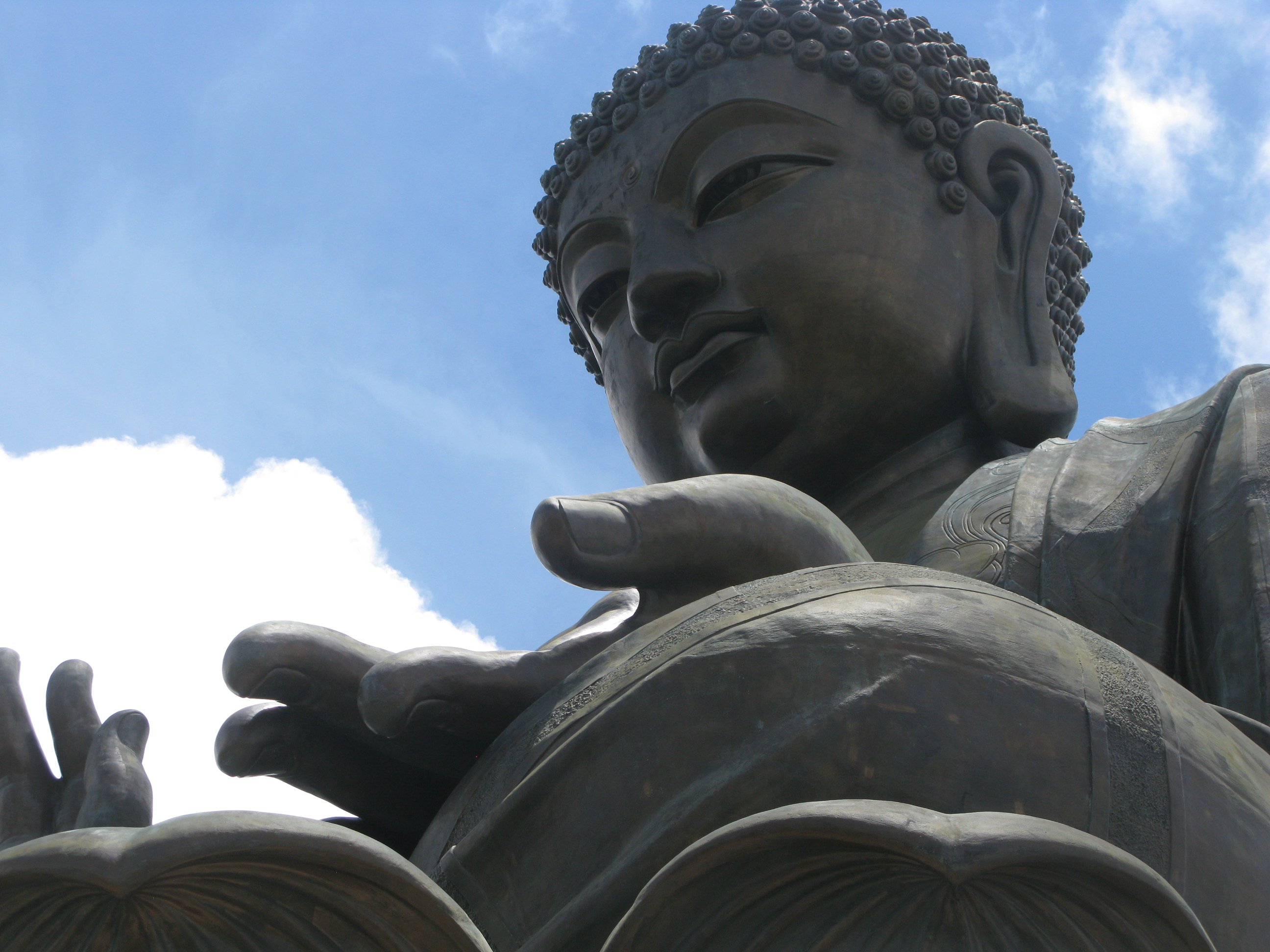
Serenity now with the Big Buddha in Ngong Ping village.
If you go
Langham Place (http://hongkong.langhamplacehotels.com/) might be the only hotel with a pillow menu, (scents include rose and lavender) such is its attention to whims and wishes. It also offers free guided walking tours to acquaint guests with nearby markets, culture and history.
Airbnb.com is an online marketplace for people to list and book unique accommodations worldwide. We followed instructions to text a housekeeper upon landing, and she was there to let us in to our home away from home. It came with everything we needed, including the use of a computer and several of the owner’s local restaurant reviews.
Disney-lovers will find most of their favourite rides at Hong Kong Disneyland, including Grizzly Gultch – similar to Big Thunder Mountain and newly opened this summer. (hongkongdisneyland.com)
For more on Ngong Ping, visit www.np360.com.hk
For more on Hong Kong, visit www.discoverhongkong.com
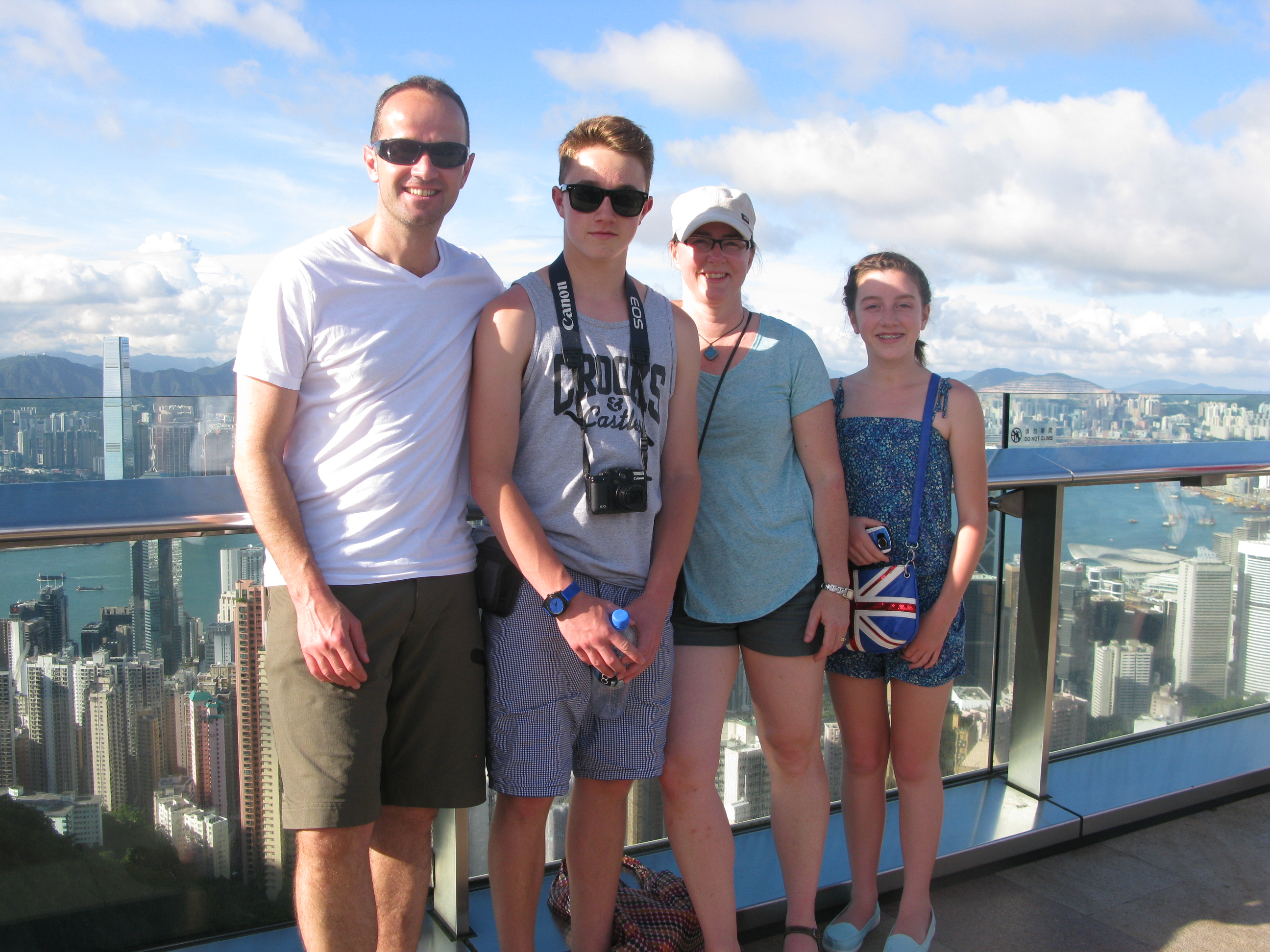
No one in the history of Hong Kong tourism ever thought to take the same photo atop Victoria Peak – seriously!
Cabin fever
Snowshoers make their way to Mount Steele Cabin, one of four cabins built by the Tetrahdron Outdoor Club in 1987. Reynold Schmidt photo

“We came in by the light of the benevolent and gibbous moon waxing to near fullness. The skies were clear and the spirits were high, peeling laughter for 48 hours and sleeping for six.”
– An entry in the Bachelor Lake Cabin, Tetrahedron Provincial Park
Some people move to the Sunshine Coast to get away from it all. The Tetrahedron is where Sunshine Coasters go to get away from it all. Six thousand hectares of mountains, lakes, streams, wetlands and forest, the Tet, as it’s fondly known, has long been cherished by backcountry enthusiasts.
In 1987, a group of those enthusiasts banded together to mobilize more than 200 volunteers, 45 businesses, schools, community groups and several levels of government: their mission, to build cabins linked by a trail network.
Back then, they called themselves the Tetrahedron Ski Club. A quarter of a century later, they’re the Tetrahedron Outdoor Club, a group justifiably proud of the legacy created northeast of Sechelt. Last summer, club members marked the 25-year milestone with dances, parties, pancake breakfasts and numerous trips down memory lane.

Tannis is one of 10 beautiful lakes in Tetrahedron Provincial Park. In June, the lake was still partially frozen.
Now they’re enjoying the snow.
“Early December, after that first big dump of snow; that’s my favourite time to go,” says club president, Reynold Schmidt. “I usually go with club members, friends – before the crowds.”
It’s June when Reynold and I visit Bachelor Lake Cabin, a one-hour hike from the trailhead up Grey Creek Forest Service Road. With snow more than a metre deep in places, I’m grateful for snowshoes. Partially frozen Tannis Lake is a testament to the cold, wet spring endured down at sea level, 1,100 metres below. At least the mosquitoes are still asleep.
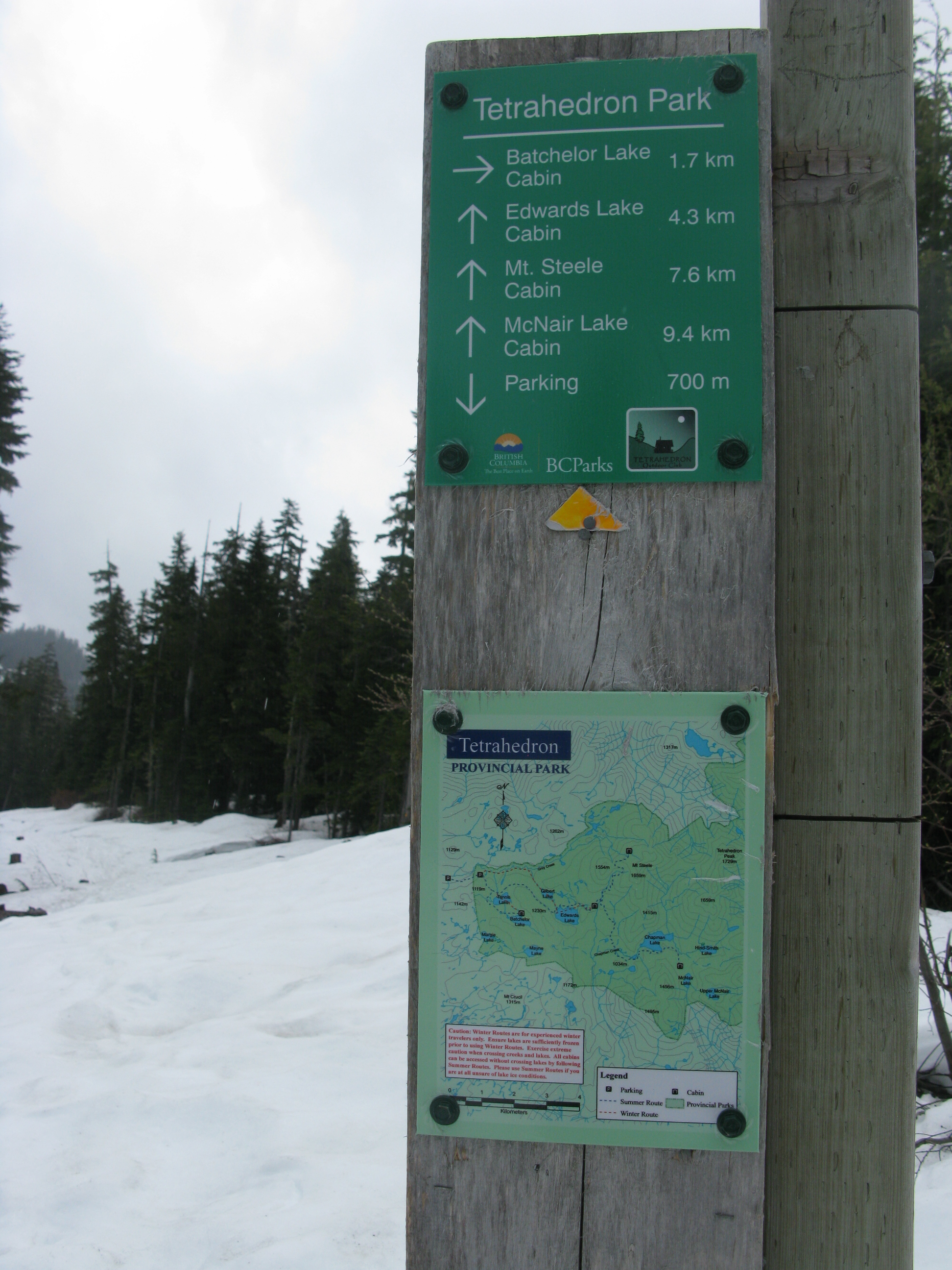
Tannis is one of 10 beautiful lakes in Tetrahedron Provincial Park. There are three mountain peaks – Panther, Steele and Tetrahedron – and some of the oldest trees in the country. Amabilis fir, mountain and western hemlock, yellow cedar and white pine can all be found here. So, too, can the club’s four rustic, two-storey cabins each built to accommodate 16 people – first-come, first serve. They can be reached via a 25-kilometre trail network and are located at Bachelor Lake, above Edwards Lake, between McNair and Chapman Lakes, and below the summit of Mt. Steele.
A 25-kilometre trail network links the cabins in Tetrahedron Provincial Park. BC Parks photo
Inside Bachelor Cabin, we stop for lunch, seated on a long wooden bench at a metal table. There’s a wood stove and firewood. Above us is a sleeping loft with foam mattresses. From the kitchen window, looking across frozen Bachelor Lake, it’s hard to imagine “crowds”. We haven’t seen a soul all day. But weekend and holidays during the winter can be busy at the cabins, confirms Reynold, a natural resource officer with B.C. Ministry of Forests, Lands and Natural Resource Operations.
“We’ve had our problems with vandalism over the years, people coming just to party and not cleaning up after themselves,” he says. “There has been a lot of debate within the club to create a reservation system, but some members are adamant the cabins remain for everyone’s use.”
This year, the club has appointed stewards, two people per cabin, responsible for maintenance and regular monitoring. “They’re regular backcountry users who get to use the lockboxes to store their gear, so they don’t have to carry stuff in each time,” says Reynold.
“It helps dispel the sense that these are party cabins,” he adds.
Naturally, the cabins are there to be enjoyed. How they came to be there is a different story, far removed from pristine mountain air – below sea level in fact!
A basement in Franklin Road, Gibsons, is where George Smith pitched his idea for a cabin and trail network. In 1985, George had skied Mount Steele with his friend Ian McConnell on June 1 weekend. He was struck by the quality of the snow and the potential of backcountry recreation in the area.

Bachelor Cabin, the closest of the four cabins to the trail head.
“The Sunshine Coast was in the midst of an economic depression,” recalls George. “People weren’t exactly light and breezy, but I thought this idea made sense.”
George approached his Franklin Road neighbor, Wayne Greggain, the titular head of the Tetrahedron Ski Club. After a heyday in the late 1960s and 70s, mostly skiing Mount Elphinstone courtesy of a Tucker Snow Cat and 600-foot lift purchased from Hollyburn Mountain, the ski club was all-but defunct by 1985. Wayne agreed to host a meeting of ski enthusiasts in his basement where George explained his vision.
The prevailing mood, recalls George, was: “We don’t know how good an idea this is, but if we don’t do it, someone else might and they won’t do it right.”
The group agreed that if George could secure funding for the project, the ski club would run it as a non-profit. By the fall of 1986, George – then a sometimes reporter with the former Coast News – had secured more than $150,000 in federal funding and another $20,000 from the province.
Yet another Franklin Road resident, Paul Anslow, was contracted to build the cabins at Sechelt airport. The cabins would then be disassembled and flown by helicopter to be reassembled on site. Forestry company, Canfor, and the Sunshine Coast Regional District donated timber, Sechelt Creek Contracting provided logging service, Airspan donated some air time, Gibsons Building Supplies provided crane trucks and the Outdoor Recreation Council pitched in with chainsaws.
A small army of volunteers mobilized to clear trails while 18 people during the course of the project worked on the cabins.
George describes former club president and long-time member, Victor Bonaguro, “a force of nature” who could “build anything”.
“Part of the reason we were able to get funding was because we created an 11-point education plan for the workers, so they would have the tools to go out and find work afterwards,” says George. Aside from cabin-building, workers learned valuable lessons in surveying and industrial and wilderness first aid, thanks to time donated by local experts.
By the time the cabins opened to the public in 1987, the club had raised more than $300,000 for the project. But perhaps more importantly, one great idea had united governments, businesses, and local volunteers in the midst of a recession, no less.
The Tetrahedron was declared a Class A provincial park in 1995. And in 2004, recognizing the year-round activities of its members, the ski club changed its name to the Tetrahedron Outdoor Club.”
“This resource is at least as good today as when it was first built,” says George, who’s still in love with the Tetrahedron.
“I feel lucky. When you walk in a forest that’s never been logged, it just feels different. It’s wonderful to be there.”
- For more information about the Tetrahedron Outdoor Club, visit www.tetoutdoor.ca
- Four-wheel drive and chains are essential for visiting the Tetrahedron. For more information about the park, visit www.env.gov.bc.ca/bcparks
- For an armchair view of the Tetrahedron, visit Coast adventurer Quinn Barabash’s website at captainquinn.com and see his video at captainquinn.com/adventure-video-blog/
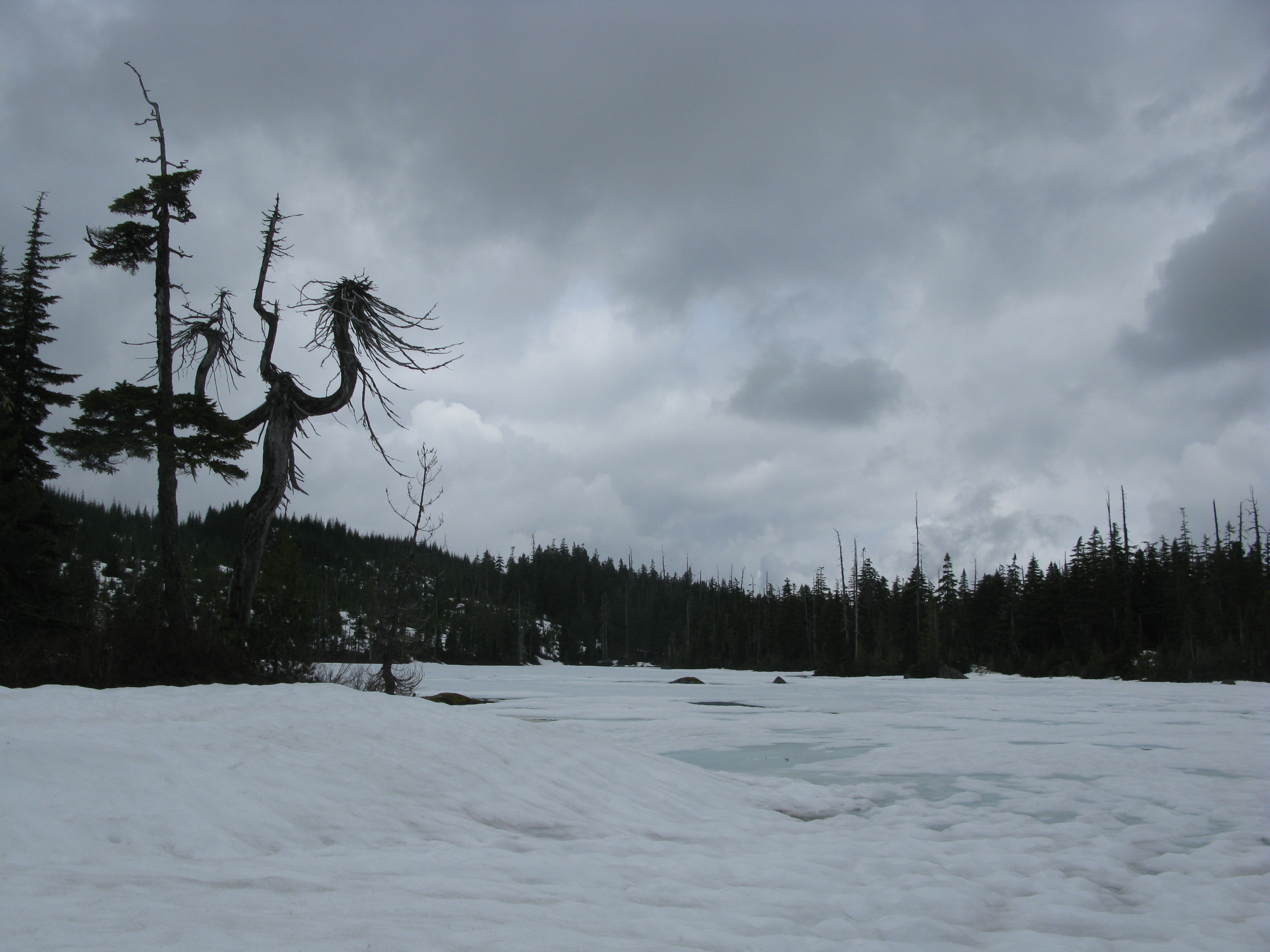
Summer comes late to Bachelor Lake, pictured here in June.
Taking the plunge
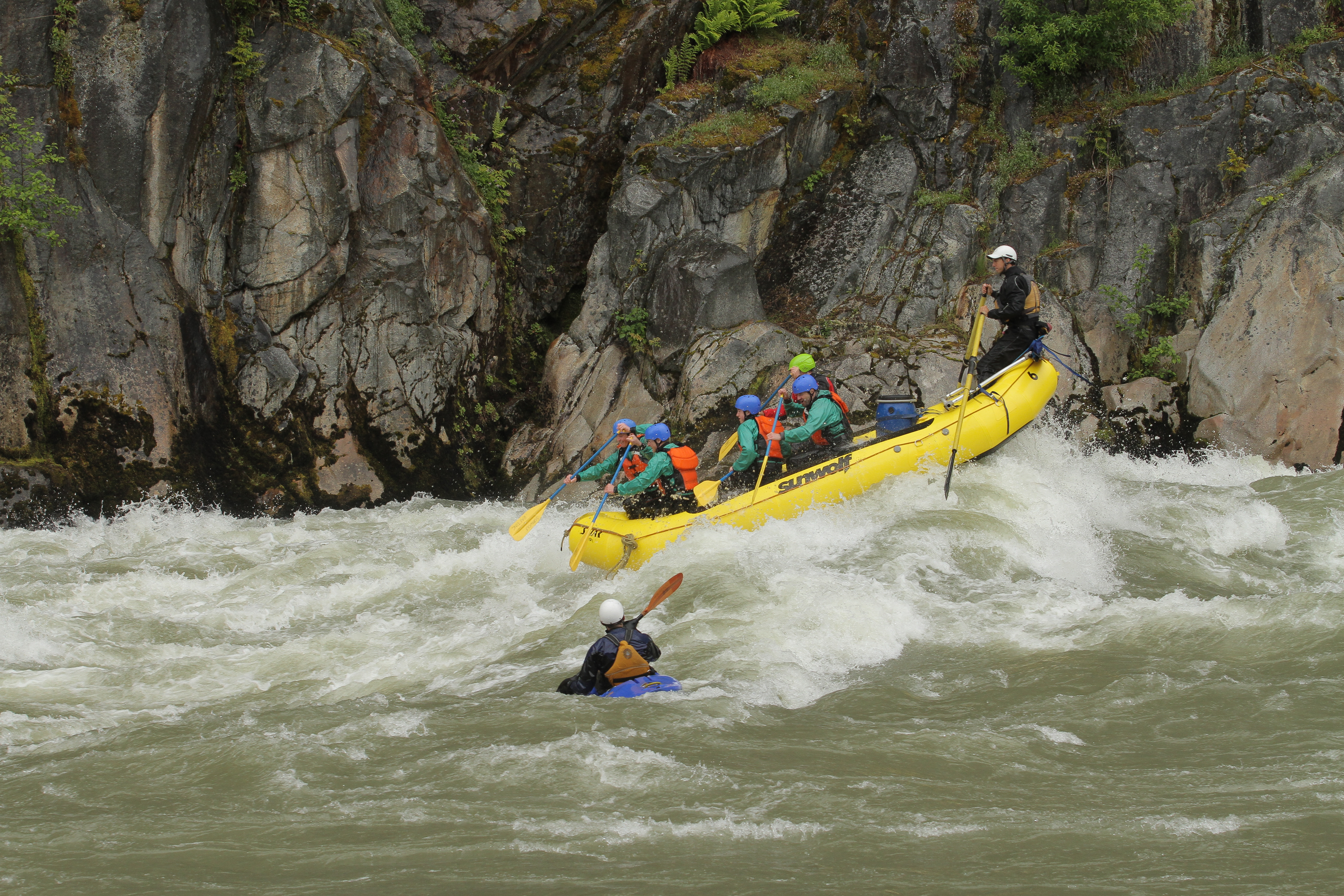
Expert kayaker, Bernardo Barajas, helps guide the Sunwolf raft down the Elaho. Eric Beckstead photos
There was a time when bonding with my son Ryan meant getting on the floor and building a train track. He’s almost 15 and not really into that any more.
Chances are he’s also not into having his dad land on top of him, soaking wet, in a 16-foot inflatable raft. But there we were, a chaotic display of arms, legs, neoprene wetsuits and lifejackets – a triumph of survival over style.
The Elaho River has a way of breaking the ice like that.
The night before we’d come to the Sunwolf Centre at Alice Lake near Squamish. In a cozy little cabin, we’d fallen asleep listening to the rain and the swollen Cheakamus River roaring by. It was still raining the next morning as we ate a huge breakfast at Fergie’s Café.
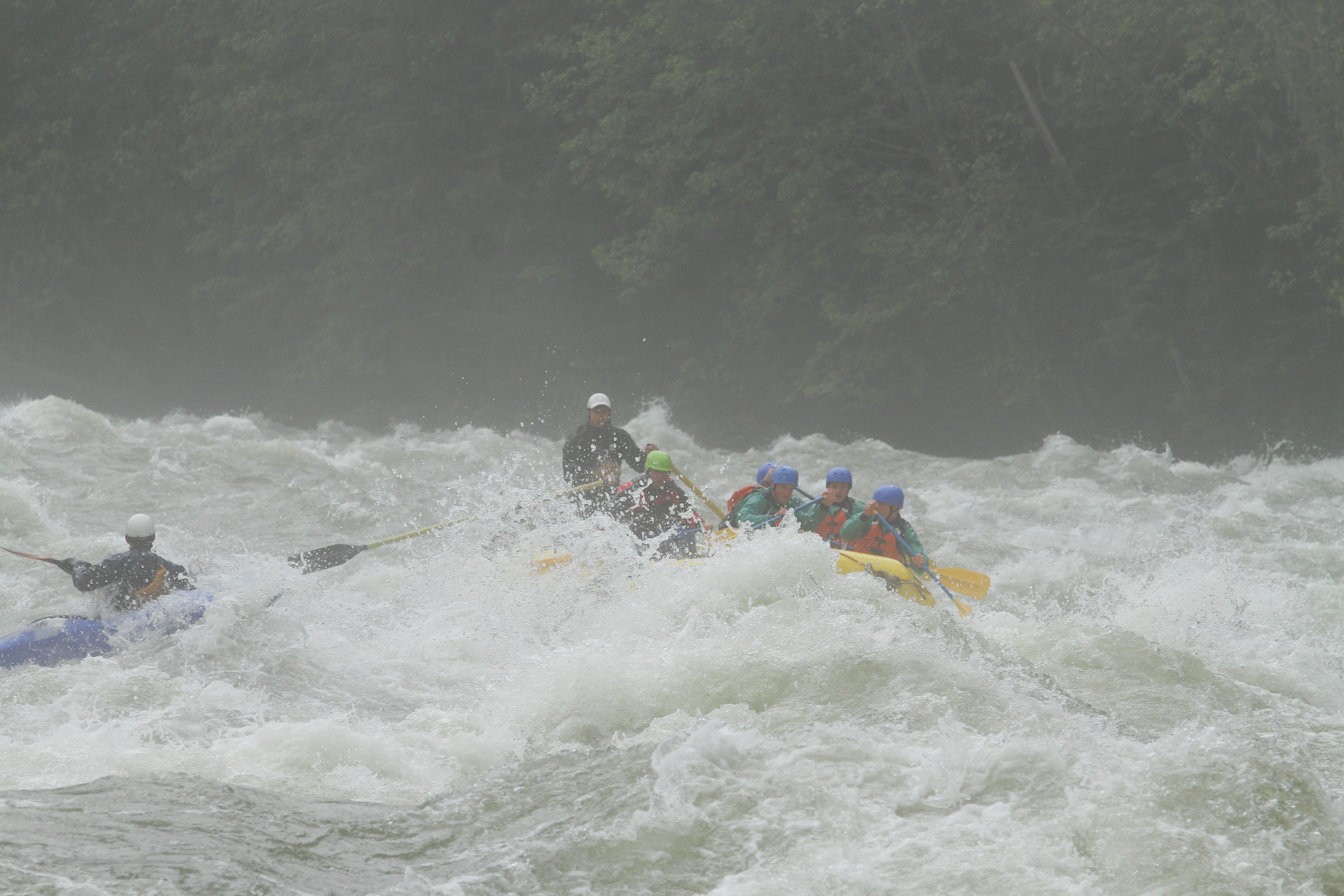
At the stern, guide Bob Vranich and his five-man crew navigate Class 4 rapids on the Elaho.
“The water level’s up 40 per cent over yesterday,” says our guide Bob Vranich with a big smile. “It could get a little spicy out there today,” he adds. For a moment I wish Ryan and I were building train tracks again.
During the hour’s school-bus drive north to the “put-in,” we glimpse the Elaho from the logging road. It looks angry, all foam and froth with some mist thrown in. It feels a bit like driving into a Lord of the Rings movie.
The 18-kilometre stretch of the Elaho we’re to raft features several stretches of Class 4 rapids, Bob tells us. They have names like Cheeseball, Devil’s Elbow, 50-50, and Steamroller. The International Scale of River Difficulty spans Class 1 (easy) to Class 6 (impassable unless you’re Chuck Norris). It defines Class 4 as follows:
Long rapids; waves high, irregular; dangerous rocks; boiling eddies; best passages difficult to scout; scouting mandatory first time; powerful and precise maneuvering required. Demands expert boatman and excellent boat and good quality equipment.
“It’s OK,” I reassure Ryan. “I grew a beard for this.”
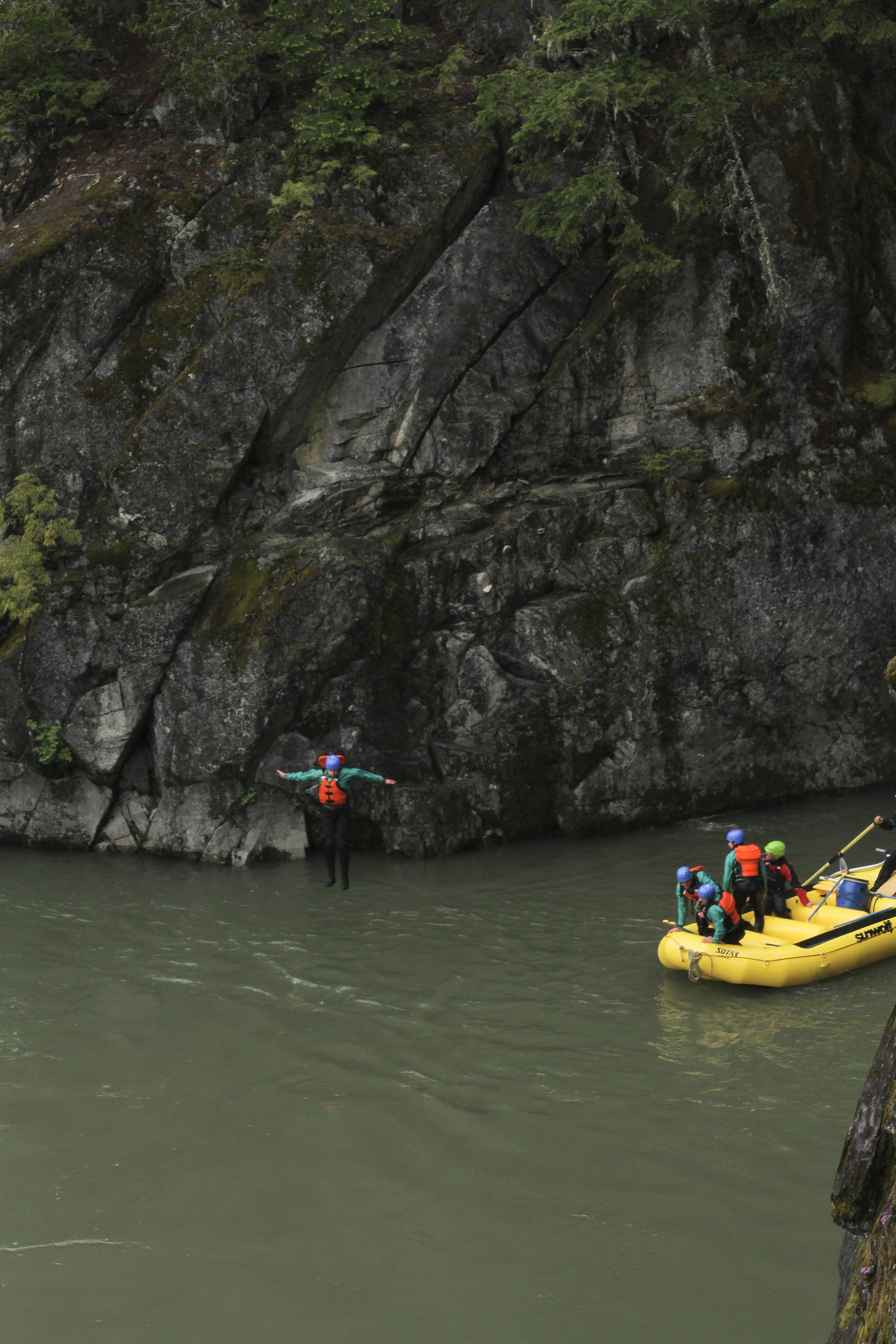
There are few more effective ways to wake up than leaping off a 40-foot cliff into the 4-degree waters of the Elaho River.
More reassuring to both of us is Bob’s track record, and the fact that expert kayaker Bernardo Barajas happens to be a doctor and will be scouting and, if necessary, rescuing. Bob’s in his 10th year of endless summers – raft guiding in New Zealand and Chile during our winters, with spells in Switzerland, Guatemala, India and Nepal thrown in. He’s rafted the Zambezi in Africa, and last month was leading a tour through the Grand Canyon. He has also appeared in National Geographic movies and on Outdoor Life Network TV.
After a lengthy safety talk on land and a quick paddling tutorial in an eddy, we’re finally in the thick of the waves, leaning as far out as we dare and paddling hard. Conditions on the Elaho change daily, and Bernardo is a little way ahead, scouting for debris and signalling to Bob the best passage. Five of us respond to Bob’s steady stream of commands and we paddle our way through Reflection Waves – a knockout combination of waves where the river pummels a vertical wall of rock and rebounds on itself. Then it’s on to Devil’s Elbow, where the river takes a jarring 120-degree turn to the right. I don’t think any of us expected conditions so intense, so soon, but Bob coaches us through the worst of it and into calmer waters.
“This is awesome,” says Ryan quietly with a grin.
Bob wields two massive oars from the stern and steers us towards a large eddy and a cliff face where natural steps lead to a ledge about 40 feet up. Bob invites us to climb up and leap off the ledge. When I realize he’s not kidding, I follow Ryan and the others out of the boat and up to the ledge. I’m sure there’s a lesson about peer pressure here, but Ryan jumps before I can tell him. Legs shaking, I have no choice but to jump, too.
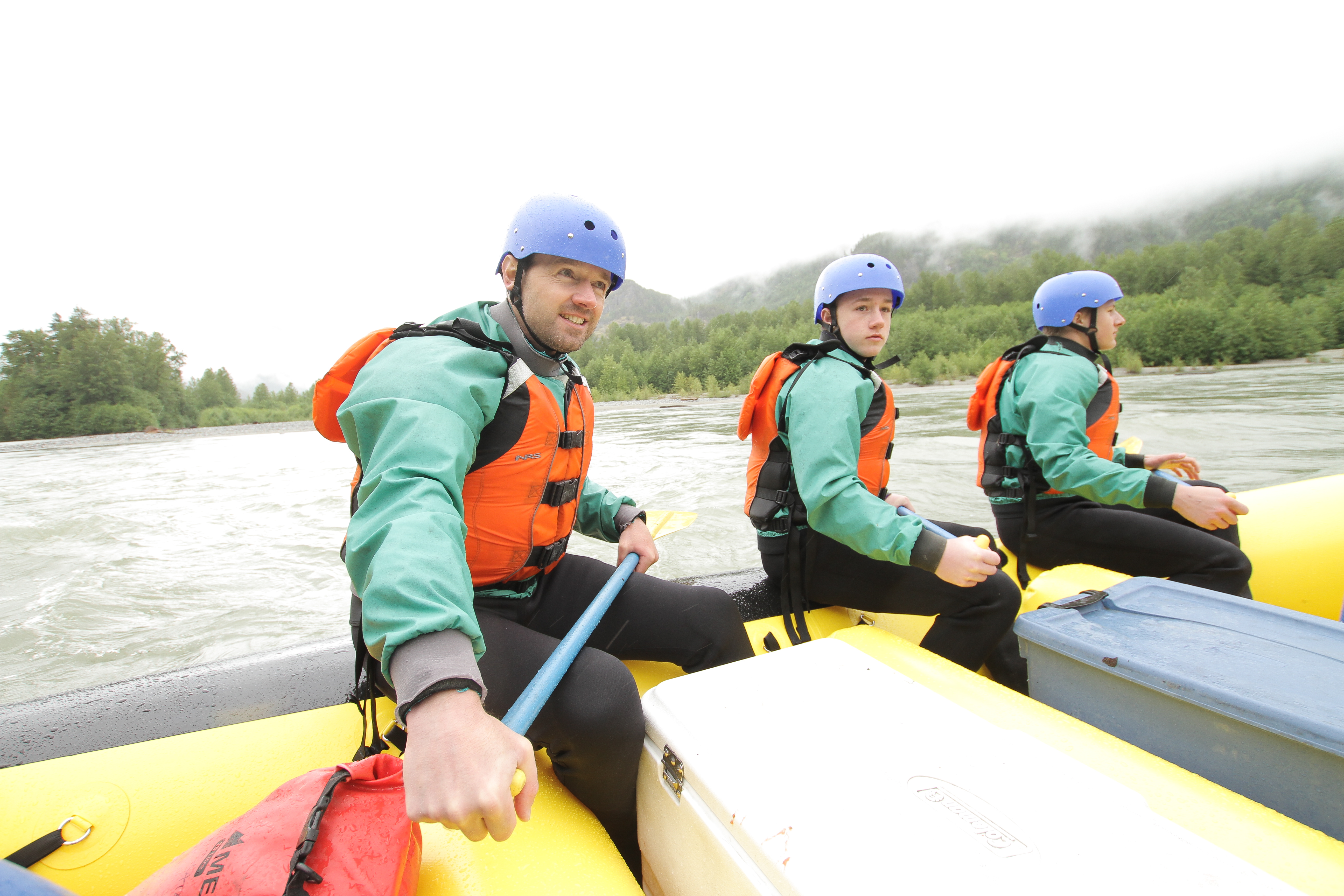
Me and the boy – in our element.
It’s breathtaking, charging all my senses and actually warming me to the core. I’m laughing as Ryan helps pull me into the boat and I fall on top of him. We’ve all taken the plunge and camaraderie replaces any lingering paranoia about falling in.
It’s just as well because more challenging rapids are ahead. But first there’s time for lunch – barbecued wild B.C. salmon with salad, hot chocolate and a fire. On a sandy beach, Bernardo has everything set up for our arrival and we’re glad of the shelter as rain intensifies. The food is every bit as good as breakfast at Fergie’s and welcome fuel for the exertions ahead.
On the second leg of our journey I begin to appreciate our surroundings. Above the cliff faces of the Elaho Canyon and far above the gnarled ranks of fir, hemlock and cedar are numerous silver streaks lining the Tantalus Mountains – waterfalls created by the incessant rain and snow melt. Bob points out Butterfly Falls, a cluster of waterfalls that on windy days evaporate before reaching the canyon floor.
As the mist clears we glimpse the peaks of Mount Caley and Mount Fee. Later we glide past a wall of dirty snow two storeys high, the legacy of an avalanche that carried trees and boulders to briefly dam the river earlier this spring. This trip is equal parts education and adventure.
The adventure returns and mounts steadily through House Rock, Playground, Cheeky Monkey and Little Steamroller – whitewater sections that climax in the main event, Steamroller. It’s the biggest rapid of the trip; a wall of water that Bob had earlier warned us would be as big as the boat is long. It doesn’t disappoint. After skirting an ominous watery hole atop Freight Train rapid, we manoeuvre left, and then right to hit an immense wave called Wu-Tang, head-on.

Behold the Steamroller! Resistance is futile!
As the boat crests we all seem to be paddling thin air before descending like a rollercoaster into a curtain of spray that drenches us all. We might have high-fived but for gripping our paddles so tightly. We’re soon back into rapids named 50-50, (“You don’t need me to explain why it’s called 50-50, right?” shouts Bob, laughing) Tombstone, and Aiden’s Alley. Somewhere in the mix, a wave catches us sideways and dislodges Ryan and me from our seats. Thankfully, we’re sent sprawling into and not out of the boat.
Our final minutes of the trip are spent quietly floating through “the Braids,” a gentle stretch of the river punctuated by fallen trees and gravel bars. It’s a welcome rest.
Back at the Sunwolf Centre, Ryan and I snack on goodies at Fergie’s Café and relive a day neither of us will ever forget. “We should do this again next year,” I say.
“Let’s do it again next week!” says Ryan.
If you go:
A full-day Elaho River expedition costs $155 per person and includes lunch, post-trip snacks, full wetsuit and related gear, plus a professional guide. Participants must be at least 12 years old and weigh more than 90 pounds.
For more information about the Sunwolf Centre and its other trips, services and accommodation, visit www.sunwolf.net or call 1-877-806-8046.
More Eric Beckstead photos, click here.
Whistler spring break for parents: Kids optional
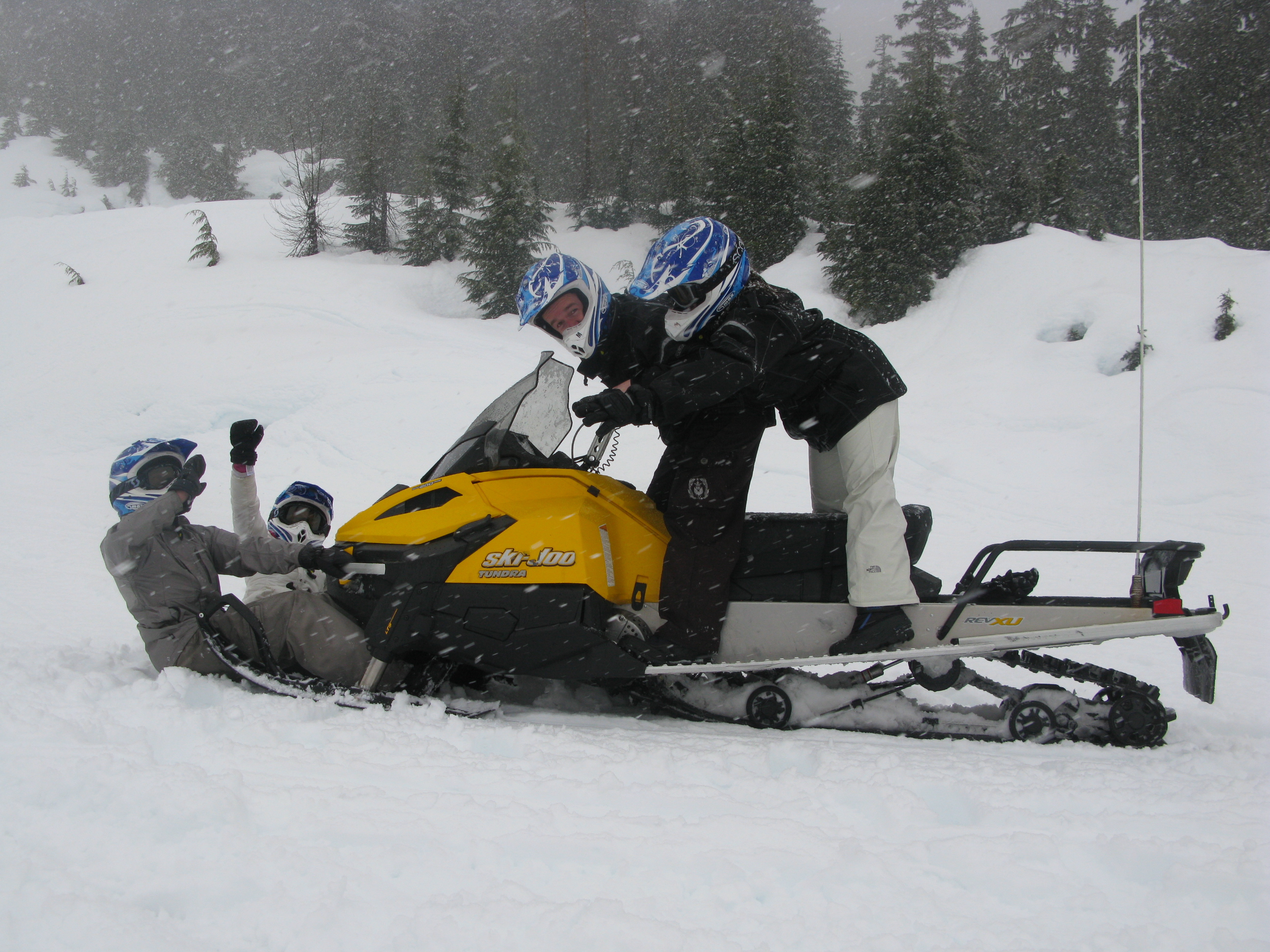
No child was harmed during the creation of this obviously staged photo. (Really.)
What to do with your kids? It’s the theme of every spring break travel story. We all love our kids, but let’s face it, they cramp our style sometimes.
So how about spring break for parents? Have we not earned a little indulgence?
From the poolside hammocks at the Scandinave Spa in Whistler, yes. From the tranquil cross-country ski trails of Callaghan Valley, certainly. From the excitement found atop a throbbing 4-stroke Bombardier snowmobile, hell yeah!
The best part of a trip can be in the planning, but sometimes it’s easier to leave it to experts. Enjoy Whistler offers personalized service to ensure travellers strapped for time can still enjoy a memorable visit, with or without children. In 72 hours, I drove fast, fired rifles, relaxed in a spa and skied till I dropped. I think I may have even had a better time than my kids.
Some of it was hard work though. Take the Biathlon Experience, for example, a two-hour immersion into the oldest winter sport of them all. At the Whistler Olympic Park in Callaghan Valley, adults can try the sport, a combination of cross-country skiing and rifle marksmanship. Aside from one regrettable hunting trip in Ireland 20 years ago (the rabbit got away), I’ve never done either. That was soon apparent to my instructor Antoine, who gently coached me through the finer points of skate skiing. In contrast to classic cross-country skis, skate skis are thinner, trickier, and faster.
“Tougher to learn, but easier to master,” said Antoine, who should know. He started 30 years ago, when he was 22 months old.
After some advice on balancing and edging, I began shifting my weight from side to side, achieving a clumsy version of V-skating – no poles, just pushing off with one ski and repeating with the other. We moved on to the classic diagonal stride, coordinating a forward poling arm with the opposite driving leg. Antoine made it look like ballet, all grace and elegance. I looked like Bambi with haemorrhoids.
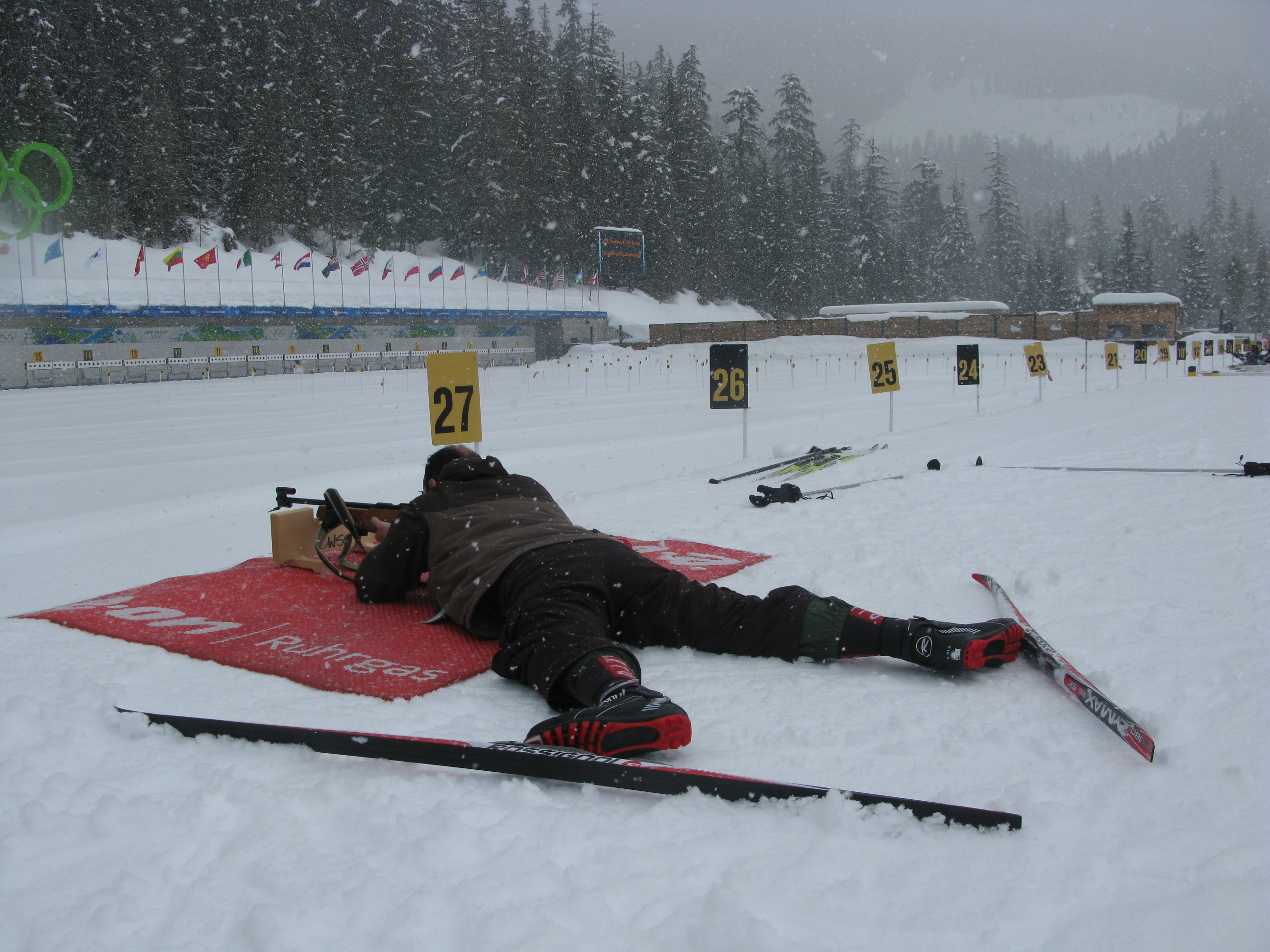
Ignore the snow, gusty winds, racing heartbeat and the burrito you ate for lunch, and just focus on the grapefruit-size target 50 metres away.
I was exhausted by the time we reached the Biathlon Range, where I at least got to lie down. It was the part I’d been waiting for: Firing a 22-calibre rifle.
Antoine demonstrated, telling me to focus on my breathing, and pointing out that with snow and gusty winds, a racing heartbeat won’t improve my chances of hitting a grapefruit-size target, 50 metres away. I hit five out of five. Would the Whistler Olympic Park really go to such lengths to make me feel good?
“The size of grapefruits, you say?” my wife whispered to me later that evening through the mist of a eucalyptus steam bath at Whistler’s Scandinave Spa. It wasn’t a whisper of hushed reverence; in fact I detected a hint of sarcasm. Talking among guests is strongly discouraged at Scandinave, which offers hydrotherapy and massage packages. The hydrotherapy comprises outdoor baths – some hot, some cold – with a sauna, steam room and solarium.
We followed the hot-cold relaxation sequence three or four times, and aside from the occasional gasp in the Nordic plunge pools, we observed the spa’s code of silence. There was plenty of time to talk, back at the Fairmont Chateau Whistler. Our kids were making the most of the hotel’s pools and hot tubs, where silence is discouraged. The hotel is more progressive than most when it comes to children. Not only do its chefs offer a children’s menu that is actually healthy (and delicious), its gym offers guided fitness training for seven to 17-year-olds.

"Yeah, it's Ryan ... wait a second, my dad's taking a picture."
On Blackcomb the next day, my son Ryan explained to me Whistler Blackcomb Live, the new Telus Mobile app. Track your runs using GPS, clock distances travelled, vertical shredded and maximum speeds. As if further proof were needed that Ryan’s cool and I’m not, the app is available on his iPhone, but not on my Blackberry. I was stressed to learn that the app logged Ryan’s fastest speed at almost 80 km/h. But then I’m a 44-year-old dad who skis: As long as Ryan’s mum doesn’t find out, he’ll be fine.
Not that any of us were slowing down the following day. The biggest adrenaline rush of the weekend came courtesy of Canadian Snowmobile Adventures’ Callaghan Cruiser tour. After getting geared up in helmets, gloves and heavy waterproof jackets, our guide Morgan gave us a detailed safety talk about the Bombardier snowmobiles and the conditions ahead. The engine sparked to life, and I was actually a little nervous until Ryan leaned into my ear and told me to step on it.
The Callaghan Cruiser tour may be billed as ‘family friendly’, but I still felt just slightly rebellious whizzing around wide and winding trails in a blizzard. We followed our guide Morgan to a frozen lake near Northair, a former gold mine, where we could really let loose on the wide-open flat.
The snow fell as thick as the traffic we encountered on the drive back to Horseshoe Bay. The backcountry snowmobile route might have been quicker. Not to mention more fun!
- Enjoy Whistler specializes in planning and booking the perfect Whistler vacation. Find a lower price within 72 hours of booking your reservation and Enjoy Whistler will match it and refund the difference, or cancel your reservation without penalty. Call 1 888 882-8858 or visit www.enjoywhistler.com
- For more details about spring-ski packages at Fairmont Chateau Whistler, visit www.fairmont.com/whistler
White and wild on Dakota Ridge

If cross-country skiing is a little slow for you, tobogganing should get your adrenaline racing on Dakota Ridge.
Forty minutes ferry-ride from West Vancouver, the Sunshine Coast is better known for The Beachcombers, scout camps and verdant shorelines. People don’t typically associate this 140-kilometre peninsula with snow. But there it is, several feet of the stuff, just waiting to be played in.
You just have to look up.

There's cross-country skiing for all ages on Dakota Ridge.
Poking through the clouds about 1,200 metres above the beaches and pretty parks is Dakota Ridge, one of the best cross-country ski destinations in the last place you’d expect to find it. Between November and March, if it’s raining at sea level, there’s a good chance it’s snowing up there.
And it’s only a 20-minute drive from sea level.
“You can come up for a couple of hours and be in a completely different world,” says Craig Moore, a cross-country skier and long-time member of the Dakota Ridge Winter Recreation Society, a non-profit group working to promote the area. “For cross-country skiing it beats anywhere on the west coast.”
It’s pretty good for tobogganing and snowshoeing, too.
A 620-hectare (1,532 acres) plateau atop a working watershed, Dakota Ridge offers a rolling landscape of stunted old growth hemlock and yellow cedar. On a clear day you can see the North Shore mountains, the Gulf Islands and Vancouver Island beyond – even Mount Baker down in Washington State.
There are 13 kilometres of groomed trails for cross-country skiers on Dakota Ridge.
Cross-country skiers will find 13 kilometres of groomed Nordic trails, all of them signposted and colour-coded according to degree of difficulty. Professional engineer Reidar Zapf-Gilje, who prepared Callaghan Valley’s 2010 Nordic Olympic course, designed Dakota Ridge’s trail network.
“In many cross-country skiing areas you’re skiing through woods and you don’t see too much,” says Zapf-Gilje.
“Dakota Ridge is way up there in terms of esthetics. Its real strength is its potential for recreation and citizen [cross-country] races.”
Jamie Mani hopes that potential will be realized. Mani owns Alpha Adventures, a Wilson Creek outdoor-adventure store specializing in guided snowshoe and cross-country ski touring on the Ridge.
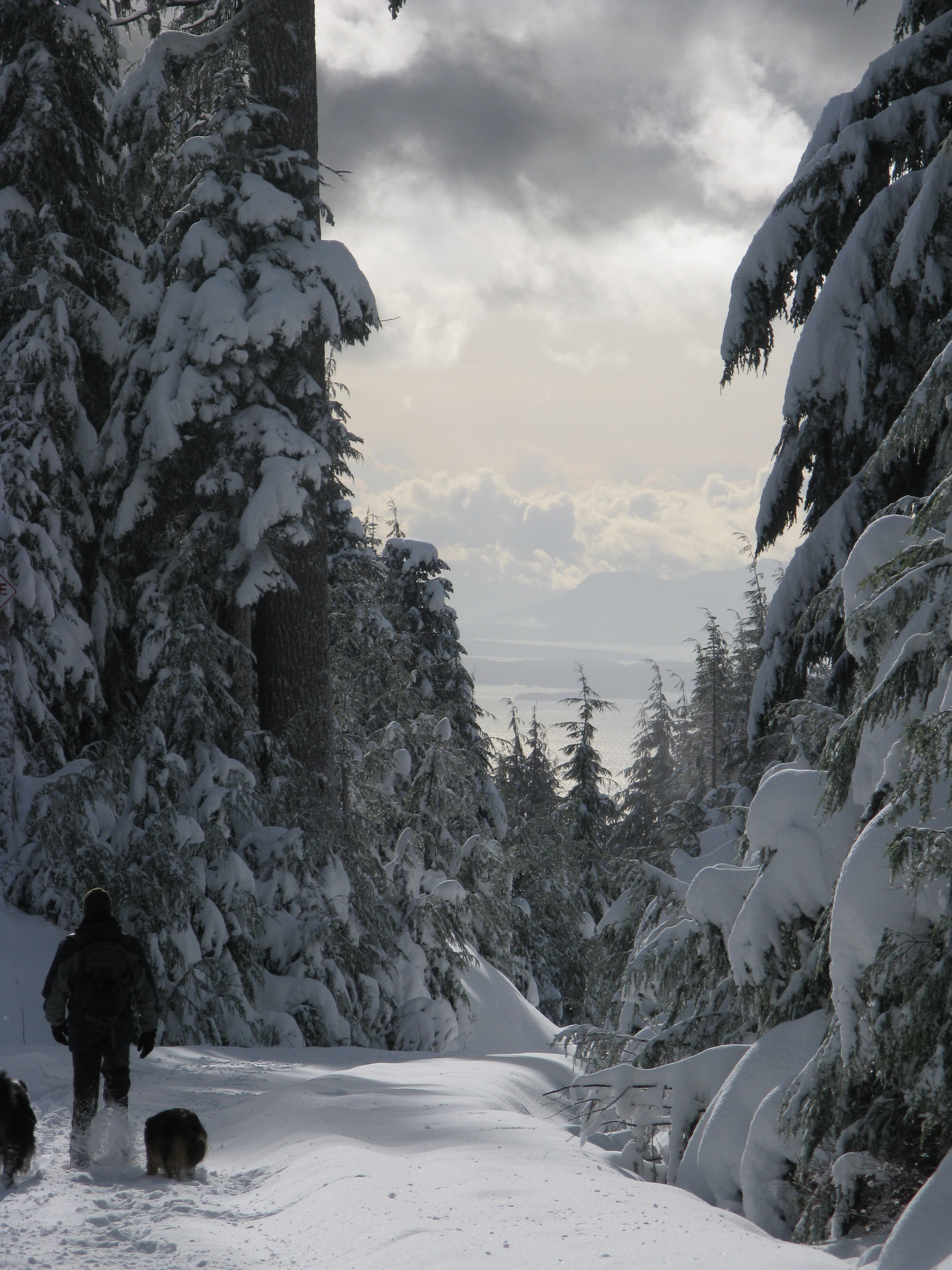
When it's not snowing, the views from Dakota Ridge can be spectacular.
“One of the great things about this place is its proximity to so many other activities,” says Mani. “Someone can literally be out snowshoeing in the morning up in the mountains and then golfing or kayaking in the afternoon.
“And for Nordic skiing we have excellent potential because of great snowfall and a blend of flat and rolling trails. We have been skiing on the Ridge as late as May in previous years.”
Snowshoers will find their own trails and there’s plenty of room for hiking and tobogganing. You’ll find a parking lot, warming hunt and toilet at the trailhead.
The turnoff for Dakota Ridge is at the top of Field Road in Wilson Creek, about half way between Gibsons and Sechelt, and 20 kilometres drive from BC Ferries’ Langdale terminal. For many years, the unplowed access road to Dakota’s trailhead made it a ridge too far for some. In recent years the 11-kilometre road has been upgraded to allow for regular plowing, but four-wheel drive vehicles equipped with chains are still the way to go.
Or take advantage of Alpha Adventure’s shuttle service.
- To learn more about Dakota Ridge, visit http://www.scrd.ca/Dakota-Ridge
- For road updates and snow conditions on the Ridge, visit www.suncoastcentral.com/outdoor-reports.asp.
- To book cross-country ski lessons, a guided tour, equipment rentals or shuttle service up to Dakota Ridge, call Alpha Adventures at 1 604 885-8838 or visit www.outdooradventurestore.ca
Vicious cycle: Biking the Big Apple’s core and beyond

You try and raise your kids right - Minutes into the Five Boro bike ride and Emma's nabbed by NYPD.
F. Scott Fitzgerald loved Manhattan. In The Great Gatsby, he described its “first wild promise of all the mystery and all the beauty in the world,” when viewed from the Queensboro Bridge.
Chances are Fitzgerald wasn’t crossing the Queensboro on a bike when he wrote those words.
With 30,000 other cyclists.
In the pouring rain.
I looked back at Manhattan over a river of bobbing bike helmets on the Queensboro Bridge and saw imposing shades of grey, the tops of skyscrapers concealed by even greyer clouds.
It was Kilometre 24 of New York’s annual TD Bank Five Boro Bike Tour, a 68-kilometre celebration of car-free cycling through Manhattan, The Bronx, Queens, Brooklyn and Staten Island. The week before, temperatures hit 32 degrees Celsius. Today, the day of the big ride, the reason we’d trained together as a family, our motivation for flying almost 4,000 kilometres to New York, the mercury was barely nudging 10.
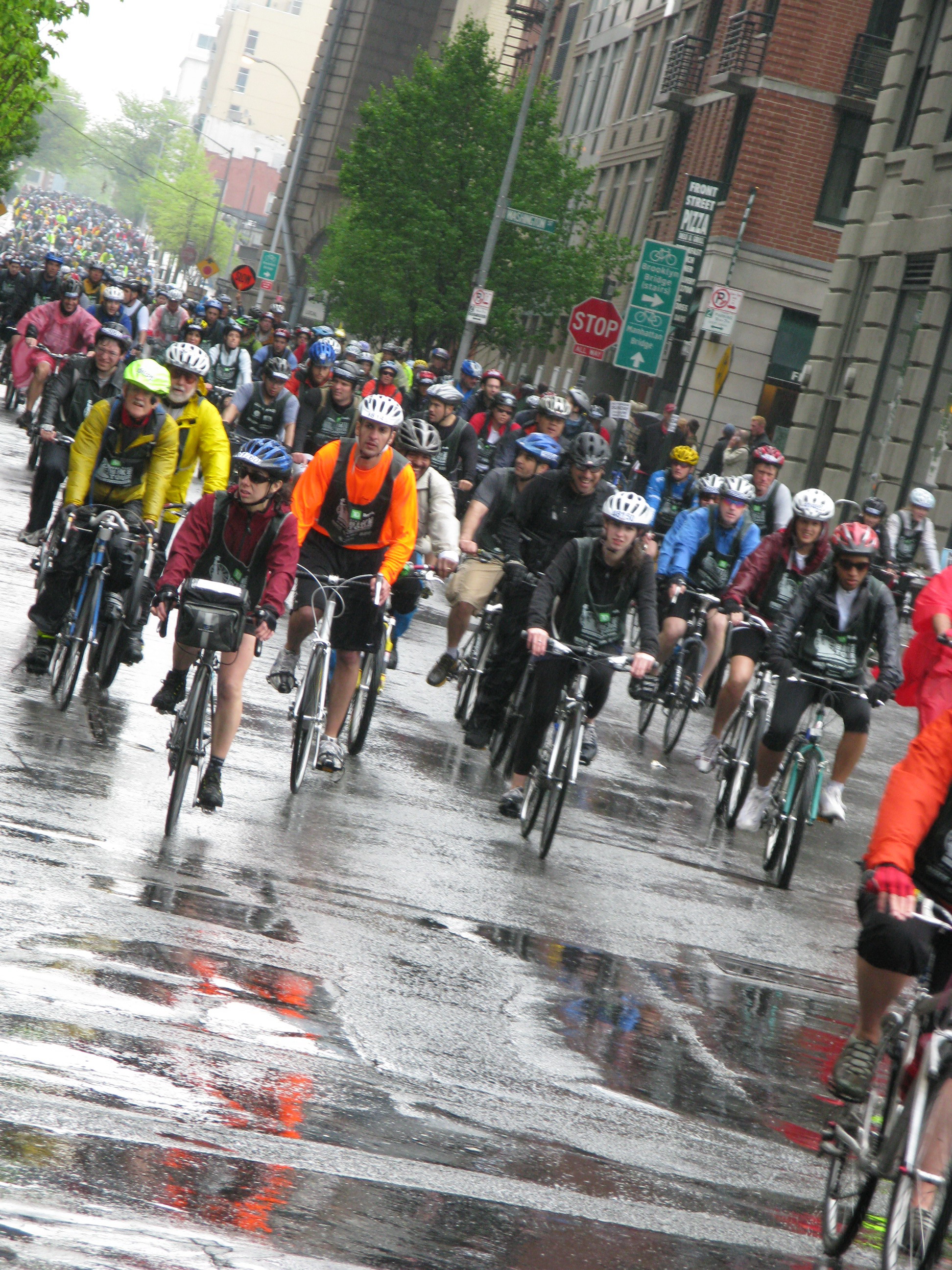
30,000 cyclists brave the rain in New York's Five Boro bike ride.
“This is actually fun,” said my daughter Emma, without even a hint of sarcasm. “Really!” she added, registering my look of disbelief.
Emma was clearly enjoying being the centre of attention as one of the tour’s younger participants. Soon after our 8-a.m. mass start from Battery Park and ride through the concrete canyon of Sixth Avenue, she’d been noticed by three NYPD bike cops as we snaked through Central Park.
“Hey, look at that kid, she’s barely breaking a sweat!” shouted one.
“What’s your name kid?” shouted another. “Well, listen Emma, don’t be thinking of beating us to the finish line, Emma. We can ticket you.”
We seemed destined to bump into the trio throughout the day, despite the numbers of riders involved and the distance covered. Accommodating 30,000 cyclists through New York’s five boroughs and across five major bridges must be a logistical minefield.
The fact that the tour has been staged annually since 1977 surely helps, but it’s only in recent years the city has begun to embrace bike culture on the other 364 days of the year. New York has expanded its urban bicycle network by 320 kilometres since 2006 while the number of New Yorkers commuting by bike has doubled in the last six In one of the busiest cities in the world, home to seven million people and 13,000 honking yellow taxi cabs, where rush hour starts at 5 a.m. and finishes about 15 hours later, riding a bike here is not as intimidating as you might think.
The day before the Five-Boro Bike Tour we had rented bikes from Liberty Bicycles five blocks south of Central Park. With some trepidation we cycled our aluminum hybrids west to the Hudson River Greenway, the longest stretch of a series of bike paths that circle the island of Manhattan. While busy with walkers, joggers and inline skaters, the greenway with its dedicated lanes and traffic signals is a great place to get acclimatized to biking in New York.
And after our first two days spent hopping on and off open-top buses visiting the Big Apple’s more obvious attractions — Empire State Building, for example — we felt a little less like tourists. (You can hardly visit New York and not visit such places, but be prepared for long lineups and short tempers.)
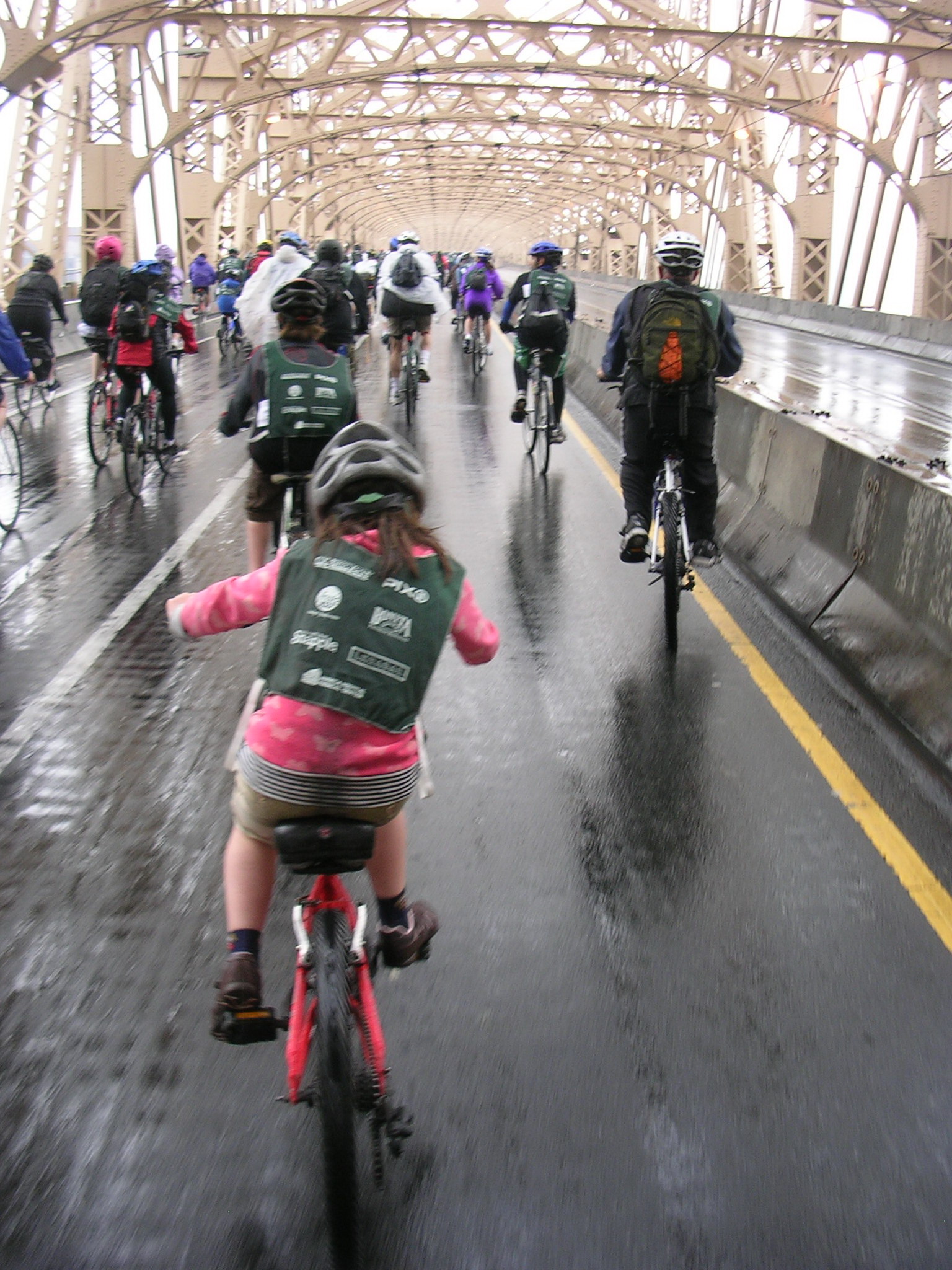
Crossing the Queensboro Bridge, over a century old, much loved by F. Scott Fitzgerald and made famous by Simon and Garfunkel’s 59th Street Bridge Song (Feelin’ Groovy).
With the eight-lane Joe DiMaggio Highway rumbling just a few metres to our left, it felt good to be setting our own pace, gliding south along the Hudson River past waterfront tennis courts, batting cages and soccer fields, piers and playgrounds. We had little trouble navigating the older, narrower streets of Greenwich Village, where we hooked up with a two-wheeled tour conducted by Levi Zwerling and Bike The Big Apple.
The company takes small groups of cyclists beyond the tourist trail through New York’s diverse neighbourhoods.
Nowhere epitomized that more than the Bedford- Stuyvesant neighbourhood in Williamsburg, Brooklyn, where we cycled empty streets in eerie silence.
Home to a burgeoning population of Satmar, a Hasidic movement of mostly eastern European Jews who survived World War II, this well-kept community of row houses and apartments might just be the quietest place in all of New York’s five boroughs during Saturday sabbath. Conservatively dressed families, distinguished by men wearing oversized fur hats called shtreimel, ambled along the sidewalks ignoring the less modestly clothed cyclists in their midst.
By contrast, we stopped for a noisy lunch and beer-tasting at the Brooklyn Brewery, whose 150-year-old premises have been restored to their original bare brick and timber finery.
Various estimates put the number of community gardens in New York at more than 600, with 10 per cent of those located in the hip East Village and Manhattan’s Lower East Side. We paused to admire one, only for two of its creators to stop by and supplement Levi’s tour with their own version.
“That happens a lot in the East Village,” said Levi with a smile.
The ride back to Manhattan across Brooklyn Bridge’s busy boardwalk proved to be the most hair-raising part of the day. As we weaved in and out of pedestrians, clearly we no longer thought of ourselves as tourists — or at least not the kind of tourists who wander in and out of bike lanes. (Think Stanley Park seawall on any summer weekend.)
The experience helped prepare us for the Five Boro Bike Tour, which required plenty of weaving with almost 30,000 companions jockeying for space. While we passed expensivelooking Cannondales, Cervélos, Konas and Bianchis all requiring various repairs — usually flats — our trusty rentals kept us moving through the Bronx where churchgoers smiled at us in sympathy as the rain intensified.
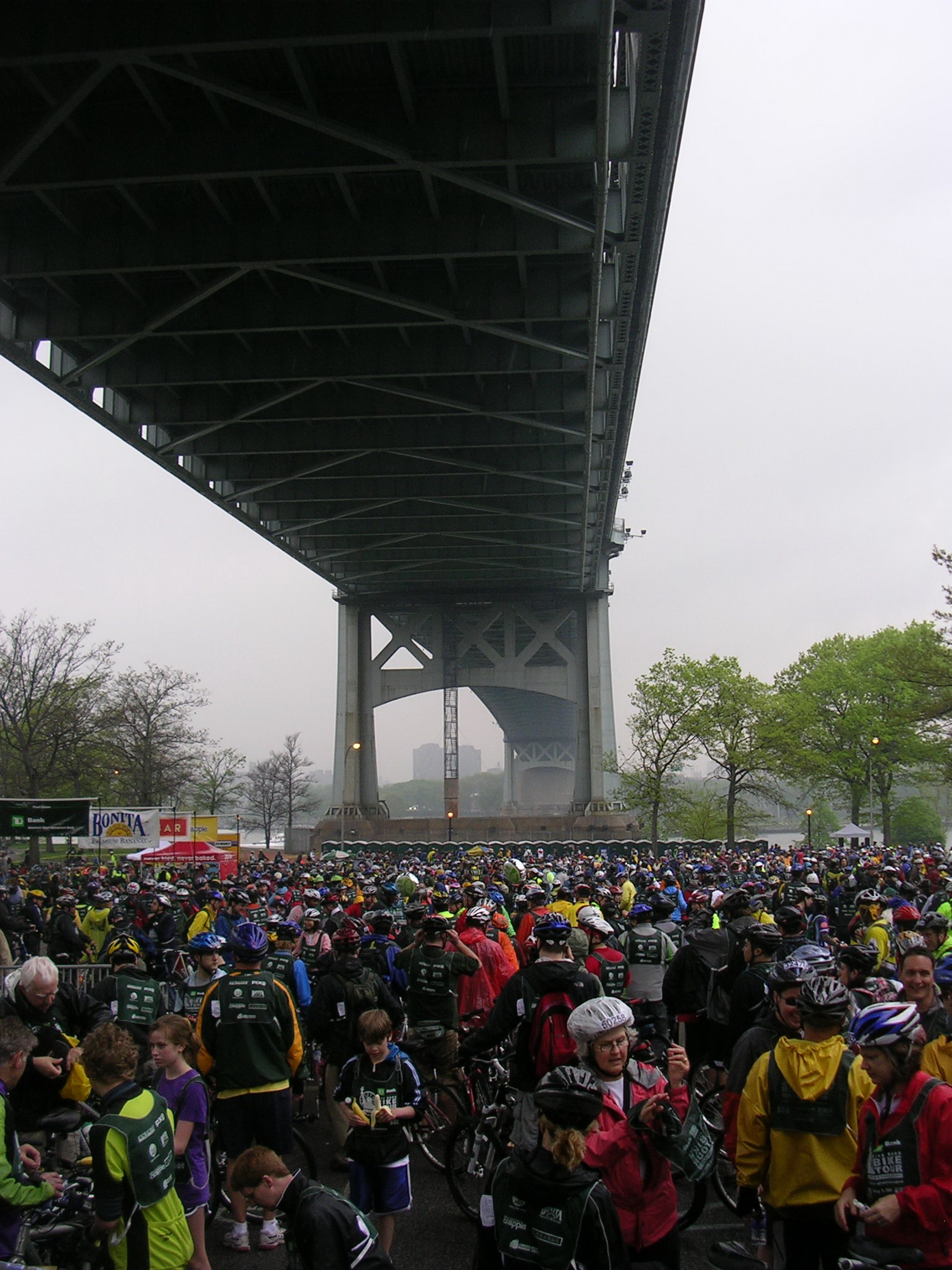
Oh, the humanity! Bikers take cover under the RFK Bridge in Astoria Park during the TD Bank Five Boro Bike Tour.
In Queens we took refuge from the elements at Astoria Park under the RFK Bridge with thousands of other soaked riders. In the trendy Brooklyn neighbourhood of DUMBO (Down Under the Manhattan Bridge Overpass) at Kilometre 43 we fell inside a busy Starbucks for a family meeting to answer the following:
Quit the tour here and shortcut to our hotel for hot showers and hot food, or slog on through the deluge to the Verrazano Narrows Bridge and the finish with everyone else at Staten Island?
“We’re going to come last if we stay in here all day,” said Emma, who clearly had decided on behalf of the family, much to her brother Ryan’s irritation.
So it was with some pride the Judd parents watched their kids high-five each other at mid-span of the Verrazano, once the world’s largest suspension bridge and closed to bikes on all but this day of the year.
Close ahead and all downhill was the finish at Staten Island.
Seven hours earlier, back in Manhattan and still half asleep, we’d cycled down Broadway and through Times Square (on a designated bike lane, no less!) to the starting line at Battery Park.
From here on the Verrazano, the city’s said to look spectacular on a clear day. Pelted by torrential rain and surrounded by leaden clouds, the view we got was lousy.
And we didn’t care.
If you go:
Bike New York organizes the annual TD Bank Five Boro Bike Tour and has a wealth of information on its website (www.bikenewyork.org) for anyone planning to cycle in the Big Apple. While the Five Boro tour is the biggest event of its kind in the U.S., Bike New York also stages smaller rides throughout the year, details of which you’ll find on its website.
Otherwise, to plan a twowheeled adventure in New York, visit nyc.gov/dotnews and click on “Bicyclists” on the left-hand side. There you can download or order the comprehensive New York City Cycling Map. Not only does the map illustrate the routes to ride, it also lists dozens of bike rental stores throughout New York’s five boroughs.
We rented reliable adult and children’s bikes from Liberty Bicycles (libertybikesny.com or 212 757-2418) in Midtown Manhattan (9th Avenue and 55th Street).
Bike The Big Apple (bikethebigapple.com or 1 877-865-0078) offers several different guided tours throughout the week and can tailor tours to suit individual requests.
New York offers hundreds of hotel options, but hotels that accommodate bikes are harder to find. The Buckingham Hotel (888 511-1900), two blocks south of Central Park, is well located and bike friendly.

After a long, wet bike ride, nothing aids recovery quite like new sun glasses.
We found New York’s subway system to be safe, reliable and relatively affordable at $2 a trip or $7 for a day-pass.While Manhattan is a great place to walk and browse, with a little planning you can easily navigate via subway between the city’s major sights. Hop-on, hop-off double-decker bus tours operated by CitySights NY (citysightsny.com) hit the highlights for $44 (adults) or $34 (children from five to 11) for a 24-hour period.
In the same vein, New York’s CityPass (citypass.com) at $79 (adults) or $59 (youth, 13-17) will buy you entry to six main attractions, including the Empire State Building observatory. It will also get you to the front of most lineups. For detailed tourism information, including the city’s calendar of events, visit nycgo.com
 Nev Judd: Online and out there