Archive for the ‘Sunshine Coast’ Category
Brewed Awakening: A tale with a hoppy ending
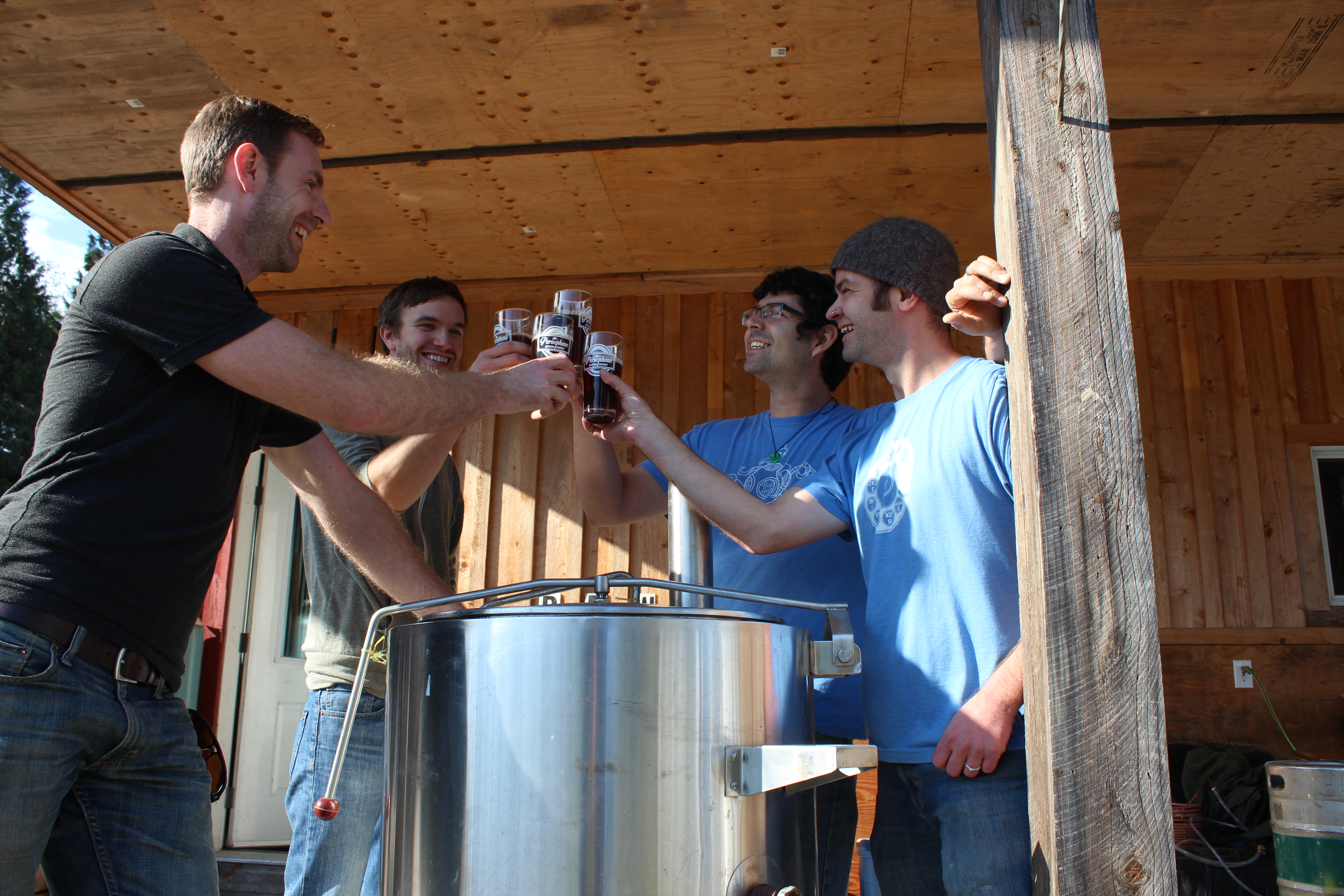
From left, Matt Cavers, Amos Harding, Monte Staats and Matt Thomson of the Gibsons Homebrewing Network are tireless in their pursuit of the perfect brew.
“Beer is proof that God loves us and wants us to be happy.”
― Benjamin Franklin
Jeff Hay-Roe’s brewery is a tribute to improvisation. On a long dining room table adjacent to the family kitchen sit a mash tun, a plastic fermentation bucket, a glass primary fermenter, a copper manifold, a grain mill, a strainer and a few packets of malt and hops. Outside is a kiddie pool, but we’ll get to that later.
“My set-up is pretty ghetto, but it works,” says Jeff, who estimates his brewery cost about $200. He started brewing from kits 10 years ago, but switched to brewing from scratch about three years ago. “My family is very supportive of me in my hobby. It’s only a couple of the kids that seem to not like the smell on brew day, but my wife likes it and most of the kids don’t mind it.”
That’s probably just as well. Jeff has nine kids.
Perhaps inspired by a wider appreciation for craft-brewed beers across B.C., (or perhaps because of the price of them) Jeff is among a growing number of homebrewers here on the Sunshine Coast and elsewhere. In an interview shortly before his death this summer, Dan Small – an icon of Vancouver’s homebrew scene and owner of Dan’s Homebrewing Supplies – had this to say about homebrewing in B.C.
“Man, in the early 90′s people just didn’t know or care anything about beer. It was tough trying to convince Kokanee drinkers to make stout. Things are much, much better now.”
On the Sunshine Coast, a thriving homebrewers’ network has quickly formed ties with the Coast’s newest craft brewer, Persephone Brewing Company in Gibsons. Persephone allows homebrewers to meet and brew on the premises and employs some of its members.
To understand the appeal of homebrewing, Jeff Hay-Roe’s two-storey Gibsons home is a good place to start. Brew day comes around once a month. For about six hours, the kitchen and dining room are requisitioned and the stove is monopolized to boil 30 litres of fluid; that’s the fluid previously separated from a porridge-like mix of grains and water with the copper manifold Jeff designed himself; the same fluid that’s been held at a high temperature for an hour so the enzymes in the grain can convert the starches to sugars. That would be the grain Jeff grinds from kernels in a converted mill operated with a drill connection, not a handle.

Prolific homebrewer Jeff Hay-Roe with his award-winning London Town Brown Ale.
“We’ve got a stove-type burner on our barbeque, so I often boil kettles for people out on the barbecue on brew day,” says Jeff.
Hops are added to the fluid boiling away in two pots on the stove, starting with bittering hops then flavor and aroma hops towards the end. An hour of boiling turns 30 litres of fluid into 24 litres of wort. “Six litres evaporate in my kitchen each time,” says Jeff.
“After the boiling’s done it’s important to cool it down immediately,” says Jeff.
A lot of people use coiled immersion chillers, says Jeff. “I put mine in a kiddie pool of cold water.”
Once cool, the wort is poured into the fermenter where yeast performs its magic and fermentation occurs. About 10 days later, Jeff bottles his brew, usually a batch of 70 bottles (each 350mls).
“I always have about eight varieties in the fridge,” says Jeff. “I always like to have a pale ale, a Belgian Blonde ale, a southern English Brown Ale …”
Jeff’s resourcefulness is by no means at the expense of quality. Earlier this year, his London Town Brown Ale won a contest run by Vancouver’s Alibi Room, Howe Sound Brewing and VanBrewers, a non-profit group of homebrewers in the big city. He won a night at the Howe Sound Brewery, participated in brewing a 2,300-litre batch and saw his beer sold in Sunshine Coast private liquor stores.
He’s won prizes for his Belgian Blondes, too. But he readily admits that he’s entered beers in other competitions without success. Winning’s satisfying, says Jeff, but so too is the brewing and the tasting.
“The process I really do enjoy,” he says. “I love the creativity; it’s interesting to see it all happen. You start with something resembling porridge; then there are the different smells all the way along and it ends with something sweet.”

So this horse walks into a bar …
Sharing the fruits of his labour is rewarding, too.
“On Fridays I’ll take some to work and at 4:30 we stop working and have a beer. For a while, I was bringing it to church and we’d have a drink afterwards.”
Matt Thomson and Matt Cavers of the Gibsons Homebrewing Network can relate to those motives. I meet them on a sunny October Saturday at Persephone where they’re brewing barley wine with fellow homebrewers Monte Staats, Amos Harding and Dion Whyte.
The group converge around a stainless steel mash tun where maintaining a specific temperature is vital.
“This is industrial chemistry,” says Matt Thomson, who gives me a crash course. “In the mash, enzymes in base grains convert starch to sugars. At the lower end of the temperature spectrum – 148 to 149 Fahrenheit – you’ll get more fermentable sugar, meaning a dryer, crisper beer.
“At the top of the mash range, close to 158 Fahrenheit, are more sugars that the yeast cannot eat – non fermentable sugars. Higher mash temperatures mean more sugars left and a sweeter beer.”
After a few minutes with the guys, I’m reminded of Jeff’s enjoyment in the process. Besides evaporation there’s enthusiasm and camaraderie in the air. I get the feeling that even a failed barley wine wouldn’t deter this group from trying to brew another. (For the record, it was a delicious success.)
“I produced my first batch, using a recipe from John Palmer’s How To Brew, in March 2007,” recalls Matt Cavers, who’s a full-time brewery assistant at Persephone. “It was miserable stuff. I boiled the specialty grains and extracted loads of astringent tannins from them. I fermented it way too hot, and as a result it tasted like bananas. Still, I drank every bottle, and my beer has only been getting better since.”
Trial and error, it seems, is part of the appeal. So too is pride in one’s own work, says Matt Thomson.
“Homebrewing is growing because it’s part of a natural reconnection to wanting to make things,” he says. “Making beer is satisfying, both in terms of process and product. It helps that most people love it, and certainly it helps that there are cost savings.
“But a really strong driving characteristic that I observe in homebrewers is wanting to be able to share something of value that they have made with a basic tool kit in their own kitchen, or backyard because they believe in it. It’s that sense of pride in something you’ve made on your own.”
Jeff Hay-Roe sees parallels in other crafts. “My wife Jacquie is more of a beer sampler than a beer drinker, but she can appreciate brewing because she’s a knitter,” he says. “Both have a long and rich history of making beautiful things from scratch.”
I’ll drink to that!
- The Gibsons Homebrewing Network is happy to welcome new members. For details, email Matt Thomson at mthomson@gmail.com

Beer’s good for you. My Dad told me so.
The Trail Collector

Creator of sunshine-coast-trails.com Becky Wayte is probably the Sunshine Coast’s most avid nature bather.
You might call Becky Wayte a wanderer. Almost every day for the last 20 years, Becky has hiked or biked a trail somewhere on the Sunshine Coast. It wasn’t until a couple of years ago though, that she became a collector.
Some people collect stamps; others baseball cards. Becky collects trails, maps them with a GPS, and documents them on sunshine-coast-trails.com, a website she created for outdoor enthusiasts. The site lists hundreds of trails, from Langdale to Earl’s Cove, with descriptions, maps, difficulty ratings and useful links. She has her favourites – three of which she describes in her own words in a sidebar to this story.
In 2011, hiking three to four hours a day, almost every day, Becky managed to map almost all of the Sunshine Coast’s trails in six months. She’s been updating her collection ever since. The Coast is home to some prolific trail builders, it seems.
“I actually thought it would take me a couple of years,” she tells me. “But I quickly realized that I’m a little obsessive. When I start something, I need to see it through to the end.”
But the truth is, collecting trails never ends. New trails are always springing up and some remain well-guarded secrets. In a recent interview with pinkbike.com, local mountain-bike phenom, Holly Feniak, describes the Coast’s trails as: “Dreamy. Loamy, mossy, bouncy, incredibly green, and in the secret spots … all that and steep.”
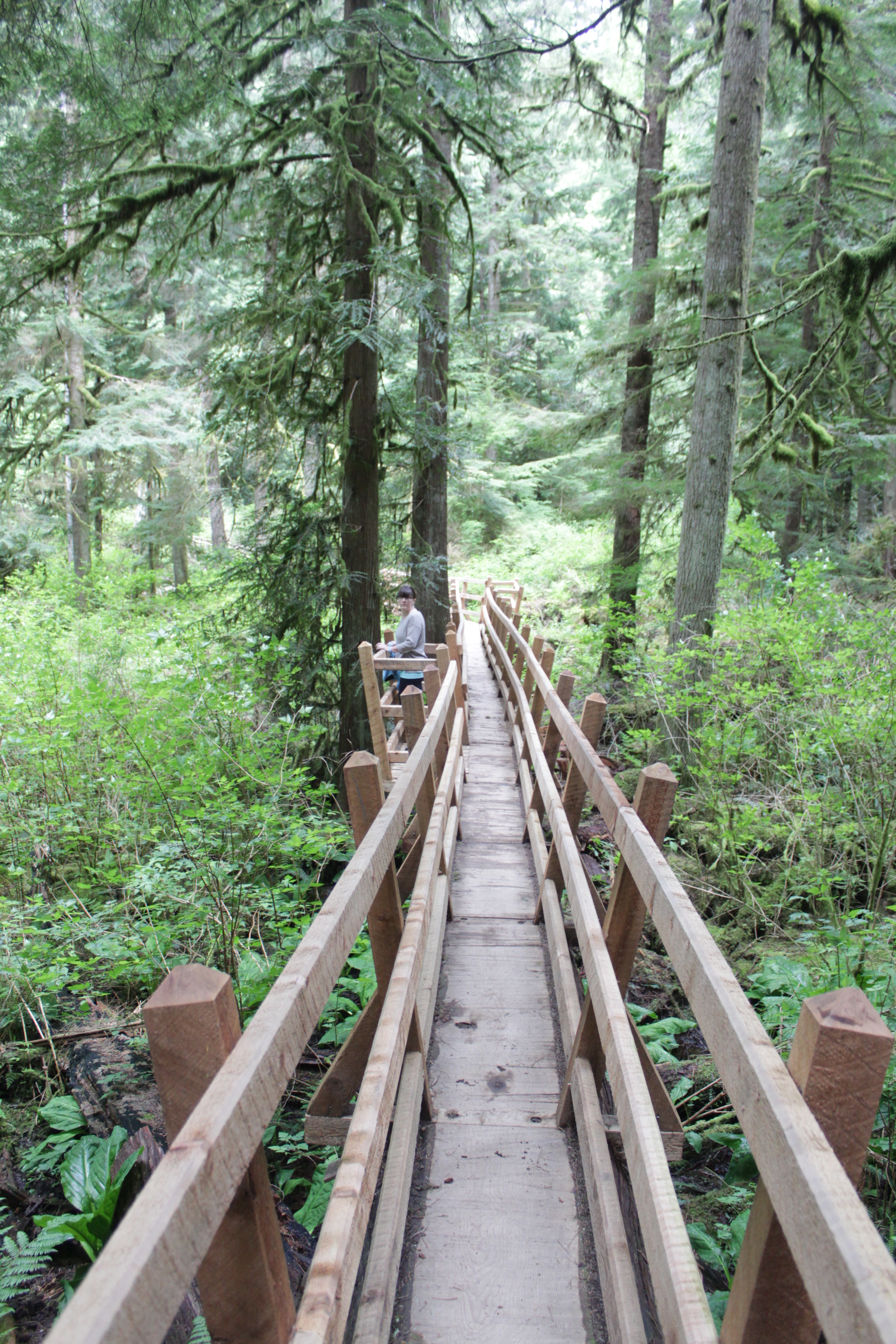
Cliff Gilker Park, Roberts Creek.
She might have added ‘never-ending’!
“For heaven’s sake, stop building trails,” Becky laughs, when I ask her about the Coast’s trail builders. “I actually love finding new trails and I admit, there might be the odd one I don’t know about. I’m always trying to keep up!”
For a moment, we think we may have found a new one. It’s an unusually hot day in May and we’re walking through a dusty trail off Field Road in Wilson Creek. We’re accompanied by Cody, a large, lovable dog from the nearby SPCA where Becky volunteers each week as a dog-walker. The path veers past someone’s back yard and into the forest.
“Let’s take a look,” says Becky, in her element. A few minutes later we come to a dead-end. Cody looks at us expectantly and we return the way we came. So what inspired Becky to take on this labour of love?
“I have three dogs and one has issues with other dogs, so I wanted to find new trails to hike where there weren’t so many people,” she says. “There were few websites, but they only featured the most popular hikes, places like Mount Daniel, so I decided I’d do it myself.”
Becky’s well qualified. Not only does she love the outdoors, but she learned to build websites through her work teaching computer courses in the Adult Basic Education Program at Capilano University in Sechelt. With the website established, Ryan Robertson, a Squamish-based app developer, who specializes in creating trail applications for iPhones and Androids, contacted Becky. Becky provided the GPS (Global Positioning System – the satellite navigation application) data and Ryan created the app. Trailmapps: Sunshine Coast costs $10 and is available at the Apple Store and Google Play.
For old-school trail lovers, she’s also created waterproof trail maps that are available in Gibsons at Spin Cycles, and in Sechelt at Source for Sports, the Sechelt Visitors’ Centre, and Off The Edge Adventure Sports.
Outdoors, technology couldn’t be further from Becky’s mind. While she’s always hiked to combat weight gain, she’s also convinced of nature’s therapeutic benefits. The Japanese have a name for it: shinrin-yoku, or forest bathing. Becky cites Japanese research, which points to the many benefits of simply being in nature – lower blood pressure, higher creative aptitude and boosted immune systems.
“I prefer the term ‘nature-bathing’ because I find just being out in nature makes me feel better. I always come home feeling better than when I left.”
Well, almost always.
Becky sheepishly recalls one particular hike that went awry, much to her husband’s despair. “I was hiking up Elphinstone and I’d let people know where I was going and what time I’d return. It took a lot longer than I’d expected though and my phone died.
“I got back around 7:45 p.m. – not the 5 p.m. I’d told my husband. He was pretty mad.”
The experience didn’t sour Becky’s love of Mount Elphinstone. In fact, the Mount Elphinstone Summit Trail ranks in her three favourite hikes and bikes. (See below.)

Kinnikinnick Park, West Sechelt.
Sidebar
My Three Favourite Hikes & Bikes, by Becky Wayte
Mount Elphinstone Summit Trail (hike only)
This is a long, fairly difficult climb, but the view at the very top is worth it. The trail to the top can be accessed from the top of Sprockids or via some feeder trails off B & K logging road in Roberts Creek. If you take your time and enjoy a picnic and rest at the top, this hike will likely take you five or six hours. Make lots of noise or wear a bell so the bears hear you coming.
Ruby Klein Traverse – Suncoaster Trail (hike or bike)
Beautiful views of Ruby Lake and a hand carved bench greet you at the highest point along the trail. Easy to make a whole day trip out of this even though the hike itself will probably only take you a couple of hours. You can visit the Iris Griffiths Centre, take a swim in Klein Lake and there is even a feeder trail down to the Ruby Lake restaurant (Trattoria Italiano).
McNeill Lake Circle Route (hike or bike)
This is one of my favourite destinations in the summer months because I always combine a bike ride with a swim. The lake itself is not that well known so often no one else is there, especially on weekdays. There are several trails that connect to create a loop around the lake, with access to the lake from a couple of spots. I park on Middlepoint Forest Service Road and take Copper Head, Dry Feet, a logging road, Old Pole Road and back to Copper Head. There is a short trail off the logging road just north of Dry Feet that takes you into the lake. This is an excellent place to ride your mountain bike if you have pre-teen kids or you just want a fairly flat ride (we don’t have many flat rides on the Coast). Hiking it probably takes about 1.5 hours and by bike about an hour, unless you stop to enjoy a swim.
For the definitive web guide to the Sunshine Coast’s trails, visit http://www.sunshine-coast-trails.com.
Heart of green
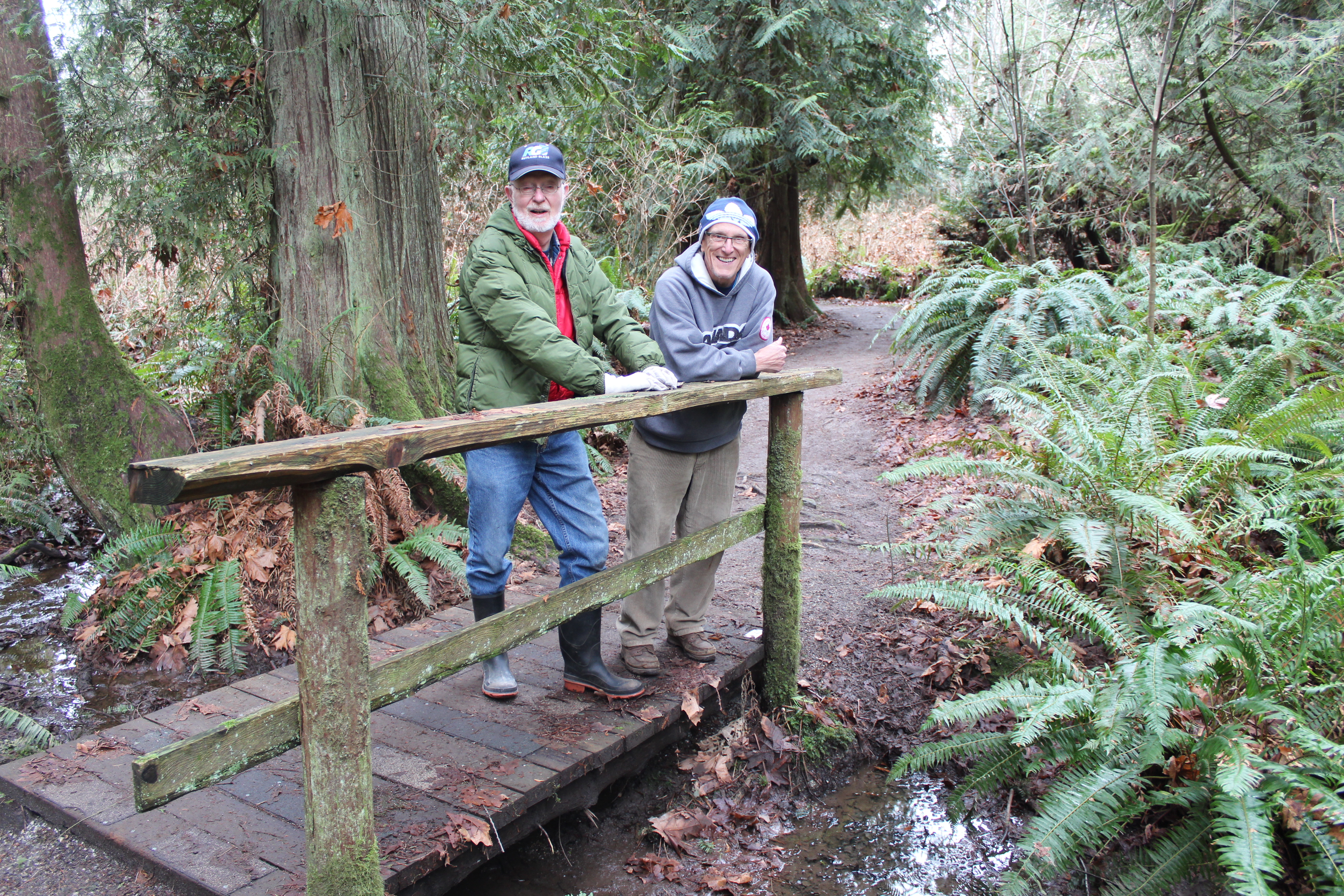
Sechelt Rotarians, Tom Pinfold (right) and Mick van Zandt on the trails of Kinnikinnick.
Shirley Macey didn’t have time to waste. When she wasn’t coaching kids, she was raising a family, working as a Gibsons RCMP dispatcher, and lobbying local government for more recreational space.
Somehow she found time every week to climb Soames Hill with a garbage bag to pick up other people’s litter.
“She was pretty amazing,” remembers her son Darin. “I didn’t think much of it growing up; now I don’t know how she did it.”
At the southern end of the Coast, 14 hectares of Soames Hill Regional Park are named after Shirley Macey. No doubt she would be proud of the soccer fields, the wheelchair-accessible playground and Frisbee golf course. Shirley – or Sam (an acronym of her full name, Shirley Amelia Macey) to her friends – was a dedicated volunteer whose legacy is by no means unique.
Shirley Macey, Maryanne West, Ted Dixon, Cliff Gilker and Hackett are – to name a few – venues so familiar to most of us that it’s easy to forget that they were also people. Ted Dixon, for example, worked tirelessly for self-government for the Sechelt Indian Band before dying in a car crash in 1981. Maryanne West was the backbone of community TV and so many volunteer projects before dying at age 90 in 2008.
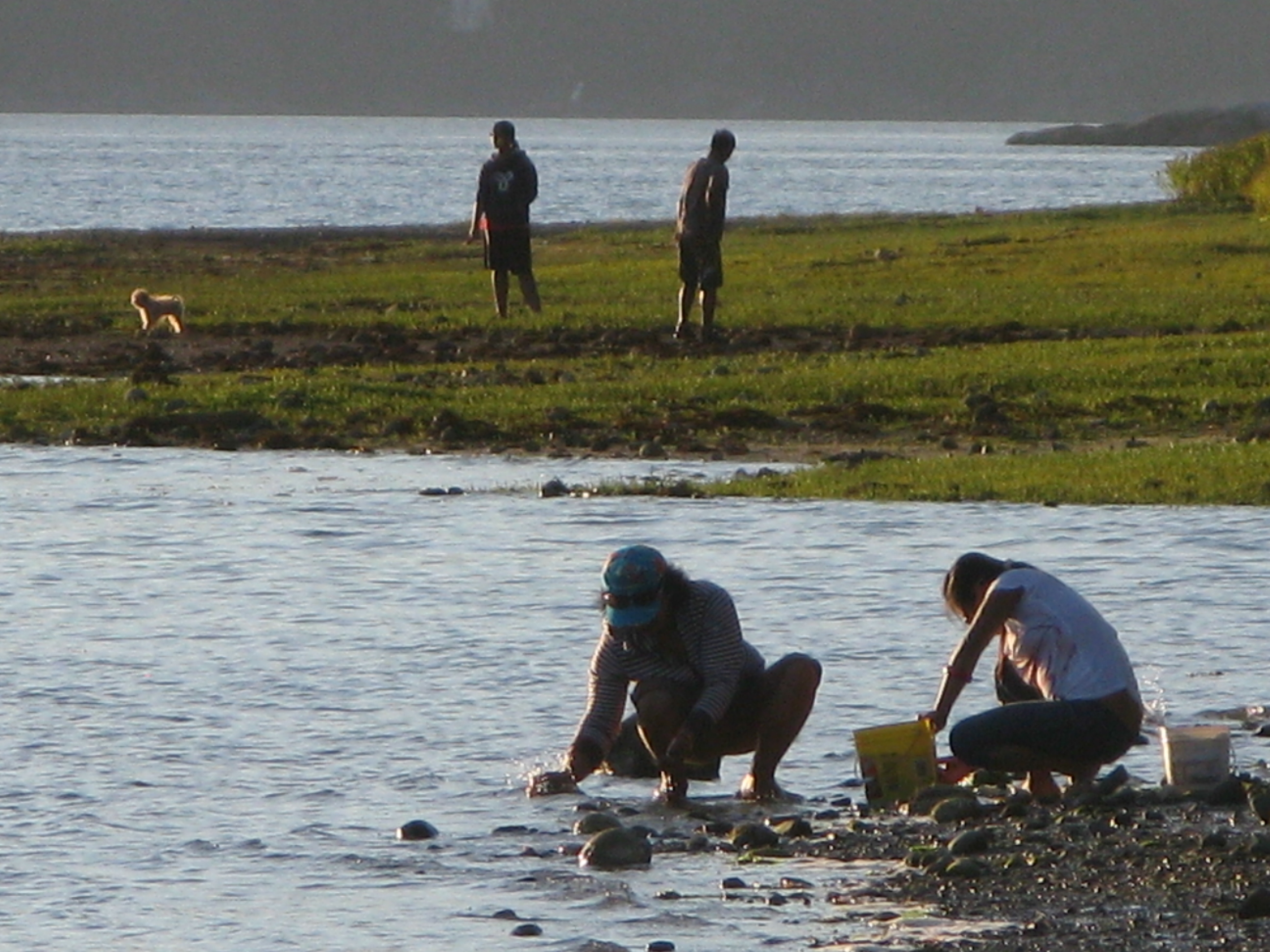
Scavenging the shoreline at Porpoise Bay. For parks and beaches, Sunshine Coasters are spoiled for choice.
And not all parks bear a family name. Brothers Memorial Park in Gibsons was named for logging contractors, Al and George Jackson who donated the land.
Today, volunteers continue to be the lifeblood of the Sunshine Coast’s parks and trails. In fact, the parks system wouldn’t work without them.
“We totally rely on volunteerism,” says Sunshine Coast Regional District parks planning coordinator, Sam Adams. “We wouldn’t be able to do what we do without it.”
For the SCRD that means mobilizing volunteer help in bigger parks like Dakota Ridge, where members of the Dakota Ridge Advisory Committee have been particularly helpful. Volunteers also help the SCRD maintain trails at Soames Hill, most recently working to improve the wooden stairs. Now the regional district is hoping to cultivate more volunteer assistance with an adopt-a-trail program.
“Part of our work plan for 2013 is to develop a more robust volunteer program,” says SCRD parks planning coordinator, Susan Mason. “We have kilometres and kilometres of trails to maintain, so people willing to document changes on a regular basis are helpful to us.”
The government-volunteer relationship is similar elsewhere on the Coast. District of Sechelt parks supervisor Perry Schmitt is grateful for the work of several trail building groups, as well as established service clubs.

Sunshine Coast Lions Club president Len Schollen at the site of the Lions’ next project, an accessible viewing deck in the corner of Mission Point Park where the beach and Chapman Creek meet.
“The Lions Club has been instrumental in making improvements to Mission Point park and the Sechelt Rotary Club has been assisting in rebuilding decks throughout Kinnikinnick forest trails,” says Schmitt. He also cites the work of the Sechelt Groves Society at the Heritage Forest trails, and the Sunshine Coast Natural History Society, which tends to Sechelt Marsh.
On a cold blustery day, Sunshine Coast Lions Club president Len Schollen shows me work completed on the Mission House deck and the next project – an accessible viewing deck in the corner of Mission Point Park where the beach and Chapman Creek meet.
“We’re basically waiting for some decent spring weather to build the viewing platform and a hard-surface ramp leading up to it,” says Schollen, surveying the footings already in place. “There’ll be a railing around it and hopefully some signs with information about the salmon run and pointing out places like Mount Arrowsmith.”
Why are Schollen and other Lions members involved in the project? “We serve, is the Lions’ motto,” says Schollen simply. “We try to make this a better place to live.”
It’s a sentiment shared by Sechelt Rotarians, Tom Pinfold and Mick van Zandt, when I meet them on the trails of Kinnikinnick park.
“We wanted to work on small projects where a few people could work for a few hours on something with lasting benefit,” says Pinfold. “We’d much prefer to let the District allocate their resources to new things instead of maintenance.”
With other Rotarians, the pair has replaced and built cedar bridges and decks throughout Kinnikinnick’s trails during the last three years. Topped with roofing tiles, the decks are essential given the drainage issues on multi-use trails in a popular park. The new bridges should be good for at least 10 years, reckons Pinfold. (Elsewhere in Kinnikinnick park and at Sprockids park in Langdale, Capilano University students hone their trail-building skills as part of the Mountain Bike Operations Certificate curriculum.)
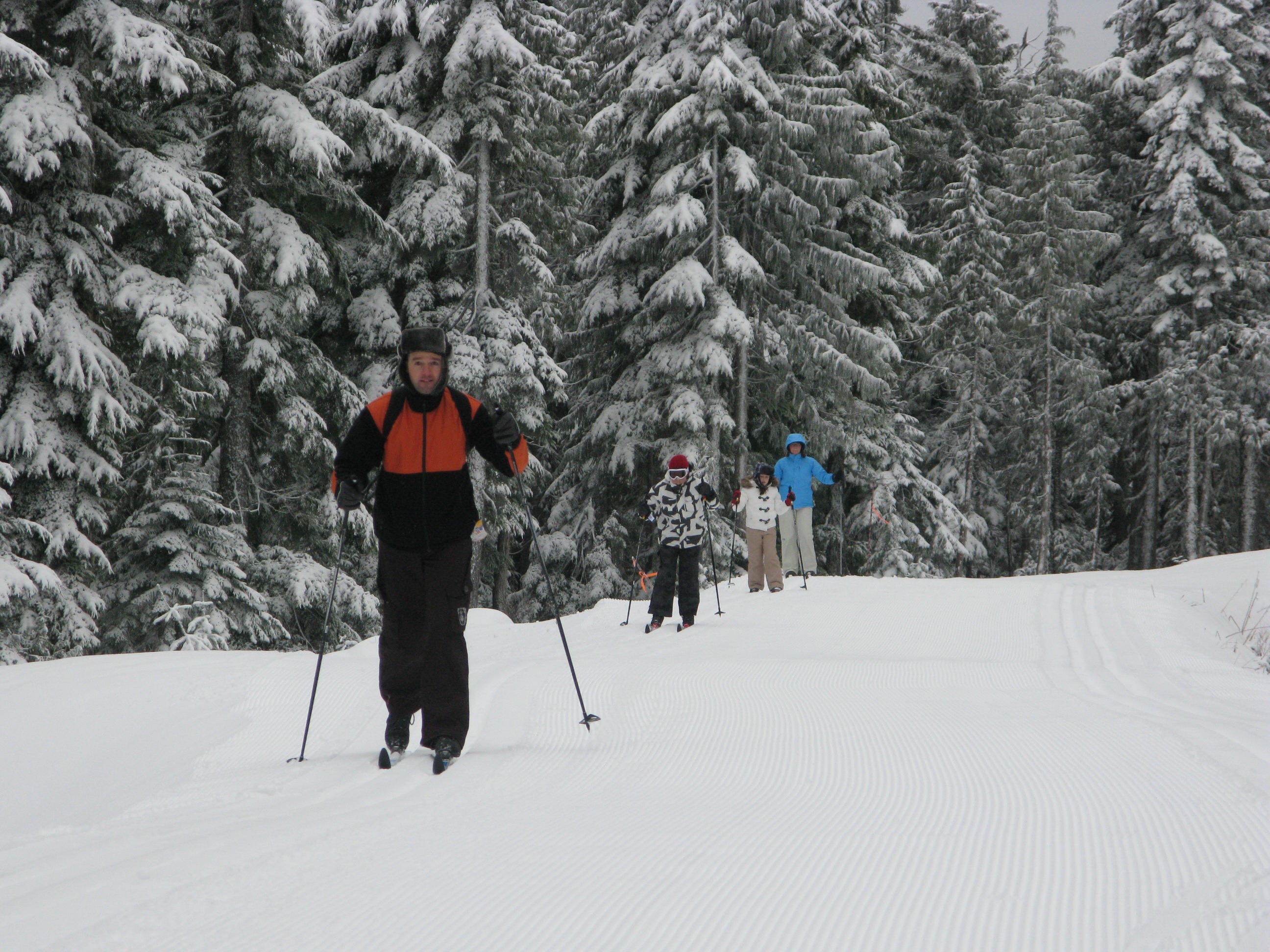
There are 13 kms of groomed trails for cross-country skiers on Dakota Ridge, yet another Coast playground.
Pinfold and van Zandt have also worked on a wheelchair accessible deck at Halfmoon Bay’s Trout Lake and a viewing platform and trail in Roberts Creek’s Cliff Gilker park.
Elsewhere, volunteers continue to make the Sunshine Coast a great place to play. If you’re searching for the heart of the Sunshine Coast you’ll find it in any park or trail. From Pender Harbour’s Lions Park (the best soccer field on the Coast) to the mountain bike trails of Sprockids Park in Langdale, outdoor recreation thrives because people care enough to make it happen.
People like Shirley Macey.
Shirley didn’t live to see the park she’d fought for named in her honour. Just months after retiring from the RCMP and paying off her mortgage, she died of cancer in 1998.
“I didn’t realize until I was older that quite a few people called her mom,” recalls Darin, who has four kids of his own now. “I met all these people I knew at her service who thought of her as a surrogate mother.
“My kids are certainly proud of the park’s name. It’s too bad she died so young.”
Trail Mix
There are numerous opportunities to get involved in outdoor volunteering. Here are a few websites where you’ll find more information.
http://secheltlionsbc.lionwap.org/
email tony@whiskeyjacknaturetours.com for the Sunshine Coast Natural History Society
Thanks to the Sechelt Community Archives and the Sunshine Coast Museum and Archives for their help in researching this feature.
Cabin fever
Snowshoers make their way to Mount Steele Cabin, one of four cabins built by the Tetrahdron Outdoor Club in 1987. Reynold Schmidt photo

“We came in by the light of the benevolent and gibbous moon waxing to near fullness. The skies were clear and the spirits were high, peeling laughter for 48 hours and sleeping for six.”
– An entry in the Bachelor Lake Cabin, Tetrahedron Provincial Park
Some people move to the Sunshine Coast to get away from it all. The Tetrahedron is where Sunshine Coasters go to get away from it all. Six thousand hectares of mountains, lakes, streams, wetlands and forest, the Tet, as it’s fondly known, has long been cherished by backcountry enthusiasts.
In 1987, a group of those enthusiasts banded together to mobilize more than 200 volunteers, 45 businesses, schools, community groups and several levels of government: their mission, to build cabins linked by a trail network.
Back then, they called themselves the Tetrahedron Ski Club. A quarter of a century later, they’re the Tetrahedron Outdoor Club, a group justifiably proud of the legacy created northeast of Sechelt. Last summer, club members marked the 25-year milestone with dances, parties, pancake breakfasts and numerous trips down memory lane.

Tannis is one of 10 beautiful lakes in Tetrahedron Provincial Park. In June, the lake was still partially frozen.
Now they’re enjoying the snow.
“Early December, after that first big dump of snow; that’s my favourite time to go,” says club president, Reynold Schmidt. “I usually go with club members, friends – before the crowds.”
It’s June when Reynold and I visit Bachelor Lake Cabin, a one-hour hike from the trailhead up Grey Creek Forest Service Road. With snow more than a metre deep in places, I’m grateful for snowshoes. Partially frozen Tannis Lake is a testament to the cold, wet spring endured down at sea level, 1,100 metres below. At least the mosquitoes are still asleep.
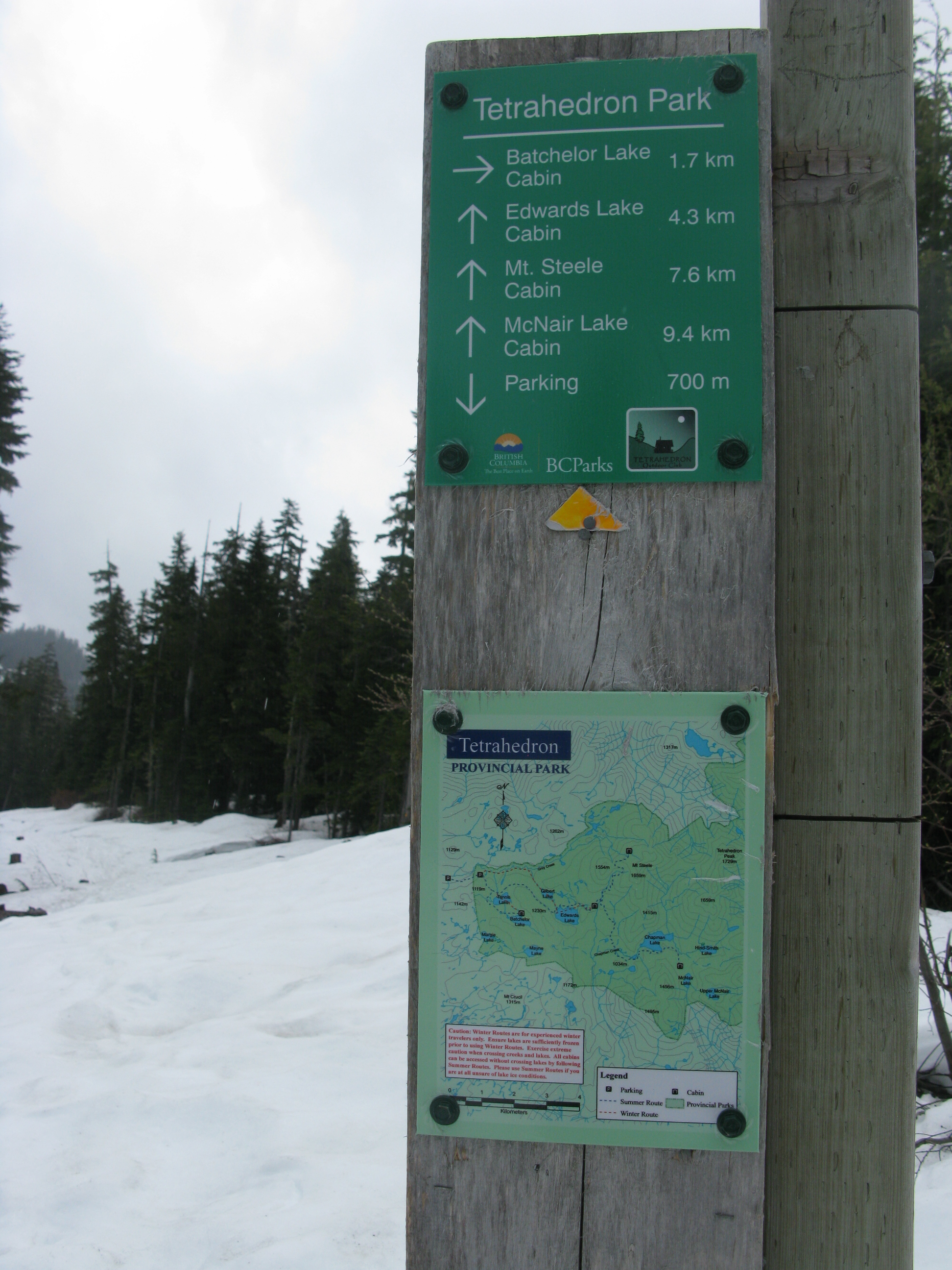
Tannis is one of 10 beautiful lakes in Tetrahedron Provincial Park. There are three mountain peaks – Panther, Steele and Tetrahedron – and some of the oldest trees in the country. Amabilis fir, mountain and western hemlock, yellow cedar and white pine can all be found here. So, too, can the club’s four rustic, two-storey cabins each built to accommodate 16 people – first-come, first serve. They can be reached via a 25-kilometre trail network and are located at Bachelor Lake, above Edwards Lake, between McNair and Chapman Lakes, and below the summit of Mt. Steele.
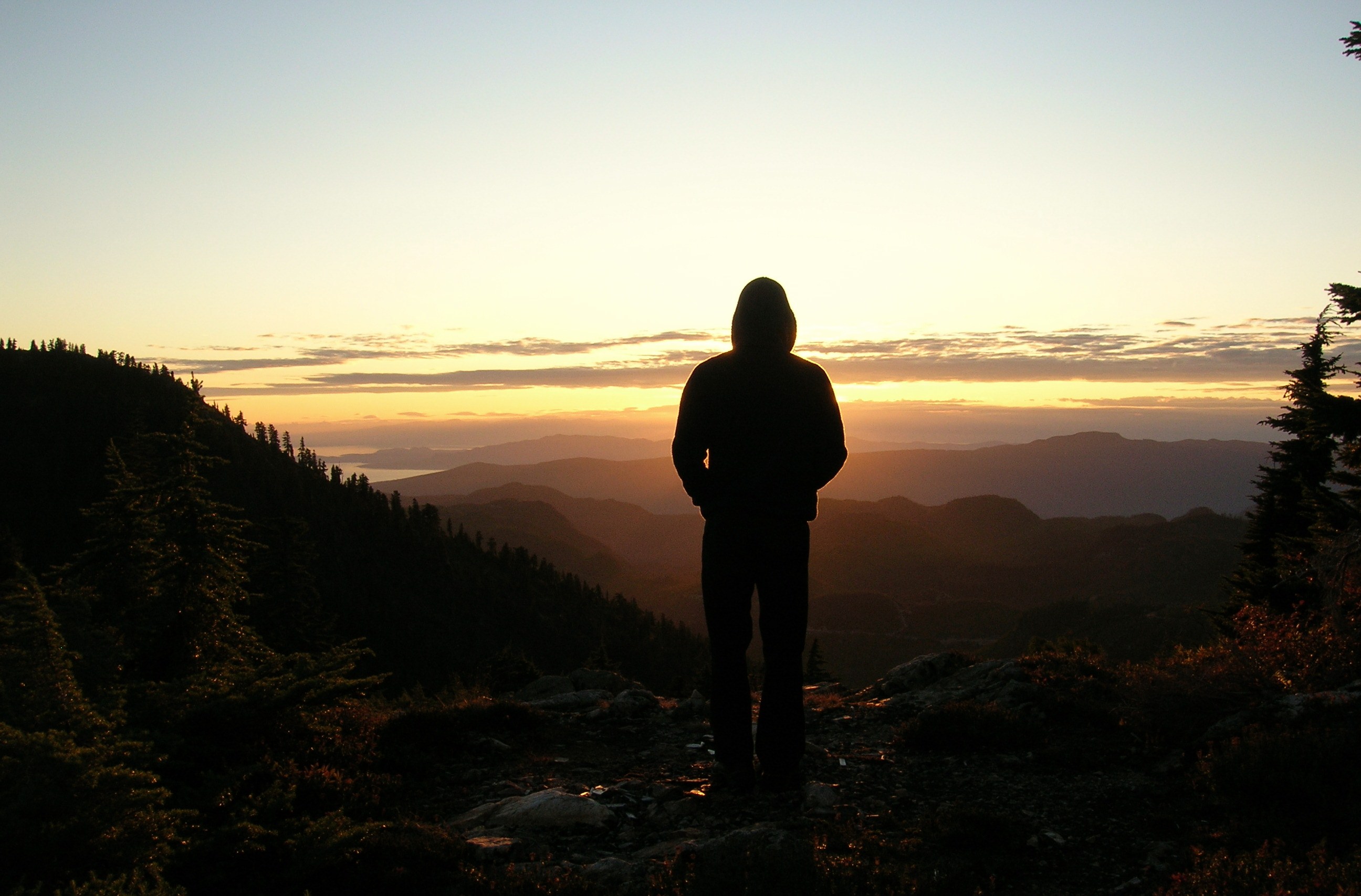
A 25-kilometre trail network links the cabins in Tetrahedron Provincial Park. BC Parks photo
Inside Bachelor Cabin, we stop for lunch, seated on a long wooden bench at a metal table. There’s a wood stove and firewood. Above us is a sleeping loft with foam mattresses. From the kitchen window, looking across frozen Bachelor Lake, it’s hard to imagine “crowds”. We haven’t seen a soul all day. But weekend and holidays during the winter can be busy at the cabins, confirms Reynold, a natural resource officer with B.C. Ministry of Forests, Lands and Natural Resource Operations.
“We’ve had our problems with vandalism over the years, people coming just to party and not cleaning up after themselves,” he says. “There has been a lot of debate within the club to create a reservation system, but some members are adamant the cabins remain for everyone’s use.”
This year, the club has appointed stewards, two people per cabin, responsible for maintenance and regular monitoring. “They’re regular backcountry users who get to use the lockboxes to store their gear, so they don’t have to carry stuff in each time,” says Reynold.
“It helps dispel the sense that these are party cabins,” he adds.
Naturally, the cabins are there to be enjoyed. How they came to be there is a different story, far removed from pristine mountain air – below sea level in fact!
A basement in Franklin Road, Gibsons, is where George Smith pitched his idea for a cabin and trail network. In 1985, George had skied Mount Steele with his friend Ian McConnell on June 1 weekend. He was struck by the quality of the snow and the potential of backcountry recreation in the area.

Bachelor Cabin, the closest of the four cabins to the trail head.
“The Sunshine Coast was in the midst of an economic depression,” recalls George. “People weren’t exactly light and breezy, but I thought this idea made sense.”
George approached his Franklin Road neighbor, Wayne Greggain, the titular head of the Tetrahedron Ski Club. After a heyday in the late 1960s and 70s, mostly skiing Mount Elphinstone courtesy of a Tucker Snow Cat and 600-foot lift purchased from Hollyburn Mountain, the ski club was all-but defunct by 1985. Wayne agreed to host a meeting of ski enthusiasts in his basement where George explained his vision.
The prevailing mood, recalls George, was: “We don’t know how good an idea this is, but if we don’t do it, someone else might and they won’t do it right.”
The group agreed that if George could secure funding for the project, the ski club would run it as a non-profit. By the fall of 1986, George – then a sometimes reporter with the former Coast News – had secured more than $150,000 in federal funding and another $20,000 from the province.
Yet another Franklin Road resident, Paul Anslow, was contracted to build the cabins at Sechelt airport. The cabins would then be disassembled and flown by helicopter to be reassembled on site. Forestry company, Canfor, and the Sunshine Coast Regional District donated timber, Sechelt Creek Contracting provided logging service, Airspan donated some air time, Gibsons Building Supplies provided crane trucks and the Outdoor Recreation Council pitched in with chainsaws.
A small army of volunteers mobilized to clear trails while 18 people during the course of the project worked on the cabins.
George describes former club president and long-time member, Victor Bonaguro, “a force of nature” who could “build anything”.
“Part of the reason we were able to get funding was because we created an 11-point education plan for the workers, so they would have the tools to go out and find work afterwards,” says George. Aside from cabin-building, workers learned valuable lessons in surveying and industrial and wilderness first aid, thanks to time donated by local experts.
By the time the cabins opened to the public in 1987, the club had raised more than $300,000 for the project. But perhaps more importantly, one great idea had united governments, businesses, and local volunteers in the midst of a recession, no less.
The Tetrahedron was declared a Class A provincial park in 1995. And in 2004, recognizing the year-round activities of its members, the ski club changed its name to the Tetrahedron Outdoor Club.”
“This resource is at least as good today as when it was first built,” says George, who’s still in love with the Tetrahedron.
“I feel lucky. When you walk in a forest that’s never been logged, it just feels different. It’s wonderful to be there.”
- For more information about the Tetrahedron Outdoor Club, visit www.tetoutdoor.ca
- Four-wheel drive and chains are essential for visiting the Tetrahedron. For more information about the park, visit www.env.gov.bc.ca/bcparks
- For an armchair view of the Tetrahedron, visit Coast adventurer Quinn Barabash’s website at captainquinn.com and see his video at captainquinn.com/adventure-video-blog/
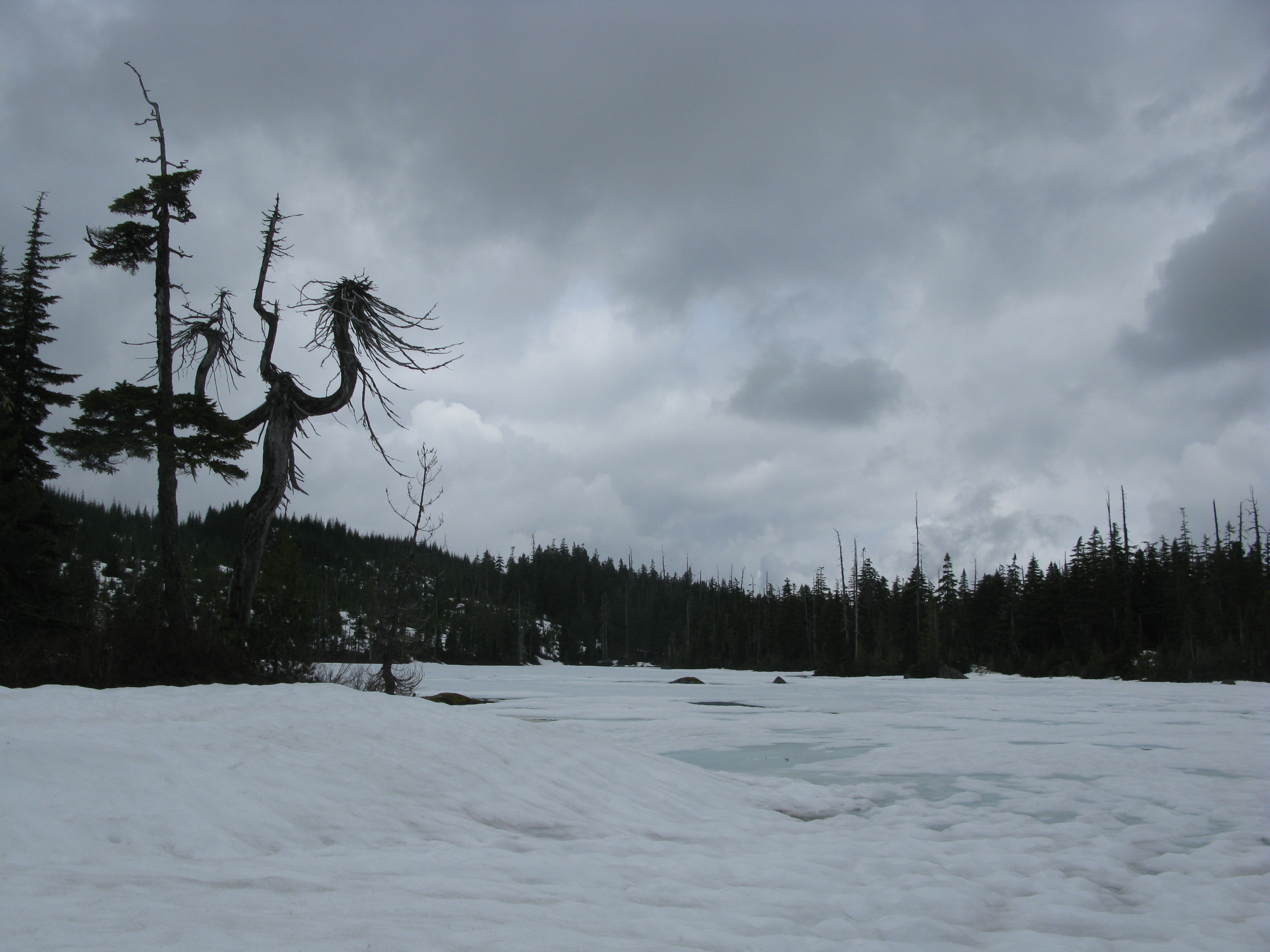
Summer comes late to Bachelor Lake, pictured here in June.
Whistler celebrates readers and writers
Sunshine Coast filmmaker Nicolas Teichrob appears at the Whistler Readers and Writers Festival, Oct. 12-14.
A comfy bed and a good book sound like the perfect antidote to the chilly onset of fall, but organizers of the Whistler Readers and Writers Festival have something less solitary in mind.
From Oct. 12-14, the resort will showcase the art of storytelling with a celebrated lineup of Canadian and international authors. Panel discussions, workshops, and speaking events make up the festival, which also pairs authors with wine and jazz at a Saturday-night gala to be held at the Chateau Fairmont Whistler. The Squamish Lil’Wat Cultural Centre will host the festival’s opening night reception.
Whistler’s festival events have an intimate feel, say organizers, who add that booklovers can interact and connect with top authors from all over North America.
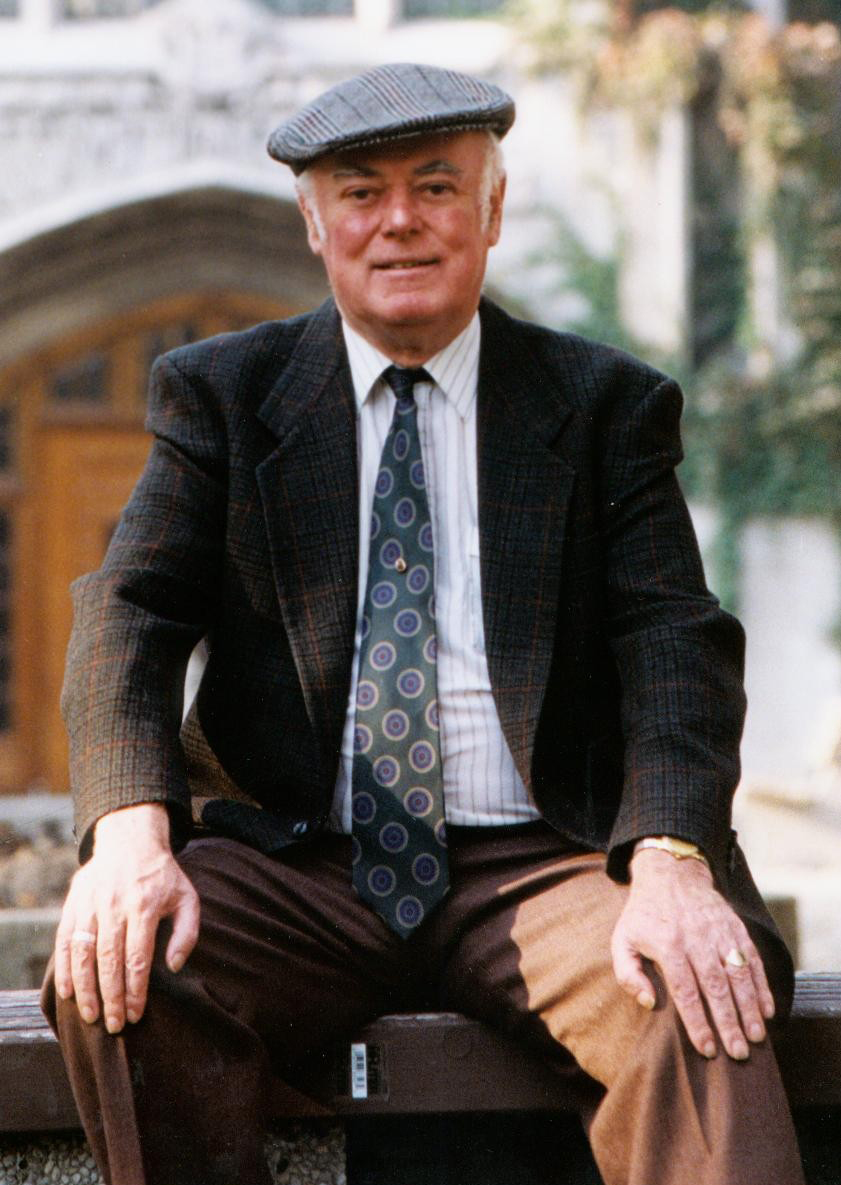
Festival headliner, Alistair MacLeod.
Headlining is Canadian author, Alistair MacLeod, best known for his critically acclaimed collection of short-stories Island as well as his multiple award-winning novel No Great Mischief. Lawrence Hill, author of the international best-seller and prize winning The Book of Negroes will be there, along with short-story author and journalist Zsuzsi Gartner (Better Living Through Plastic Explosives). Also speaking will be young adult writer Susan Juby (Alice, I Think, The Woefield Poultry Collective); non-fiction and fiction writer Margaret Macpherson (Nellie McClung: Voice for the Voiceless, Body Trade); historical fiction novelist, Jack Whyte (A Dream of Eagles, The Templar Trilogy); fiction and poetry writer Miranda Hill (Sleeping Funny) and celebrated poet John Burnside(Black Cat Bone). Local author and festival director Stella Harvey will be releasing her new book, Nicolai’s Daughters.
In 2001, Harvey founded the Whistler Writers Group, otherwise known as The Vicious Circle.
“Our first festival was 20 people in my living room,” laughs Harvey. “We had a guest author – Andreas Schroeder – and a workshop the following day. We were finished by 4:30!”
Harvey invited the poet, novelist and Roberts Creek resident, Schroeder, back for the festival’s 10th anniversary. Another Sunshine Coast resident, Nicolas Teichrob, will appear at this year’s festival. The filmmaker will be part of a panel discussion on writing and film on Oct. 14.
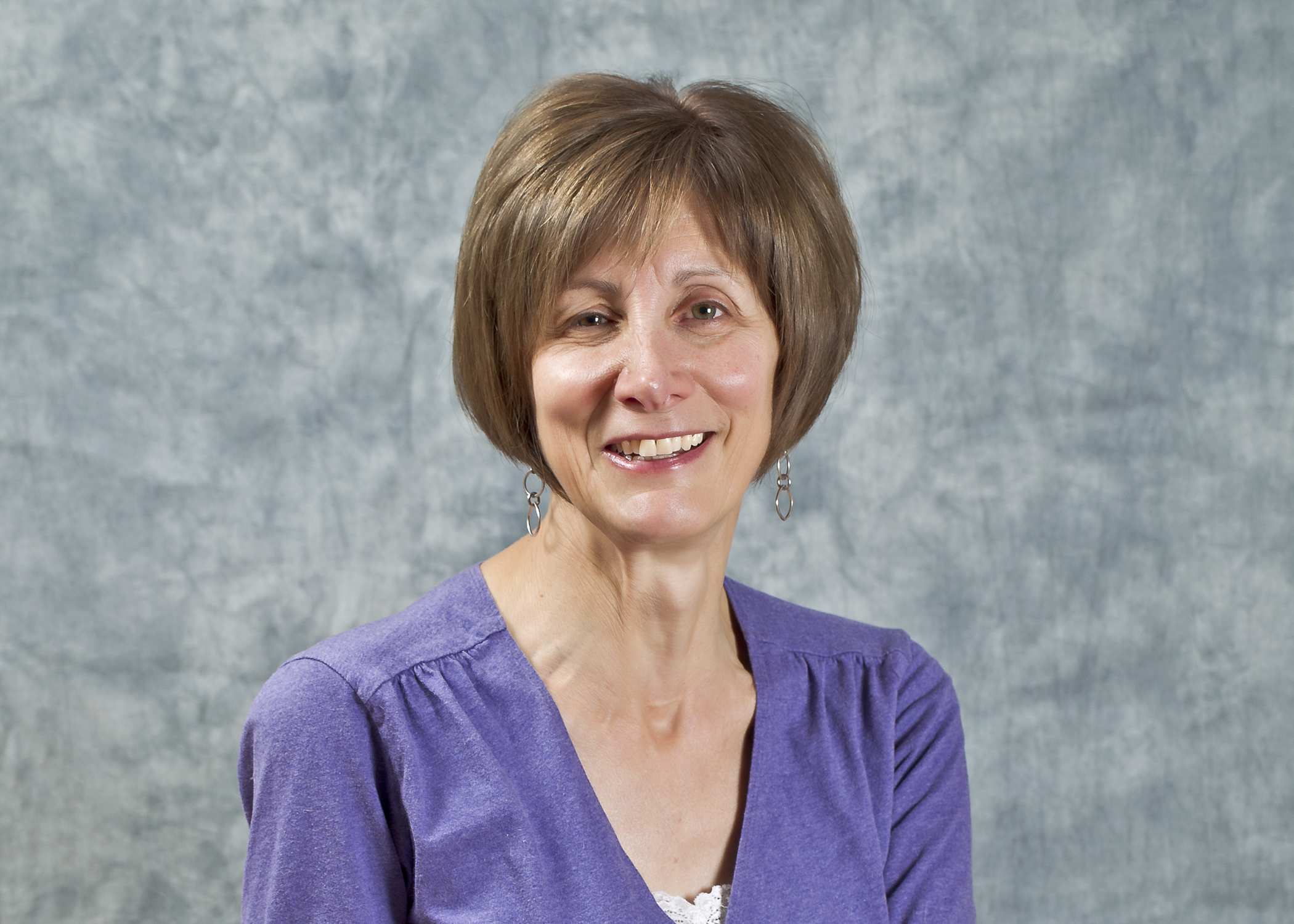
Festival founder, Stella Harvey.
The Whistler Writers Group now has about 150 members and has seen its annual festival grow to a three-day event, attracting internationally acclaimed writers and about 300 participants last year.
But, says Harvey, the festival has lost none of its intimacy.
“One of the things we hear most in evaluations by guests and authors is that intimacy is a great strength of the festival. The fact that you can share lunch or a coffee with the authors and hear about the books they like, or what their motivations are, is definitely appreciated.”
Saturday night’s “Wine, Books and Jazz” event at the Fairmont Chateau Whistler is a first for the festival, says Harvey, who hopes it will be another way to cultivate that intimacy. “It will be a pub-like setting and a chance to share a drink with authors while listening to good music.”
The New Orleans Ale Stars take the stage with swing-era jazz from 7:30 p.m.
In partnership with the Fairmont Chateau Whistler, the Whistler Readers and Writers Festival is offering “Book and Bed” packages. The full “Book and Bed” package starts at $658 and includes two full event passes (entry to 14 events over the festival weekend) for the festival plus accommodation for two nights, based on two sharing.
For more information, visit www.theviciouscircle.ca and http://www.fairmont.com/whistler/special-offers/other-offers/readers-writers-festival/, or call 1 800 606-8244.
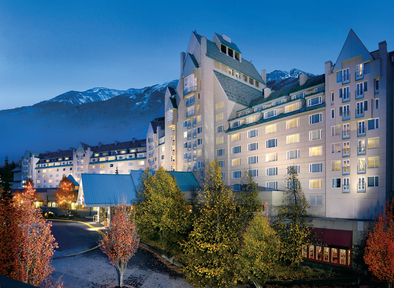
The Fairmont Chateau Whistler hosts the Whistler Readers and Writers Festival, Oct. 12-14.
White and wild on Dakota Ridge

If cross-country skiing is a little slow for you, tobogganing should get your adrenaline racing on Dakota Ridge.
Forty minutes ferry-ride from West Vancouver, the Sunshine Coast is better known for The Beachcombers, scout camps and verdant shorelines. People don’t typically associate this 140-kilometre peninsula with snow. But there it is, several feet of the stuff, just waiting to be played in.
You just have to look up.

There's cross-country skiing for all ages on Dakota Ridge.
Poking through the clouds about 1,200 metres above the beaches and pretty parks is Dakota Ridge, one of the best cross-country ski destinations in the last place you’d expect to find it. Between November and March, if it’s raining at sea level, there’s a good chance it’s snowing up there.
And it’s only a 20-minute drive from sea level.
“You can come up for a couple of hours and be in a completely different world,” says Craig Moore, a cross-country skier and long-time member of the Dakota Ridge Winter Recreation Society, a non-profit group working to promote the area. “For cross-country skiing it beats anywhere on the west coast.”
It’s pretty good for tobogganing and snowshoeing, too.
A 620-hectare (1,532 acres) plateau atop a working watershed, Dakota Ridge offers a rolling landscape of stunted old growth hemlock and yellow cedar. On a clear day you can see the North Shore mountains, the Gulf Islands and Vancouver Island beyond – even Mount Baker down in Washington State.
There are 13 kilometres of groomed trails for cross-country skiers on Dakota Ridge.
Cross-country skiers will find 13 kilometres of groomed Nordic trails, all of them signposted and colour-coded according to degree of difficulty. Professional engineer Reidar Zapf-Gilje, who prepared Callaghan Valley’s 2010 Nordic Olympic course, designed Dakota Ridge’s trail network.
“In many cross-country skiing areas you’re skiing through woods and you don’t see too much,” says Zapf-Gilje.
“Dakota Ridge is way up there in terms of esthetics. Its real strength is its potential for recreation and citizen [cross-country] races.”
Jamie Mani hopes that potential will be realized. Mani owns Alpha Adventures, a Wilson Creek outdoor-adventure store specializing in guided snowshoe and cross-country ski touring on the Ridge.
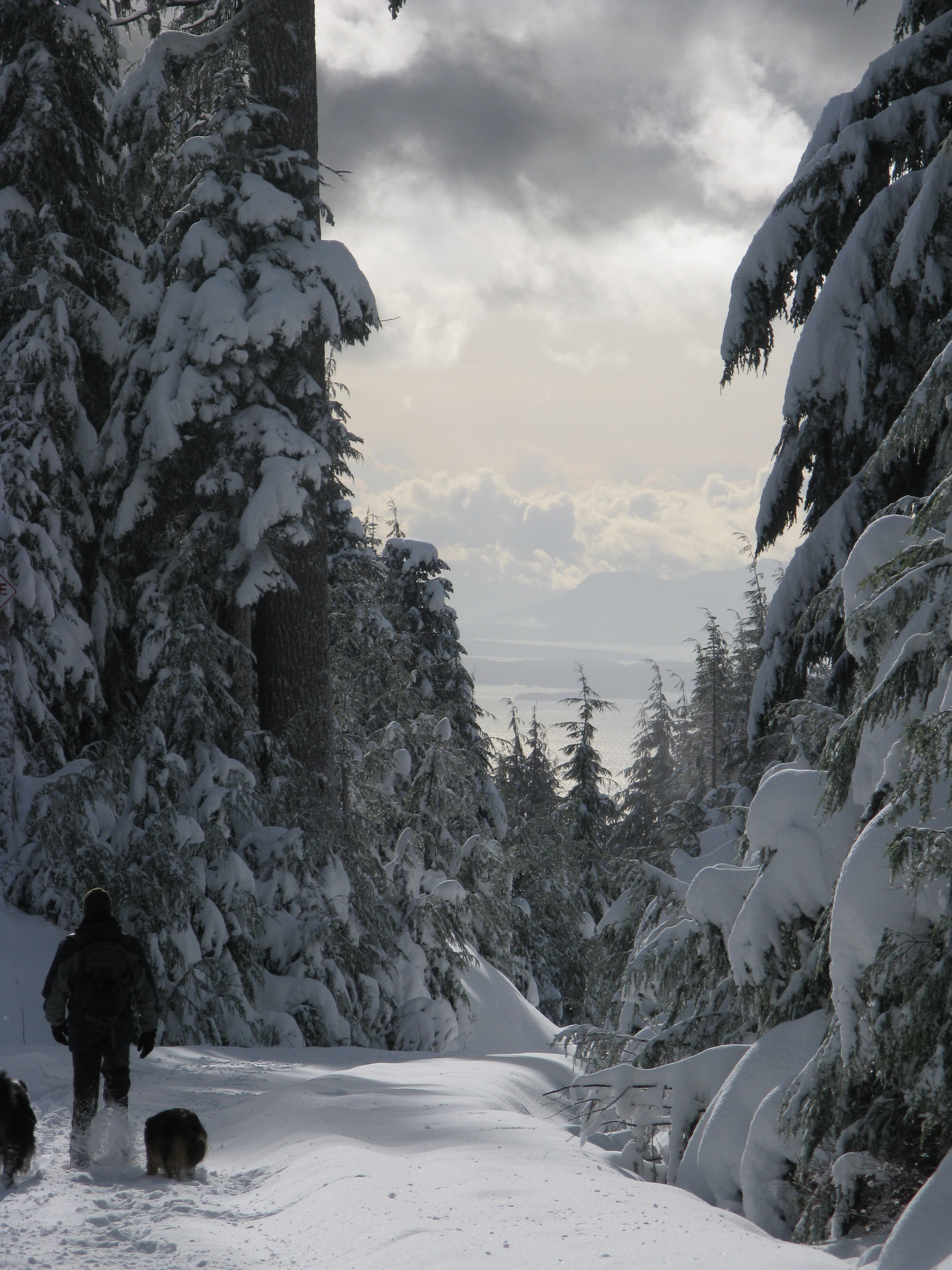
When it's not snowing, the views from Dakota Ridge can be spectacular.
“One of the great things about this place is its proximity to so many other activities,” says Mani. “Someone can literally be out snowshoeing in the morning up in the mountains and then golfing or kayaking in the afternoon.
“And for Nordic skiing we have excellent potential because of great snowfall and a blend of flat and rolling trails. We have been skiing on the Ridge as late as May in previous years.”
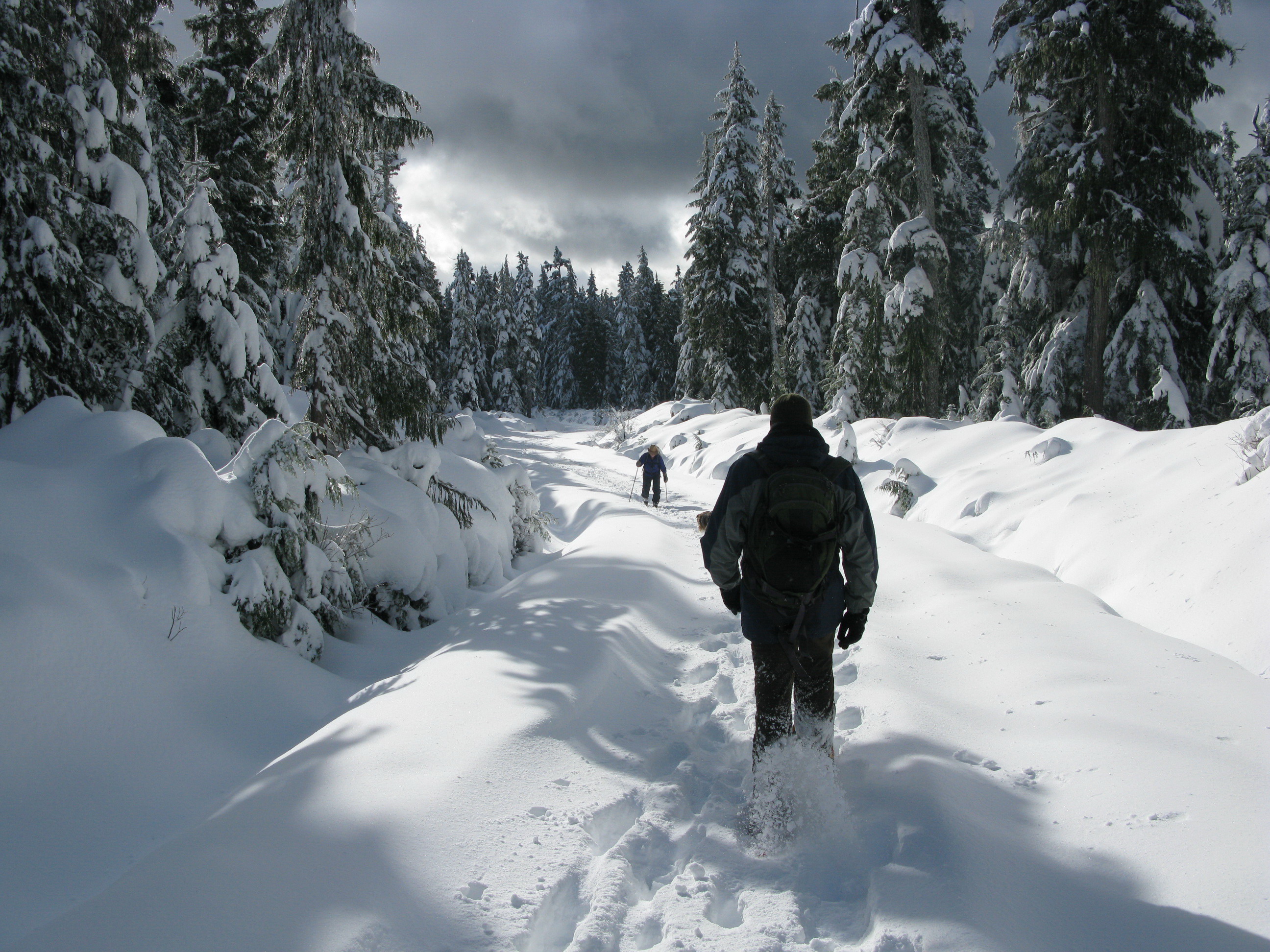
Snowshoers will find their own trails and there’s plenty of room for hiking and tobogganing. You’ll find a parking lot, warming hunt and toilet at the trailhead.
The turnoff for Dakota Ridge is at the top of Field Road in Wilson Creek, about half way between Gibsons and Sechelt, and 20 kilometres drive from BC Ferries’ Langdale terminal. For many years, the unplowed access road to Dakota’s trailhead made it a ridge too far for some. In recent years the 11-kilometre road has been upgraded to allow for regular plowing, but four-wheel drive vehicles equipped with chains are still the way to go.
Or take advantage of Alpha Adventure’s shuttle service.
- To learn more about Dakota Ridge, visit http://www.scrd.ca/Dakota-Ridge
- For road updates and snow conditions on the Ridge, visit www.suncoastcentral.com/outdoor-reports.asp.
- To book cross-country ski lessons, a guided tour, equipment rentals or shuttle service up to Dakota Ridge, call Alpha Adventures at 1 604 885-8838 or visit www.outdooradventurestore.ca
Treasure in our midst
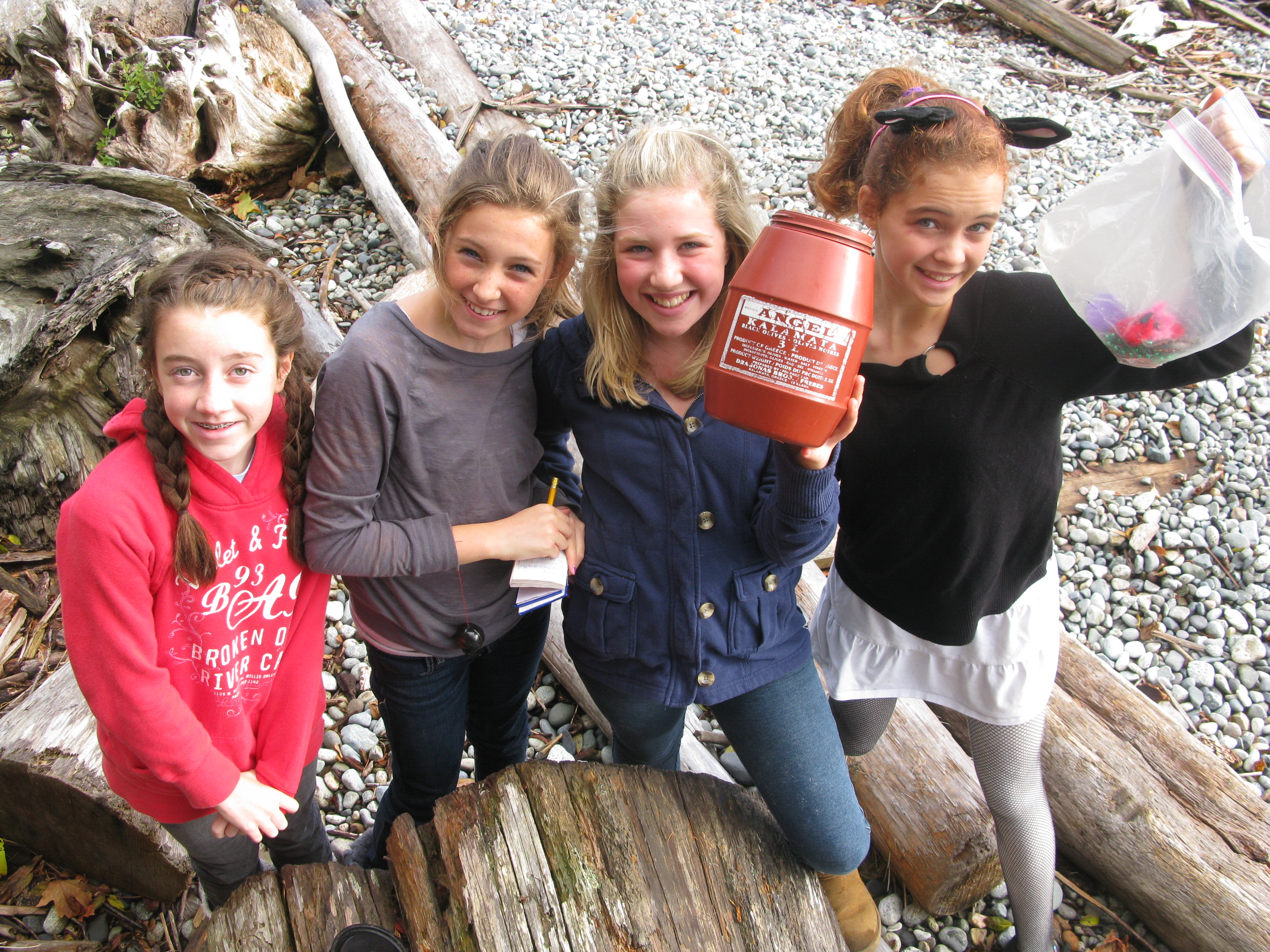
Geocaches are hidden everywhere, often right under our noses!
Purpose and Porpoise Bay
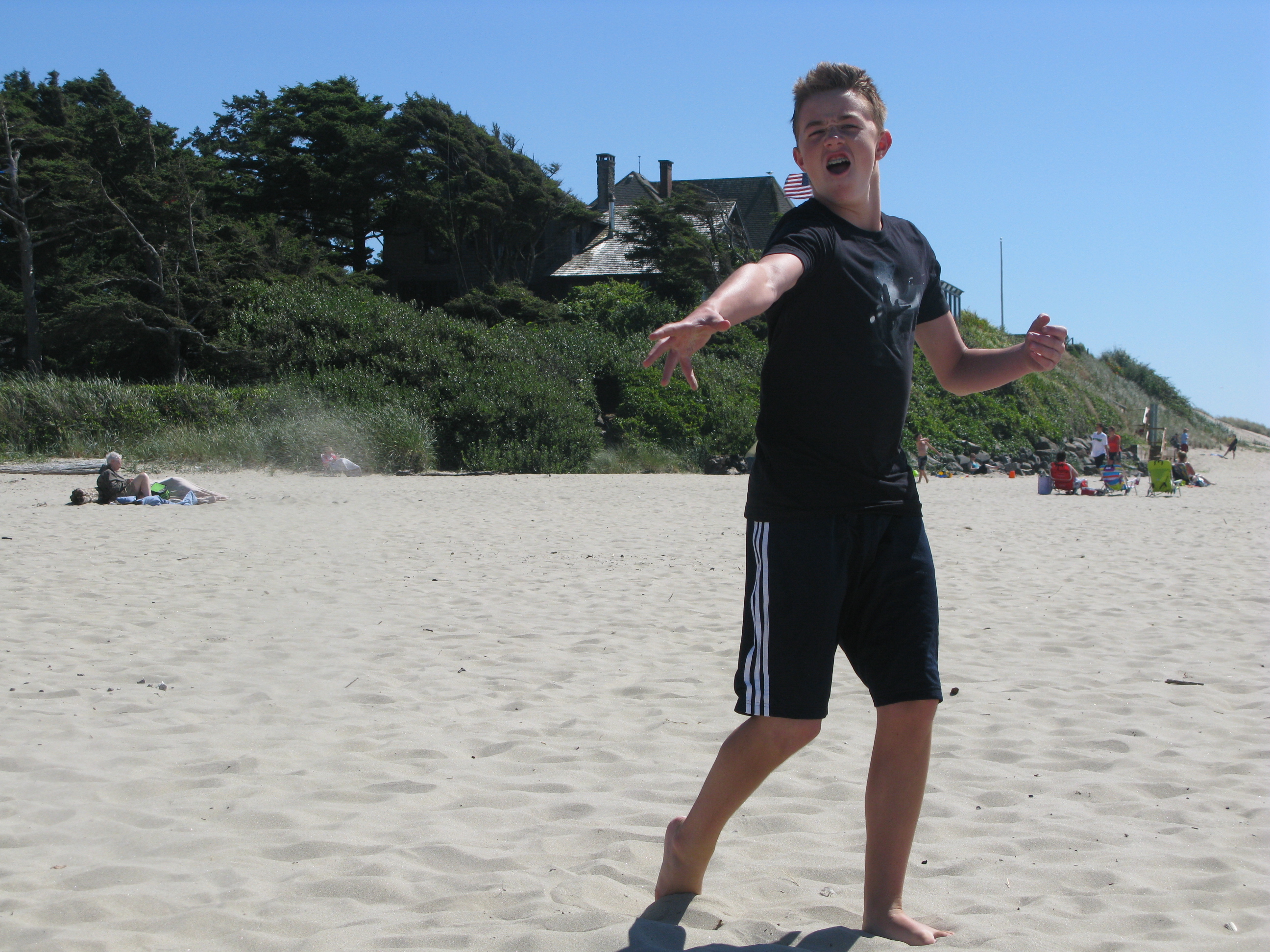
Ryan, where I like him to be: On dry land.
About 10 years ago my son Ryan learned how to ride a bike here at Porpoise Bay. Back ache and heart ache were the prevailing emotions as my four-year-old finally wobbled away from me along the green towards the forest.
Ten years later I’m back here, sitting on the shore of Sechelt Inlet, looking for Ryan. He was last seen paddling an inflatable dinghy with three 14-year-old friends whose idea of “planning” was to bring a paddle: Sunscreen and lifejackets, not so much.
“We’re probably not going to get far,” were Ryan’s last words heading away. That was two hours ago.
Every year, you’ll find us camping here, usually on Canada’s Labour Day weekend. It’s a ritual I like to think of as planned spontaneity – the last chance to fill days with life’s pointless yet most meaningful pursuits: reading, writing, playing, eating and drinking.
There are lots of friends and no deadlines.
Porpoise Bay is a beautiful camping spot with sheltered sites, wooded trails and a sandy beach on the inlet. The sites and trails were carved out of the forest by Ole Johansen. In the 1940s, Ole was a champion ski jumper, competing all over the Pacific Northwest. He was the caretaker at Mount Seymour in North Vancouver, living in the two storey cabin he built himself. Every week the native Norwegian would walk from Mount Seymour Highway back up the mountain after evening classes to improve his English. It took him three hours each time.
I say a quiet thank you to Ole every time I come here, and to Leah, who brought me here the first time. Growing up in London, my experience of camping was a farmer’s field in Dorset and disorganized rows of tents, tarps and windbreakers. The camp site at Charmouth had all the privacy of a refugee camp.
It’s almost 7 p.m. and I’m a little anxious. I only wish my legs could race as fast as my mind.
“Oh, they’ll be back when they’re hungry,” the mum of one of Ryan’s fellow paddlers tells me.
At 7, their boat appears from behind an island in the inlet. Ryan’s friend is wearing pyjama bottoms. The four of them are a mix of bronzed and burnt, all of them bearing the scars of a late afternoon session of cliff jumping.
They disembark and Ryan sees us on the beach.
“What’s for dinner?” he says.
 Nev Judd: Online and out there