London on two wheels

London Bicycle Tour Company guide, Tarik de Vries, in his element at Trafalgar Square.
My first job after leaving school was a stone’s throw from St. Paul’s Cathedral. Every day, I’d herd on to British Rail with a million other commuters for the 10-mile trip to Cannon Street. Not once did it ever occur to me to ride a bike.
A lot’s changed in London since 1985. British Rail’s been replaced with private train operators and fares as confusing as they are expensive. Buses don’t accept cash: Oyster cards and credit/debit cards only. Motorists pay a daily congestion charge (about $20) for the privilege of driving in the capital. And, as I write this, London’s Tube train drivers are on strike.
Again.
No wonder cycling is so popular now, and not just with Londoners; tourists, too.
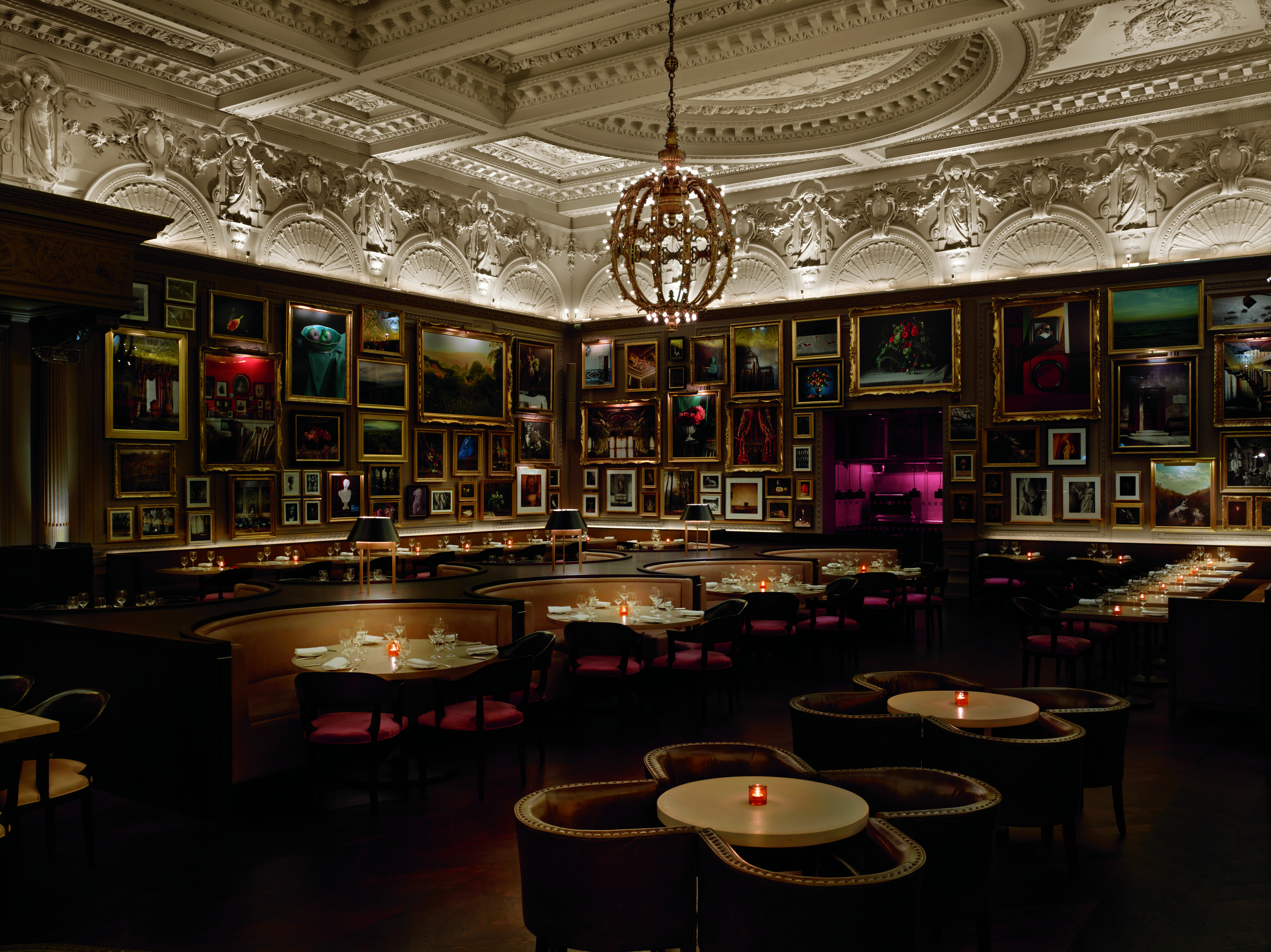
Berners Tavern, at the London Edition hotel, is the sort of place Agatha Christie might have set a mystery. Nikolas Koenig photo
Almost 30 years after that first job, I returned to my old London haunts this summer as a visitor with my family. We stayed a night at the London Edition in Fitzrovia, an artsy neighbourhood of galleries and upmarket stores. Virginia Woolf, George Bernard Shaw and Arthur Rimbaud used to call this area home back when it had a decidedly more Bohemian edge. Accommodation was probably more affordable then, too.
The Edition is pricey, but memorable. Oak floors, wood-paneled walls, and silk area rugs make the guest rooms feel like a sophisticated hunting lodge. The hotel’s restaurant, Berners Tavern, reeks of opulence with a high ornate ceiling, decadent chandeliers, low lighting and almost every square inch of wall space covered by framed art. The staff are young and beautiful. It’s the kind of place Agatha Christie might have set a mystery.
Walking the quiet backstreets of Marylebone, Fitzrovia and Soho we first noticed just how popular cycling had become in the capital. Along with numerous people riding high-saddled, three-gear road bikes with baskets on the front and panniers on the back, we saw lots of ‘Boris Bikes’ – London’s ubiquitous hire bicycles nicknamed after Mayor Boris Johnson. Similar to North America’s Bixi Bikes, London’s hire-scheme sponsored by Barclay’s Bank supplies 10,000 bikes from 720 stations around the city. The sturdy, three-gear bicycles feature puncture-resistant tires and LED lights, and can be rented by credit/debit card for 30-minute rides.
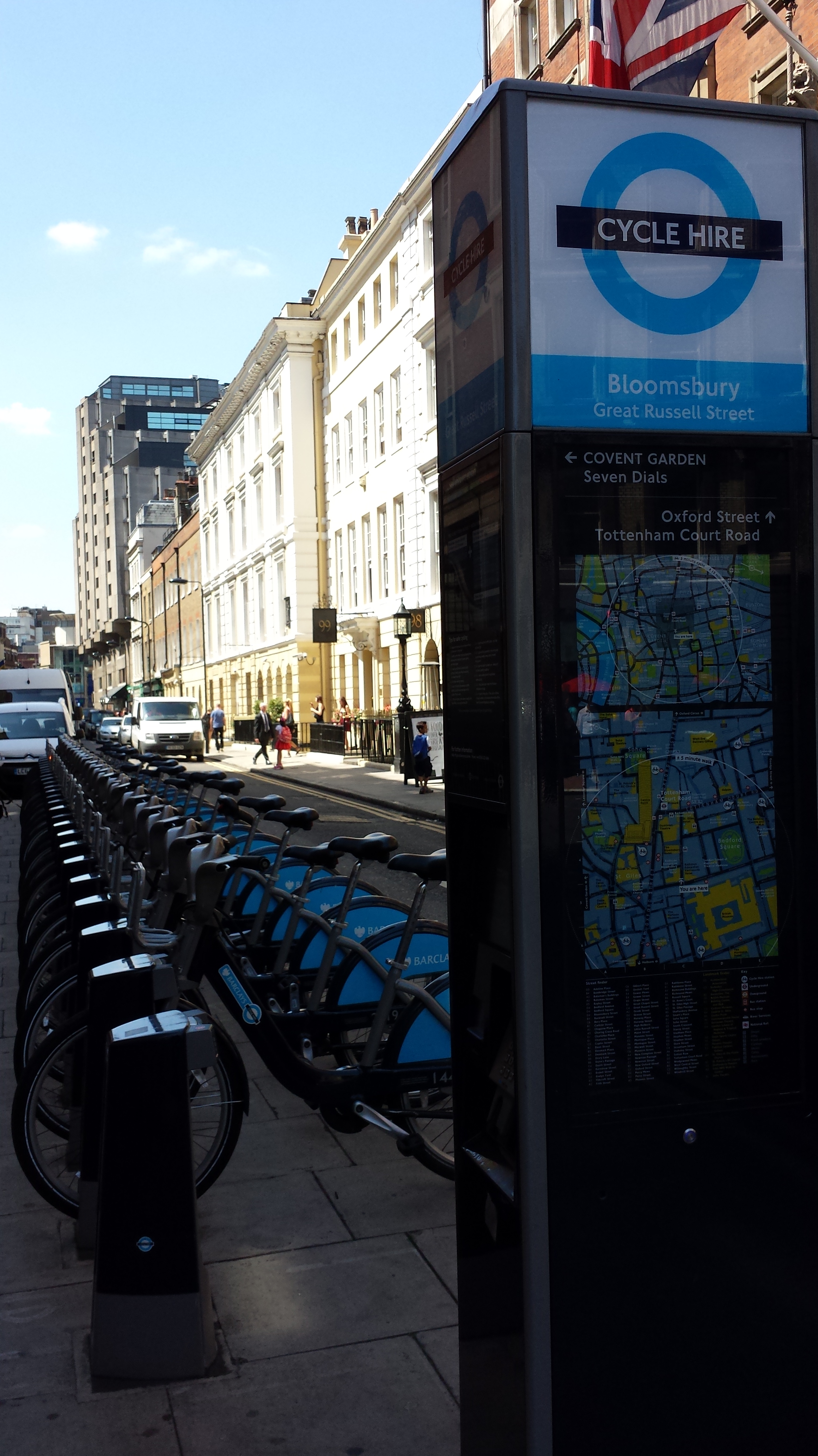
A fleet of ‘Boris Bikes’. In London, there’s usually one just around the corner.
With two days to see London, we booked two bicycle tours: the first, a Central Tour with the London Bicycle Tour Company; the second, an East End Tour with Cycle Tours of London. The Central Tour is a good place to start because it covers just about every London landmark on a tourist’s must-see list. The Houses of Parliament, Big Ben, Westminster Abbey, Trafalgar Square and St. Paul’s Cathedral are among the highlights of the Central Tour, timed perfectly by our guide Tarik de Vries so we could see the Changing of the Guard at Buckingham Palace.
While we watched soldiers in scarlet tunics and bearskin hats march down The Mall, Tarik regaled us with tales of over-zealous tourists bugging members of the Queen’s Guard. Soldiers standing all but motionless on guard are used to people posing for photos next to them. When that becomes a nuisance either because of physical contact or shouting, soldiers first stamp their feet, then issue a warning.
“When they raise their rifle, that’s considered a final warning,” said Tarik. “Next you’re detained.”
My favourite stop brought us to Westminster School, the only part of the tour I hadn’t visited before. Plenty of parks offer an escape from London’s crowds but the school, which stands in the shadow of Westminster Abbey, feels like a village. The streets are cobbled and on three sides of the green stand the school buildings, some of which date back to the 11th Century. Set back on the fourth side is Westminster Abbey, the traditional site for coronations and burials of Britain’s monarchy.
The peace and tranquility here – so remarkable in the centre of a city home to seven million people – contrasted dramatically with our ride to St. Paul’s Cathedral. Our approach from Smithfield Market (London’s central meat market with some absolutely gruesome history!) past the Old Bailey was busy enough before turning onto Ludgate Hill where traffic was so congested we cooled our heels on the equally congested sidewalk for a while. Congestion charge or not, motorists and pedestrians all appeared to have slowed down to admire Sir Christopher Wren’s masterpiece.
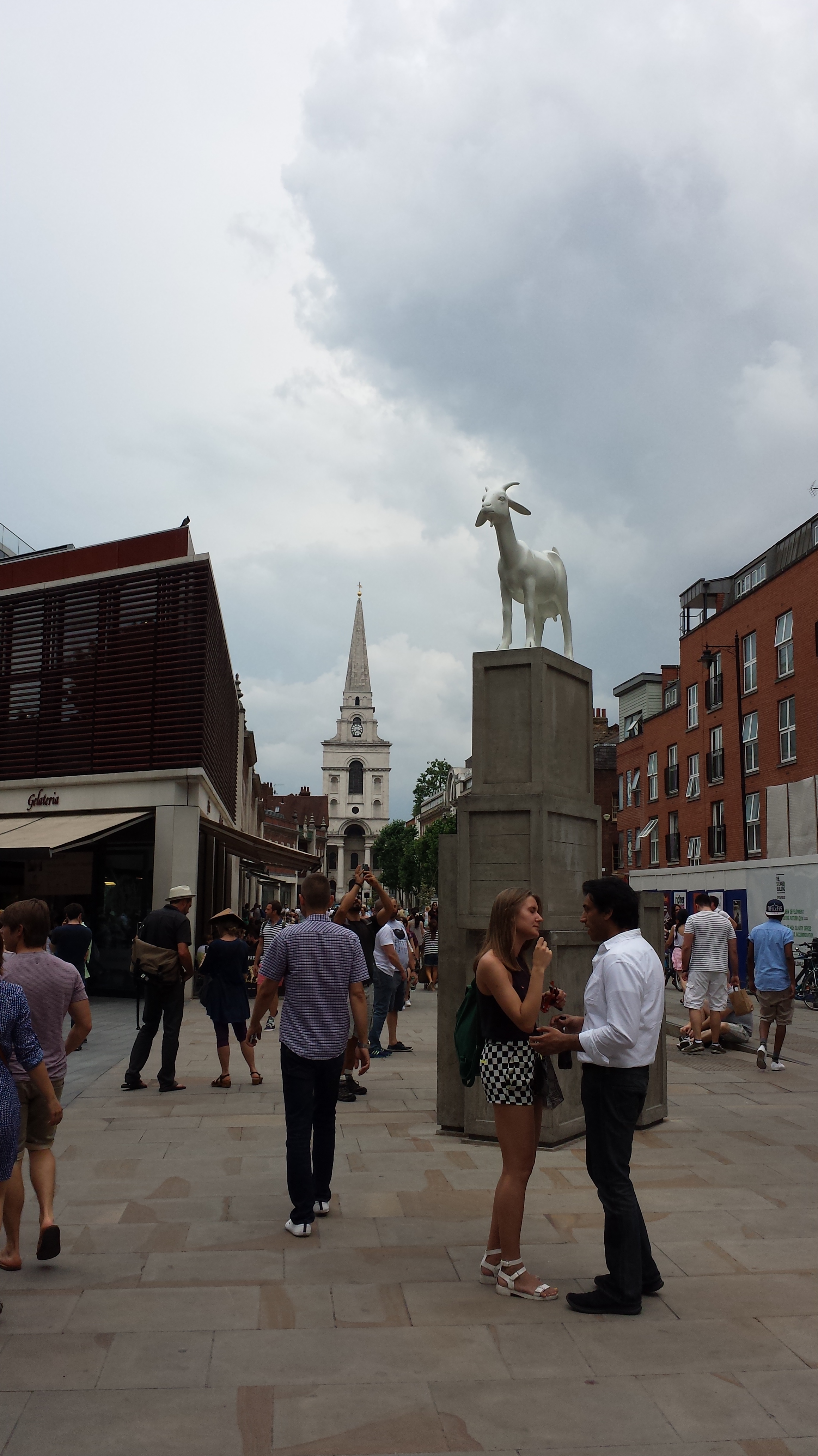
Shop, browse or chat – whatever floats your goat – at Spitalfields Market.
While Tarik covered London’s essentials, Mathew Tregaron’s East End Tour was a decidedly more offbeat excursion from a tourist’s perspective, making it all the more interesting. Tower Hamlets, so long synonymous with poverty and overcrowding, featured prominently in the tour, which also covered Shakespeare’s Globe Theatre, Southwark Cathedral and – a personal highlight – a ride across Tower Bridge.
Shortly after Tower Bridge we were at another old haunt, St. Katharine Docks. My dad, a marine engineer, used to bring the family here for boat shows and tall ships festivals. That was in the 1970s, shortly after St. Katharine’s warehouses were demolished and the area was commercially redeveloped. The stylish flats, yachting marina and pubs and restaurants are all still here. So, too, is the Tower Thistle Hotel, a corpulent, concrete monstrosity that epitomizes the worst of 1970s London architecture. But that’s just me.
In contrast to St. Katharine Docks, a failed attempt at gentrification is just a short ride away at Tobacco Dock. More than 200 years old, this abandoned brick and timber warehouse was turned into a shopping centre in 1990. Surrounding development failed to take off and dreams of creating an East End version of Covent Garden failed to materialize. The place has been abandoned for more than a decade. Yet until recently, piped music could be heard inside Tobacco Dock. A security guard still patrols the empty premises and, according to Mathew, spotless public toilets used to make this a timely stop on cycling tours.
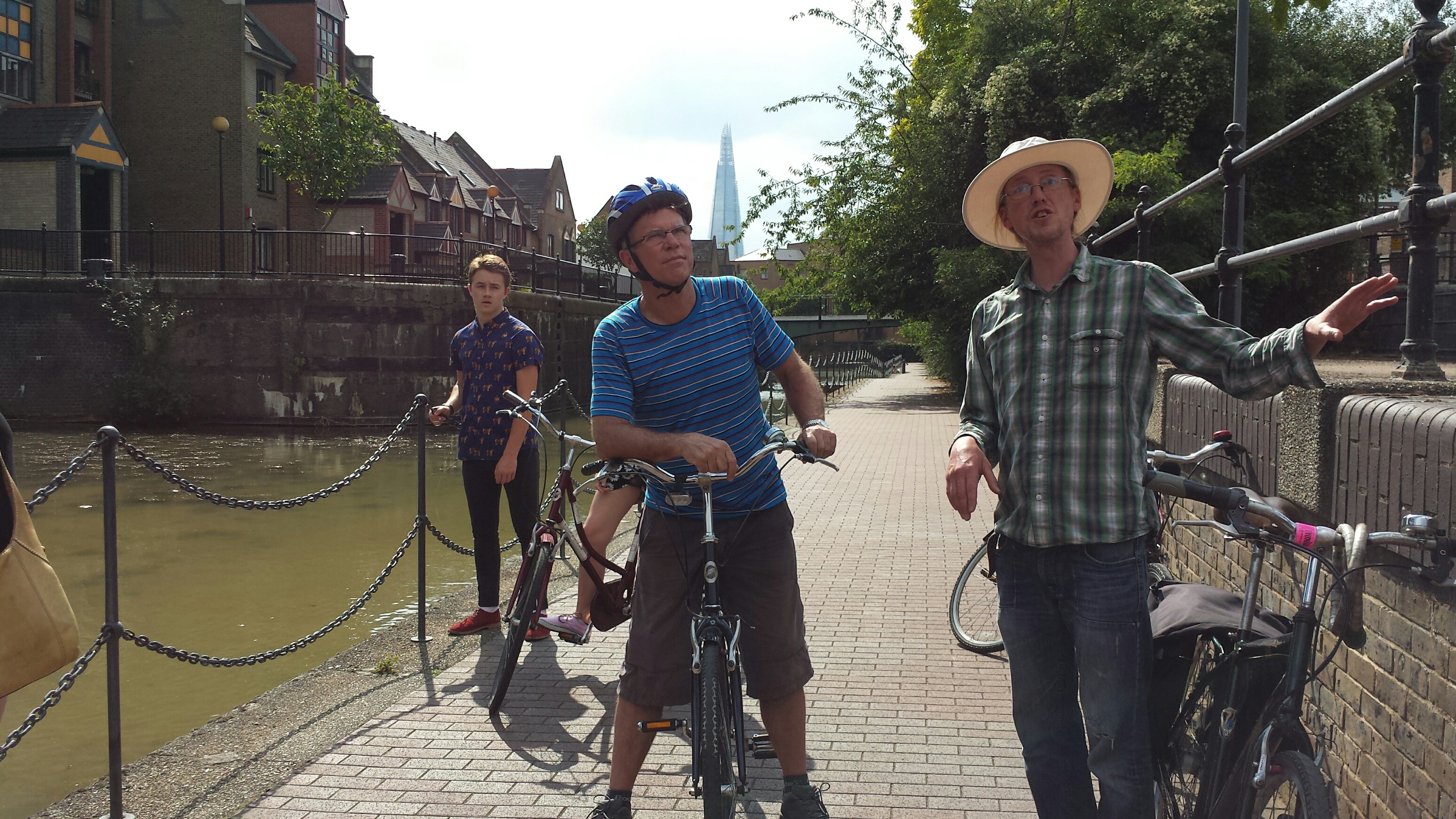
Mathew Tregaron (right) of Cycle Tours of London stops for a breather at deserted Tobacco Dock.
Infinitely more compelling is Cable Street and a mural depicting one pivotal day in London’s political history. For centuries, Tower Hamlets, with its close proximity to the city and the Thames, attracted waves of foreign immigration looking for employment. In 1936, looking for scapegoats for the country’s perceived ills, the British Union of Fascists targeted the community for a march. Despite the protection of some 6,000 police officers, the BUF’s supporters, known as Blackshirts, more than met their match. United under the rallying cry, “They shall not pass,” as estimated 300,000 residents prevented the BUF’s entry to London’s East End, but not without considerable bloodshed.
The Battle of Cable Street mural, begun in 1976 and restored in 2011, vividly depicts the violent confrontation of that Oct. 4 day. We propped up our bikes and lingered to admire the colourful tribute to this community’s resilience.
Following French Huguenots in the 17th century, Irish in the 19th century and Ashkenazi Jews into the 20th century, Bangladeshis form the main group of immigrants living here today. On nearby Brick Lane, clubs, pubs, markets, and some of the best curry restaurants in the UK compete for space. On weekends it’s packed. On a quiet Tuesday afternoon we cycled down the middle of Brick Lane just wishing we could stop for a chicken tikka masala.
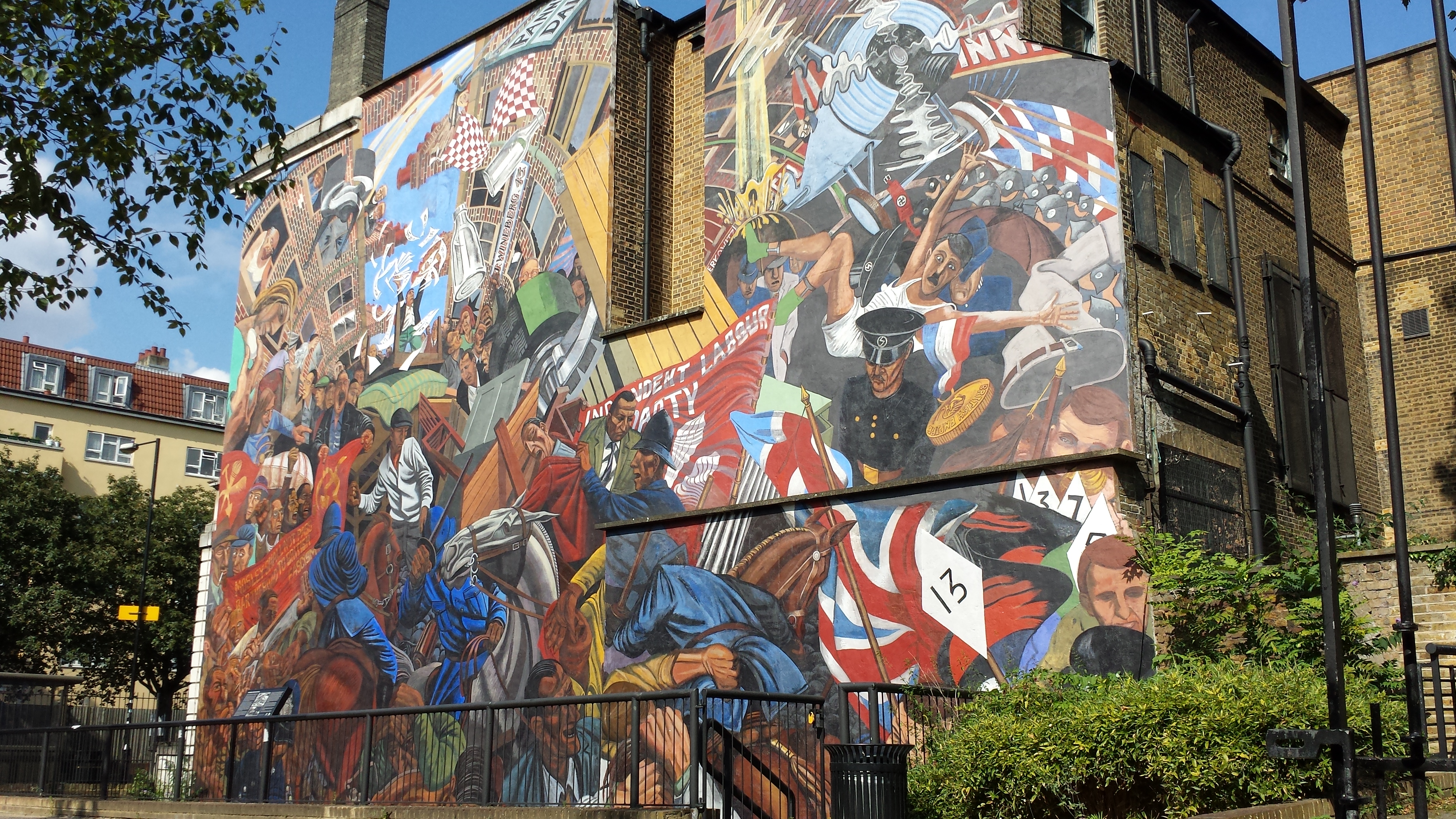
A pivotal day in London’s political history is vividly depicted in the Battle of Cable Street mural.
Before we returned to Mathew’s bike store on Shoe Lane, we stopped at Postman’s Park, once a popular spot for General Post Office workers. In 1900 it became home to the Watts Memorial to Heroic Self Sacrifice. Thirteen years earlier, an ardent socialist named George Frederick Watts had first proposed a park commemorating otherwise ordinary people who’d given their lives attempting to save others. Fire, drowning and train accidents dominate the brief but brave stories documented on glazed Doulton tablets.
Like so many of the stops on Mathew’s tour, Postman’s Park felt like a refuge from London’s bustle. It was only as we left I realized that first job of mine was just a few streets away. I might have found it sooner with a bike.
If you go:
- The London Edition recently launched a family package, featuring a loft or loft suite plus complimentary connecting room, with “big kid/little kid” treats, including a movie night and a London-inspired in-room tent. Rates start at $920 a night. For details of this and other packages visit edition-hotels.marriott.com/London
- Cycle Tours of London’s East End Tour takes about three and a half hours and costs about $35. Details of this and other tours at biketoursoflondon.com
- The London Bicycle Tour Company’s Central Tour takes three hours and costs about $43. For details of this and other tours, visit londonbicycle.com
- For more information about cycling in London, check out visitlondon.com
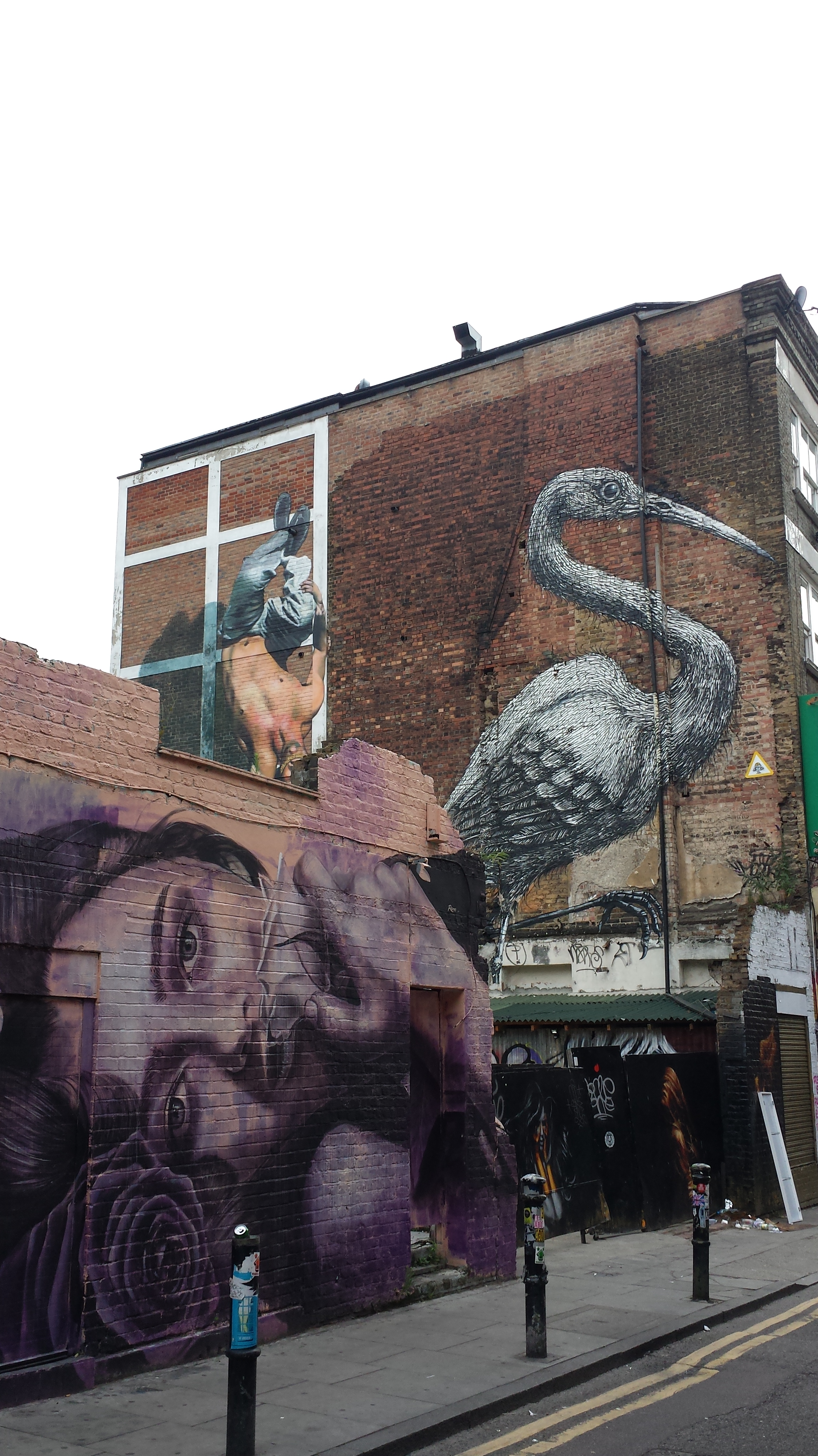
Street art pervades Brick Lane and adjoining streets like Hanbury Street, where the giant crane by Belgian artist ROA is hard to miss. Community uproar dissuaded Tower Hamlets council from covering it with a banner before the 2012 Olympics.
It takes a village to raise a beer festival
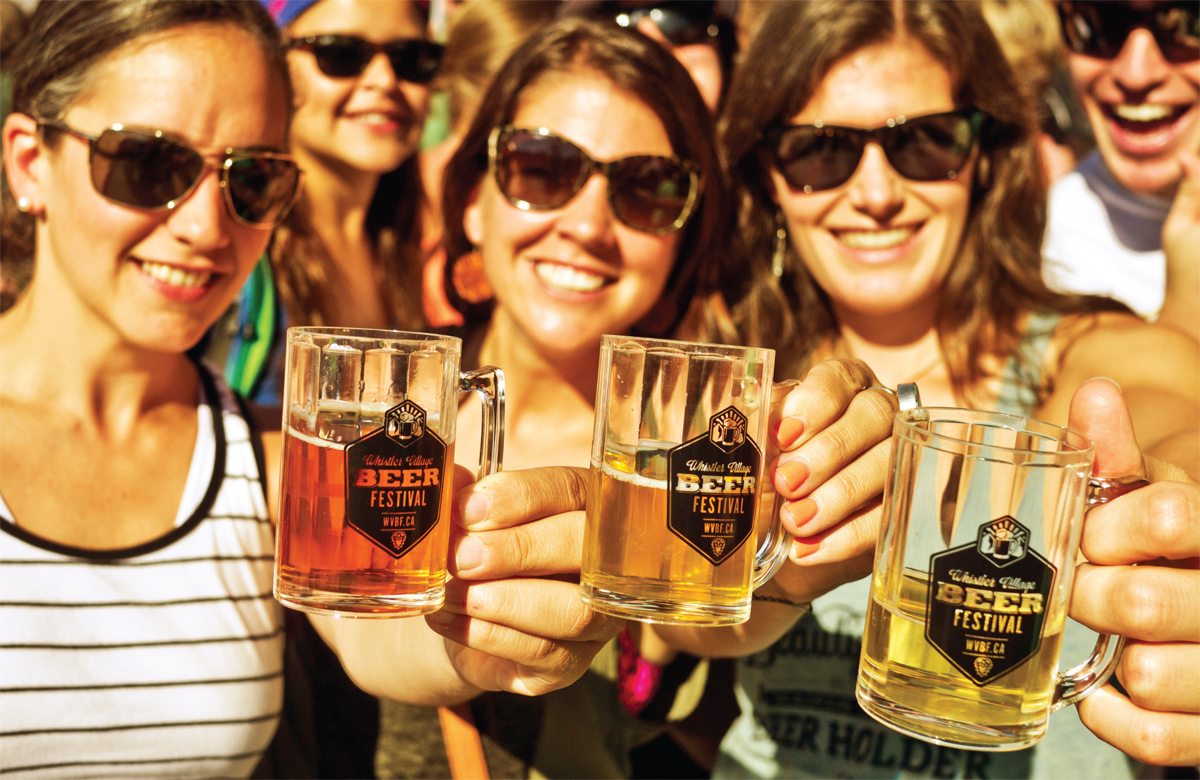
According to Benjamin Franklin, beer is proof that God loves us and wants us to be happy. Benjamin may have been on to something.
A cultural experience, not a chug fest, is how Liam Peyton describes this weekend’s second annual Whistler Village Beer Festival (Sept. 11-14). That’s not to say the four-day celebration is solely for purists: Far from it.
“There’s something for everyone,” says Peyton, who organizes the festival, which features more than 150 beers from 50 breweries in Canada, the U.S. and Europe. Along with Saturday’s main tasting showcase from 1 till 5 p.m. at Whistler Olympic Plaza, there are a broad range of events to immerse guests into beer culture, including beer dinners, seminars, parties and cask showdowns.
The latter particularly appeals to the expat Brit, who hopes his responsibilities hosting more than 4,000 visitors still allow him to attend a showdown or two.

Saturday’s tasting showcase at Whistler Olympic Plaza features more than 150 beers from 50 breweries.
“The cask showdowns feature one-offs, rare brews created for the event,” says Peyton. “You meet the brewmasters, sample the ales and vote on what you like.” The festival hosts three showdowns – Best of the Island, Best of the Mainland, and Best in West (U.S. West Coast breweries).
Cask showdowns are among several new additions to the festival, which is significantly bigger than the 2013 edition.
“Last year we had six events between four venues. This year there are 31 events spread over 11 venues,” says Peyton. He credits several reasons for the growth. “Last year we went from scratch to a sold-out festival in 10 weeks. Some people were skeptical to begin with but then participating venues saw their revenues jump 40 per cent and the 31-degree weather didn’t hurt either.”
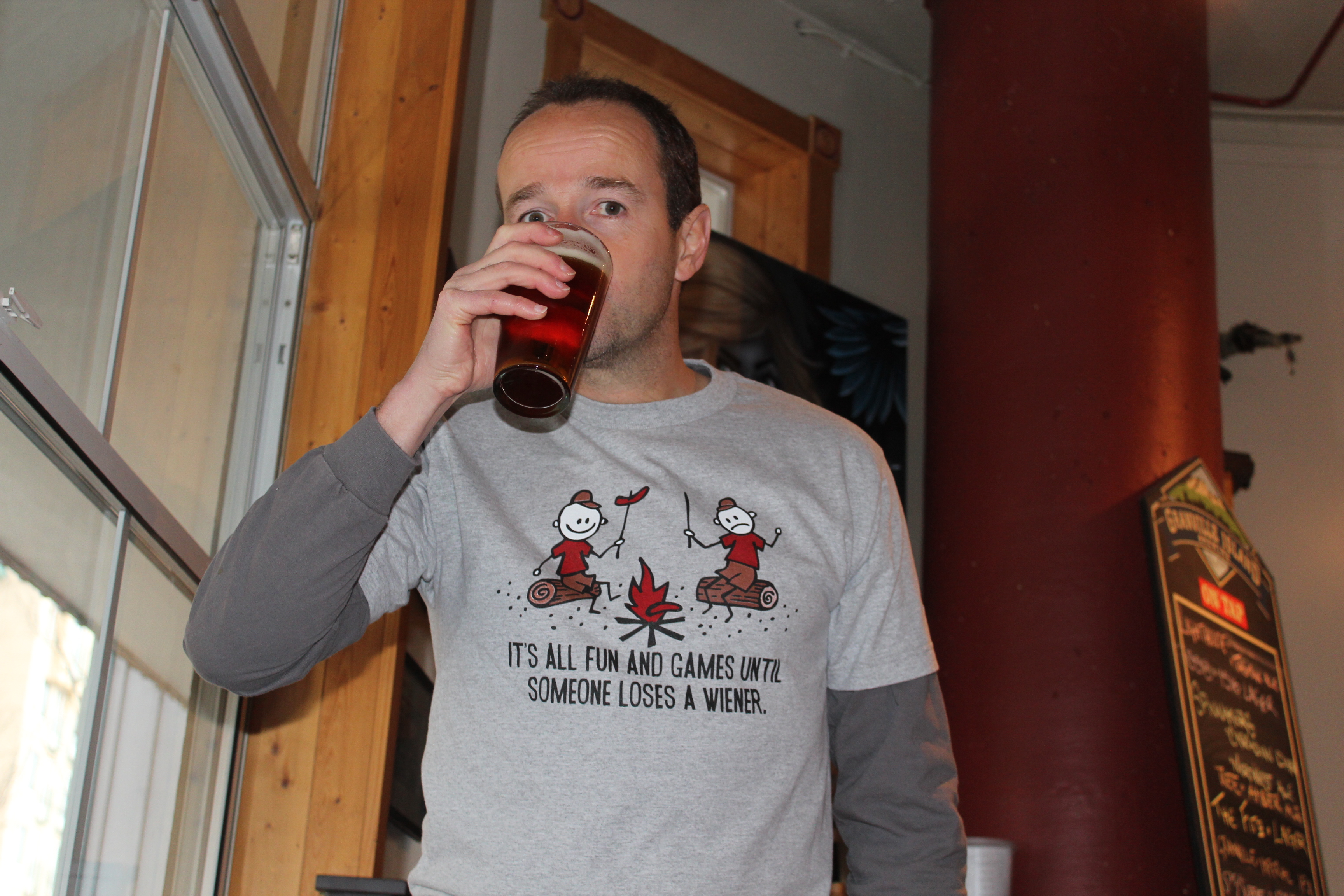
Just one of the many interesting T-shirts I’ll be wearing at the Whistler Village Beer Festival.
Now familiar with navigating B.C.’s quirky liquor laws and with 12 months to organize this year’s festival, Peyton says he’s confident he’s ahead of the curve. “It’s a little unnerving at times, but we’re far ahead in organization and in ticket sales now compared to where we were this time last year.”
At 27, the transplanted Birmingham native comes by his love of both Whistler and beer honestly, having worked as doorman, barman and manager of The Longhorn Pub before joining Gibbons Hospitality Group in 2009.
The company represents many of Whistler’s best-known pubs and created the annual beer festival to drive more business to the area, as well as forge new partnerships. Top placing breweries in Saturday afternoon’s Best in Fest voting, for instance, win one-year draught contracts to supply local venues. Local hotels are participating, including the Westin Hotel, (westinwhistler.com) which is hosting beer seminars and the Summit Lodge and Spa, (summitlodge.com) which presents nightly beer tastings. The festival also offers a food voucher program, allowing festival-goers to get $5 off meals in local restaurants.
As for Peyton’s favourite brews, IPAs are a good start. After a birthday pilgrimage in April-May to brewing hot spots in Washington, Oregon and northern California, he returned a dedicated fan of Deschutes, Lagunitas and Pyramid breweries.
“For my 27th birthday we stopped at Deschutes Brewery in Portland,” recalls Peyton. “They made me a Black Butte Porter ice cream float as a birthday cake!”
You’ll find all three breweries at the second annual Whistler Village Beer Festival, Sept. 11-14.
- For festival tickets and a full schedule of events, visit wvbf.ca

Stay thirsty my friends.
Summer in Whistler begins at the lake
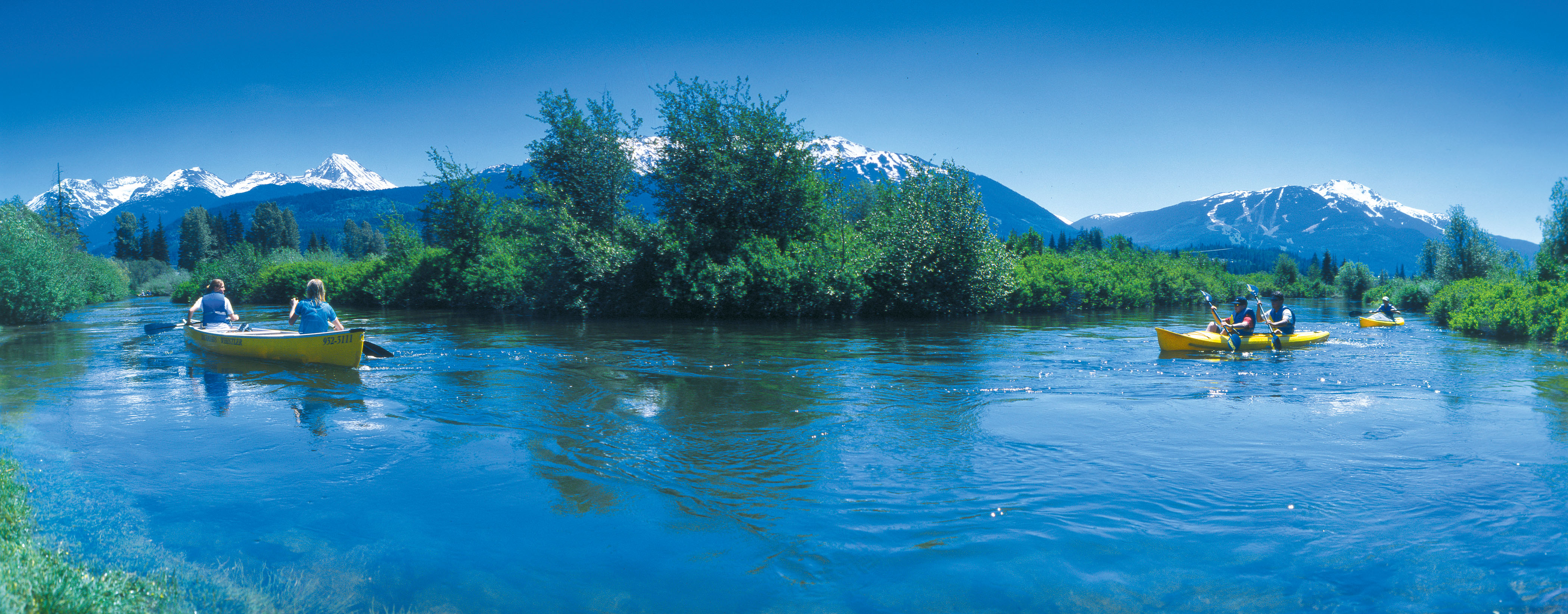
The River of Golden Dreams is an idyllic waterway for a quiet paddle … unless you find yourself in the middle of Whistler’s annual Go Fest and the Great Snow-Earth-Water Race. riverofgoldendreams.com photo
A quiet meander down the River of Golden Dreams, I’d promised my wife. After 36 hours of skiing, cycling, trail running, stand-up paddle boarding, dancing, eating and drinking, this would be a relaxing canoe cruise in the sunshine, a chance to mellow ourselves from weekend warriors to weekend wanderers.
It didn’t work out that way.
We’d come for Whistler’s Great Outdoors Festival, aka GO Fest. Held on the Victoria Day long weekend, GO Fest was the chance to cram an entire Whistler summer of activities into four days. A packed schedule had offered everything from fly-fishing to disc golf, river rafting to yoga, and much in between that involved wearing a silly costume.
By Sunday, my legs were aching from Saturday-night’s AlpenGlow Fun Run, a six-kilometre jog around Lost Lake, while wearing glow sticks. Or they might have ached from skiing Blackcomb’s Seventh Heaven all day; or from jumping up and down to The Sheepdogs during Friday night’s concert in the village.

The River of Golden Dreams connects Alta Lake and Green Lake. riverofgoldendreams.com photo
Cycling Whistler’s Valley Trail on Sunday morning, we stopped at Lakeside Park where we met Eric White of Backroads Whistler. When he told us about paddling the River of Golden Dreams, the timing seemed perfect: No pressure to perform; tranquility now. Backroads Whistler even picks you up at the end of the two- to three-hour paddle.
“People were coming here for the lakes long before the skiing,” Eric pointed out. “I think you’ll really enjoy it.”
To get our sea legs we warmed up with a stand-up paddle boarding session. Stand-up paddle boarding, or SUP, has taken off in recent years and it’s easy to see why. Not unlike snowshoeing, SUP offers a short learning curve and gets you closer to the elements. It can be as relaxing or as strenuous as you want. Eric gave us a quick tutorial on the dock and we were off.

Pasty Englishman attempts balance feat on stand-up paddle board!
The Kahuna boards designed by Whistler local, Steve Legge, were exceptionally stable, despite my initial fears of falling. (The lake ice broke just a month before!) It only took a couple of lengths between Lakeside’s docks for it to begin to feel like a core workout.
Now acclimatized to the occasional gusts picking up on Alta Lake, we paddled to shore for a new vessel.
Backroads offers kayaks and double kayaks but we opted for a two-person canoe. The canoe requires smooth communication between paddlers to navigate the notoriously tight corners of the River of Golden Dreams.
It’s also known as “The Divorce Boat,” according to Eric.
“We’ve only been married 23 years, what could possibly go wrong?” I asked my wife.
The River of Golden Dreams connects Alta Lake with Green Lake about three kilometres north. Because of its stubborn refusal to follow a straight line, the river’s full length is closer to five kilometres. In places, the river is barely wider than a canoe and portaging is sometimes necessary, depending on water levels, which can fluctuate rapidly depending on rain and snow melt.
After a quick paddling tutorial, we donned our lifejackets and set sail. Within 15 minutes we’d crossed Alta Lake and were nearing the mouth of the river. That’s when I noticed people waving at us from a bridge. Seconds later we heard a siren – the kind that’s normally accompanied by a loud voice shouting “release the hounds”.
“Why are those people waving at us?” asked my wife from the bow.

riverofgoldendreams.com photo
The answer appeared over our left shoulders: canoeists, two to a boat and wearing helmets and numbered pinnies, launching from a nearby beach and paddling straight for us. Unsure whether the people on the bridge were waving us in or away, we opted to paddle for the river, full steam ahead.
At the bridge we made two discoveries. The first was that we’d need to portage a few yards because we’d arrived at a weir. The second was that we’d unwittingly joined a pivotal leg in GO Fest’s Great Snow-Earth-Water Race – a grueling six-stage competition involving skiing, biking, running and canoeing.
“We’re expecting two dozen canoes through here,” a young man with a radio told us. “You might want to sit out and let them through.”
It occurred to me that on a narrow, winding river with few passing lanes and a head start, we could actually try and win the race. Then my wife reminded me that this was supposed to be a cruise. She also said something about ethics.
So for 20 minutes we perched at a picnic table and watched contestants portage their canoes around the weir and back into the river, cheered on by locals. When everyone had passed us, we re-launched and quickly learned to adapt to the river’s ever-changing moods: turn too tightly and fast eddies would pull us into the reeds; lose concentration and we’d find ourselves turning sideways to the current.
But the lush wetlands and snowy peaks beyond the banks made up for the occasional brushes with low branches. Better yet, during the course of our 90-minute paddle we became minor celebrities to those who had turned out to cheer on the racers. Everyone loves plucky losers and despite not wearing race pinnies, we were assumed by many to be the last-place finishers in the canoe stage of the Great Snow-Earth-Water Race.
I still think we probably could have won it!
The River of Golden of Golden Dreams (Backroads Whistler – riverofgoldendreams.com or 604 932-3111) is just one of a multitude of adventures awaiting visitors to Whistler this summer. Here are five more.

Several runs atop Blackcomb and the Horstman Glacier are open for skiing and boarding until late July.
Hit the Valley Trail: For a better perspective on Whistler’s surroundings get out of the village and onto the Whistler Valley Trail. More than 40 kilometres of paved trail and boardwalks connect Whistler’s lakes, parks and neighbourhoods. The trail is suitable for bikes, rollerbladers, joggers, walkers and well-behaved pets. Whistler.com offers more information on making the most of the Valley Trail, including a blog on the trail’s “six perfect spots”.
Shred the Park: Valley Trail offers a benign cycling experience and cross-country cyclists will find more than 500 kilometres miles of single track around Whistler. The Whistler Bike Park though condenses the best of Whistler’s downhill for all levels of mountain biker. Ride the lift up and take your pick of alpine view trails, banked cruisers through the forest, tight, winding single track and – for the experts – steep rock faces. Whistler Bike Park offers numerous ticket deals, including some with rentals, and accommodation packages. More information is at whistlerblackcomb.com.

Buckle up and ride the Elaho! Eric Beckstead photo
Ride the river(s): If paddling the River of Golden Dreams is too tame for you, consider whitewater rafting either of the Green, Lower Cheakamus, Elaho or Squamish rivers. A range of half-day and full-day tours are available from Whistler, (whistler.com/rafting) or from the Sunwolf Centre in Brackendale near Squamish (sunwolf.net/rafting).
Fly by the seat of your pants! The most exciting thing I’ve ever done in Whistler is ziplining at Cougar Mountain, just north of Whistler. Superfly Ziplines (superflyziplines.com) runs Canada’s longest, fastest, highest ziplines where speeds of more than 100 km/h are made possible by runs well over a kilometer long, 200 metres off the ground. Strap into a paragliding-style harness, attach to half an inch of galvanized steel with a trolley rig and prepare to fly! Ziptrek Ecotours (ziptrek.com) combines similar thrills above Fitzsimmons Creek with a strong environmental ethos.

Ziplining at Cougar Mountain, just north of Whistler.
Ski in a T-shirt: For all the great winter skiing at Whistler, the novelty of descending Horstman Glacier while wearing a T-shirt in July is hard to beat. Until late July, two or three runs, plus the terrain park remain open atop Blackcomb where lunch on the deck of the Horstman Hut is a must.
* For details of summer accommodation packages, visit fourseasonswhistler.com

Sip and cycle in Osoyoos

Silver Sage Pearle is a port-style wine made from blackcurrant and blackberry. The tasting notes tell me it’s good with cheese cake, vanilla ice cream, or mixed with vodka, or with champagne.
There are a couple of other things it’s good with, according to Silver Sage sales manager, Elena Dudlettes. “It’s good with a Cuban cigar,” she says. “Or just with a Cuban. Carlos, Ramon, Enrique … take your pick!” she adds with a wink.
“Your team loses in the last minute and you need a drink,” she says, introducing the next wine for us to taste. “There’s nothing wrong with a glass of this with bacon and eggs for breakfast,” she says of the Silver Sage Gewürztraminer. “Hey, you don’t do bad things, you have nothing to talk about,” she says about … I can’t recall what that was about.
Elena had me at hello.
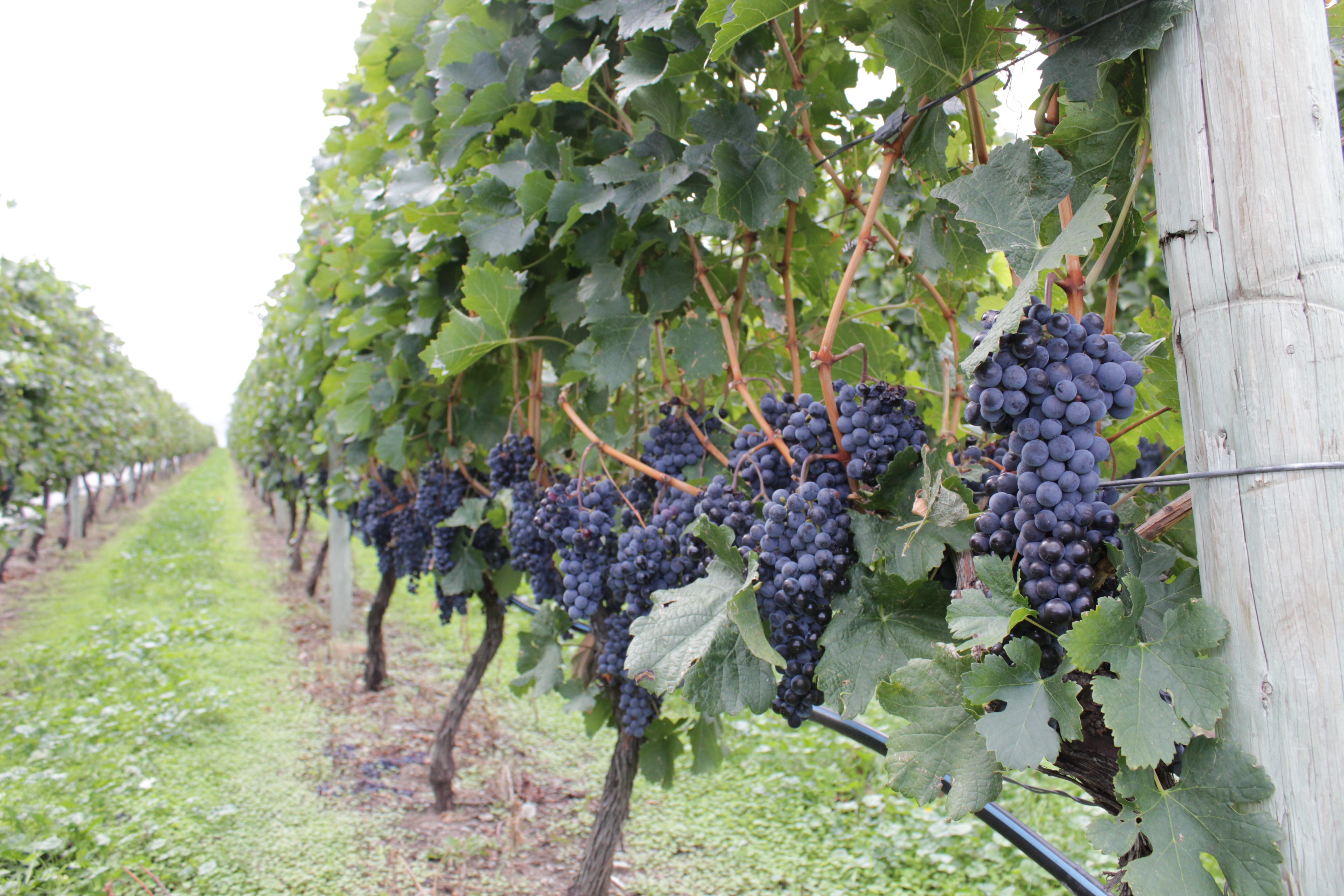
Dark blue and ripening fast, these grapes soon became Merlot at Hester Creek, the first winery on a tour of the Golden Mile Bench near Osoyoos.
Silver Sage is the last of seven wineries on a Sip and Cycle Tour through Okanagan wine country last October. Several hours earlier, five of us had set off with Richard Cooper, owner of Heatstroke Cycle and Sport. Cooper was born and raised in Osoyoos and operates Heatstroke from the Watermark Beach Resort on Osoyoos Lake.
I’d been expecting pedal bikes. After over-indulging in goat cheese lamb meatballs, pan-seared scallops and flank steak in the Watermark’s tapas bar the night before, I’d been hoping for pedal bikes. If I was to visit seven wineries, I reasoned that I’d have to earn every sip. The sight of bright orange Pedego electric bikes leaves me mildly disappointed.
Until I try one.
In seconds, I speed up Hester Creek’s driveway just by easing back on the throttle, mounted on the handlebars. I coast back to the bottom and do it again for fun.
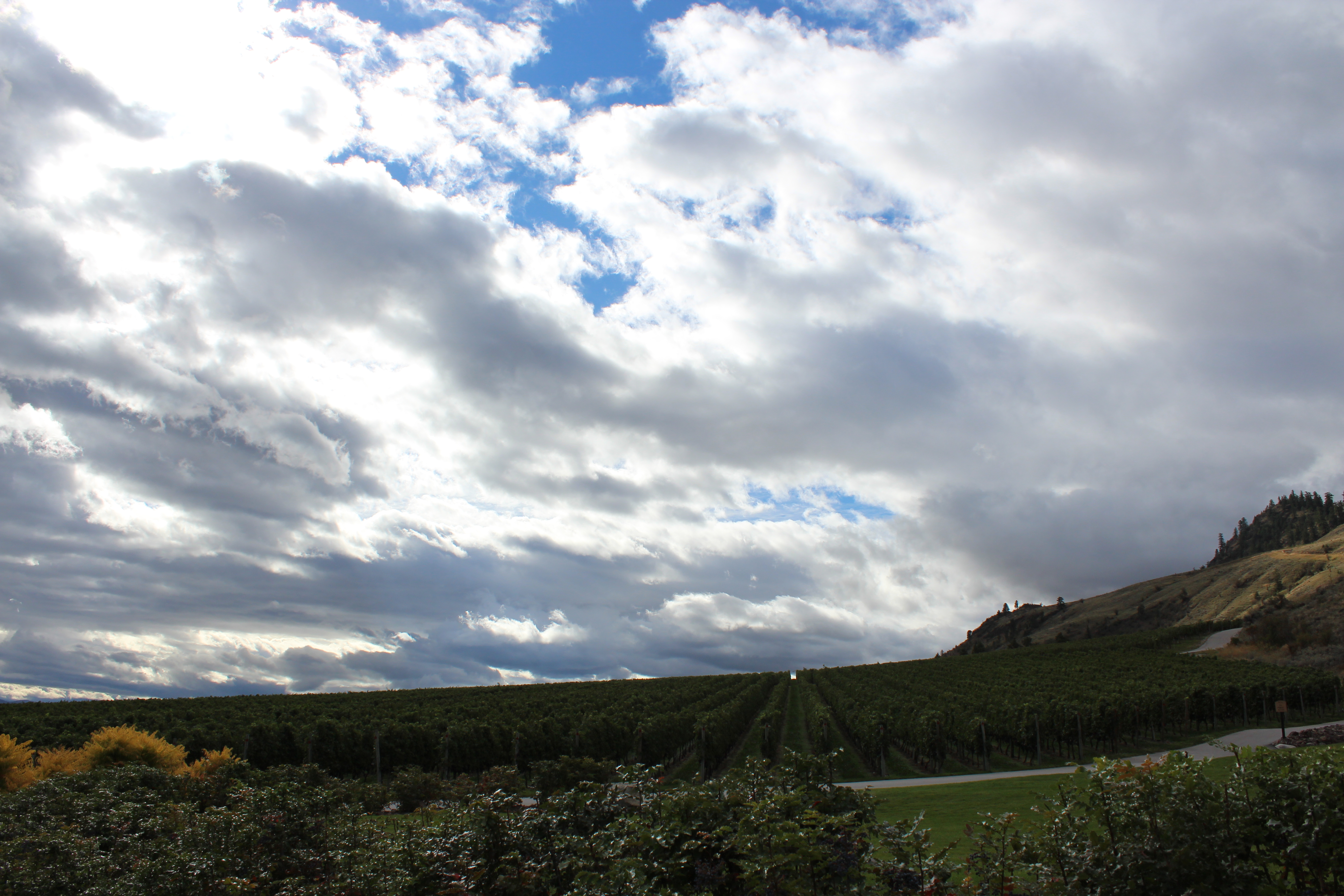
Hester Creek, the first stop on the Golden Mile Bench – three verdant terraces and a series of alluvial fans on the slopes of Mount Kobau between Osoyoos and Oliver.
“I told you it was like riding a bike,” says Cooper, who’s used to guests falling in love with his bikes. “There’s no way we could keep to our schedule on ordinary bikes. And let’s be honest, who wants to pedal uphill on a wine-tasting tour?”
He’s got a point.
Hester Creek is our first stop on the Golden Mile Bench – three verdant terraces and a series of alluvial fans on the slopes of Mount Kobau between Osoyoos and Oliver. As well as an opportunity to taste a multitude of great wines, the Sip and Cycle Tour is a lesson in geography, chemistry and history, key ingredients in the area’s wine production.
Luke Whittall greets us Hester Creek and first pours a taste of the Character White, which includes a blend of the Okanagan’s only Trebbiano. The award-winning Trebbiano is made from some of the oldest vines on Hester’s Mediterranean-style estate, but sadly, it has “Elvised,” says Whittall. “Left the building, sold out,” he adds by way of explanation. Like the Okanagan Valley itself, the Golden Mile terroir and its blend of gravel, silt, clay and sand, was formed as glaciers retreated 10,000 years ago, says Whittall.
Just above the valley floor, the Golden Mile is better protected from severe frost. In fact, knowing that a single degree Celsius can make a huge difference to wine quality, vineyards use wind machines to blow away cold air.

Only on a wine-tasting tour can you really appreciate what a 48-volt, 10-amp electric engine can do. The Pedego is one sweet ride!
“We’re left with amazing soil composition around different creeks,” says Whittall, who gives us a 101 class in how local geology can affect grapes and the wines they produce. Whittall has worked in most aspects of the wine industry, from crushing grapes under foot (“the Stairmaster from hell!”) to the VQA (Vintners Quality Alliance), the regulatory body guaranteeing quality and authenticity of origins for Canadian wines.
We try Hester’s Reserve Merlot, Late Harvest Pinot Blanc (similar to an ice wine, but not) and my favourite, The Judge – a hugely fruity red that smells of pepper and caramel, and makes me want to order a steak immediately.
Next-door to Hester Creek at Gehringer Brothers, Bob Park gives us several of the vineyard’s 22 wines to taste and a pocket history of the region. “Walter and Gordon Gehringer bought the property in 1981 when there were only four estate wineries in B.C.,” says Park. “They were taking a bit of a gamble. Back then, the few wineries were protected from foreign competition and made cheap wine for local markets.
“NAFTA [the North American Free Trade Agreement signed in 1991] changed that. Knowing they couldn’t compete with California wine producers, the government paid B.C. wine producers to rip up their inferior hybrid vines and replace them with premium European grapes and promote a shift to higher value wines.”
Today there are more than 200 wineries in B.C. and 60 varieties. “Last summer, wine was the number one best seller, according to the Liquor Distribution Board,” points out Park. “It used to trail behind beer and spirits.”
I thank Park for the history lesson and buy a bottle of Gehringer’s Auxerrois. We’re back on the bikes and waving at passing motorists who look bewildered at how easily we speed along the Okanagan Highway. Just down the highway at Inniskillin, Audrey Silbernagel leads us directly to the main event – Inniskillin’s Tempranillo Icewine. The sweetness seems to last forever and at under 10 percent alcohol, I’m not about to leave anything at the bottom of the glass. It might be the most beautiful thing I’ve ever tasted. On impulse, I tell Silbernagel I’d like a bottle and hesitate only for a moment when I discover it’s a $100. (My budget blown, I passed on the $35 Riedel icewine glass.)
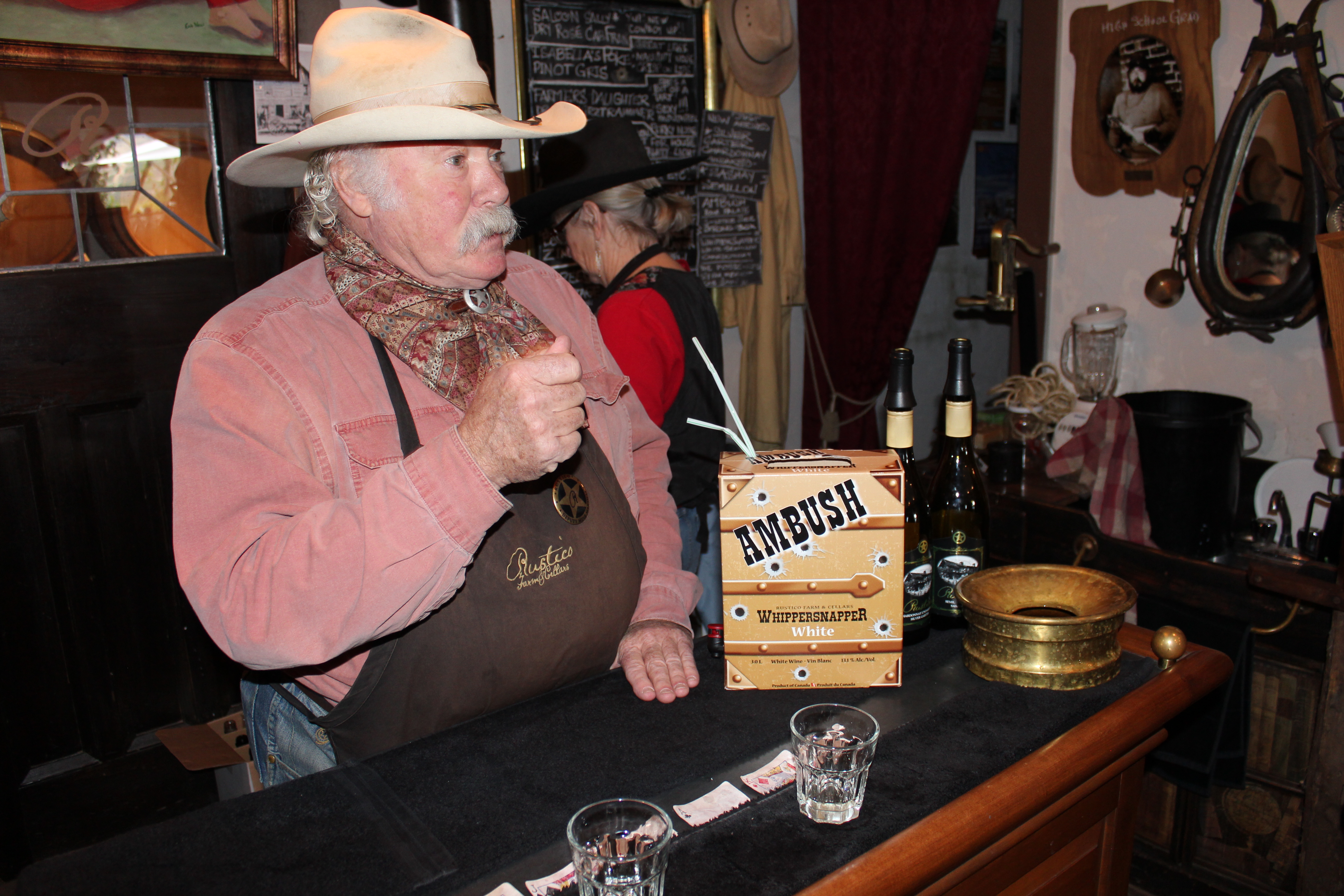
Bruce Fuller, the larger-than-life owner of Rustico Farm and Cellars.
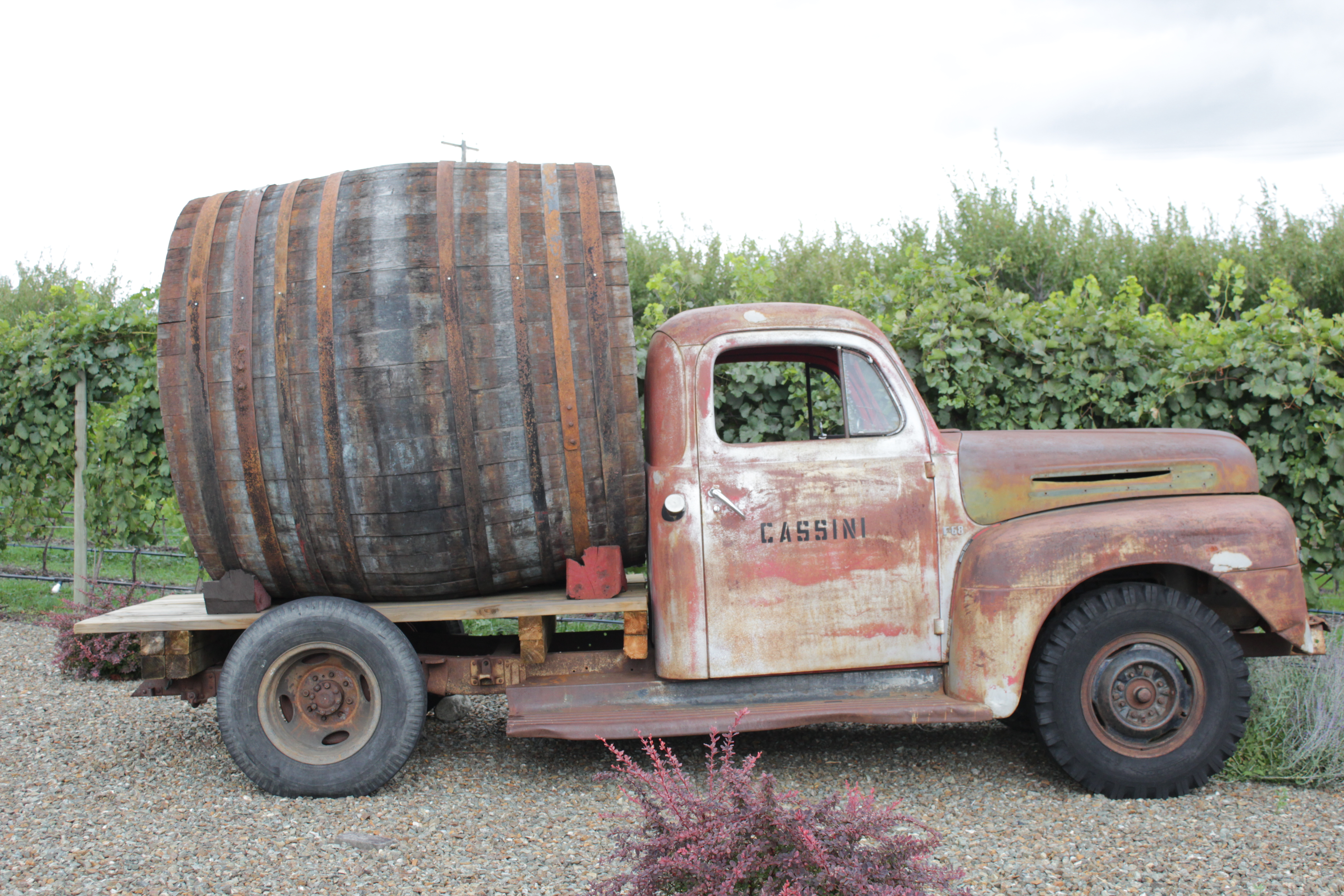
Tastes of Mamma Mia Pinot Gris, Sauvignon Blanc, Moscato, Syrah, Quattro and Maximus follow at Cassini Cellars, poured by owner Adrian Cassini himself. “How involved are you in the daily business?” one of our group asks Cassini.
“Today is Sunday and I’m here,” says Cassini with a tired smile. “So are my wife and daughter.” Cassini used to run fitness clubs in Vancouver. “Then I had a mid-life crisis and decided to build a vineyard,” he says.
Someone else obviously putting his heart soul into the business is Bruce Fuller, the larger-than-life owner of Rustico Farm and Cellars. Fuller’s in cowboy gear when he greets us and he stays in cowboy character as he tells jokes almost as quickly as he pours Rustico wines into whiskey tumblers. Fuller’s tribute to the Okanagan’s mining and ranching history is behind names like Bonanza Zinfandel, Mother Lode Merlot and Isabella’s Poke, a Pinot Gris with a saucy story.
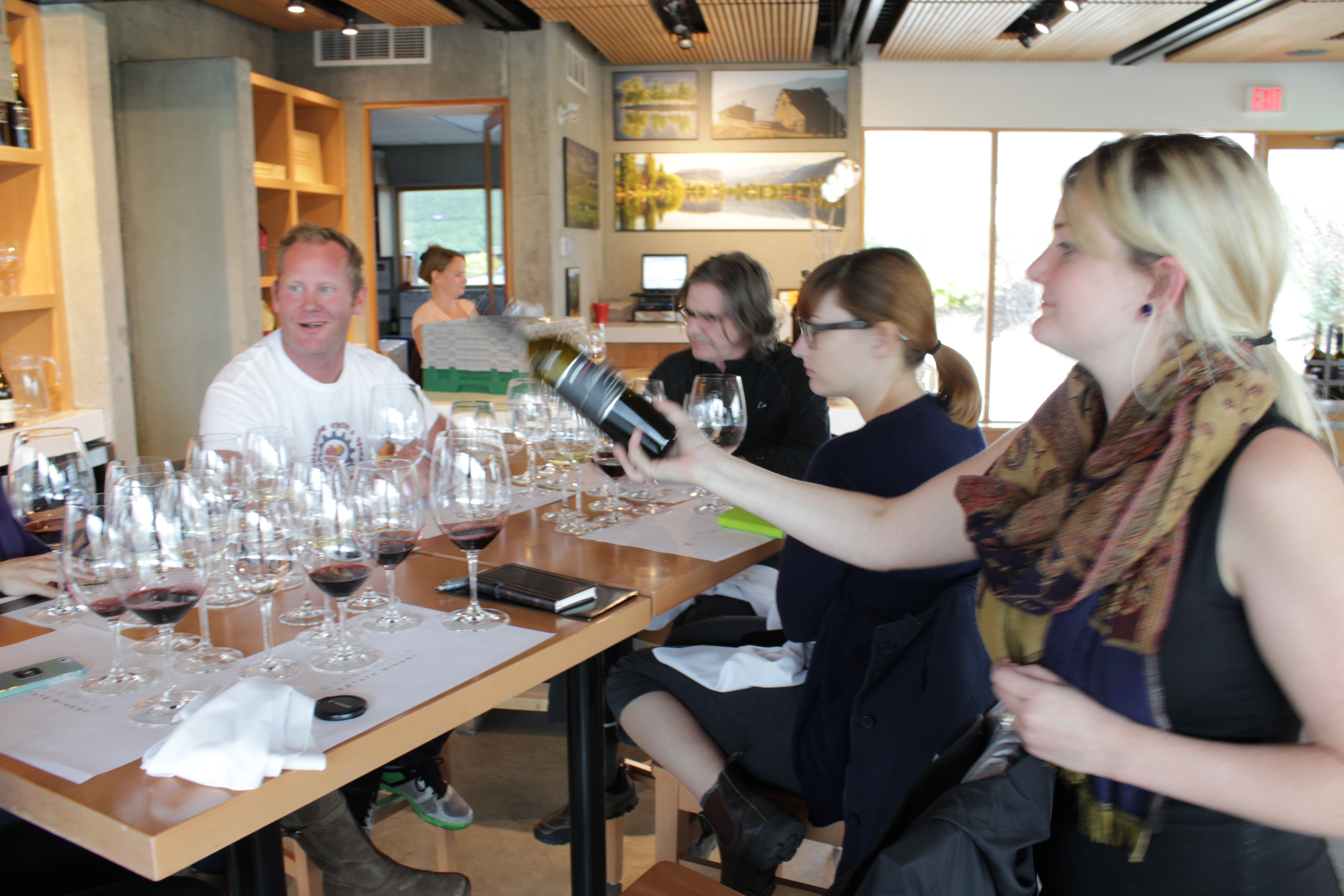
At Black Hills Estate Winery, a dedicated ‘wine evangelist’ pours a bottle of 2011 Nota Bene, a Bordeaux-style red wine.
We turn off the Okanagan Highway and throttle up to the Black Hills Estate Winery. With its manicured lawns, swimming pool, cabana and sleek tasting room, Black Hills is the antithesis of Rustico. A ‘Wine Evangelist’ already has a table set with numerous glasses ready for tasting. Lunch is served and we taste our way through several vintages, including a Carmenere, unique in that Black Hills is the only winery in Canada producing this varietal on its own. I forget the budget I’d broken three wineries ago and buy a bottle of Black Hills Chardonnay. At Silver Sage Winery, I’m powerless to resist the smooth-talking Elena and buy a bottle of Sage Grand Reserve because Elena says it complements turkey and Thanksgiving is only a week away. (For the record, Elena was right.)
Coasting along Black Sage Road, with seven wineries behind us and pedaling just for show, I truly appreciate what a 48-volt, 10-amp electric engine can do. At $2,400, the Pedego is a sweet ride. Looking back, I’m just relieved I didn’t try and buy the bike as well.
If you go:
The Sip and Cycle Tour plus one-night’s stay at The Watermark Beach Resort is $169. Call 1 855 270-7699 1 855 270-7699 or visit watermarkcycling.ca and heatstrokecycle.com for more details.
Las Vegas: The beaten track and the single track
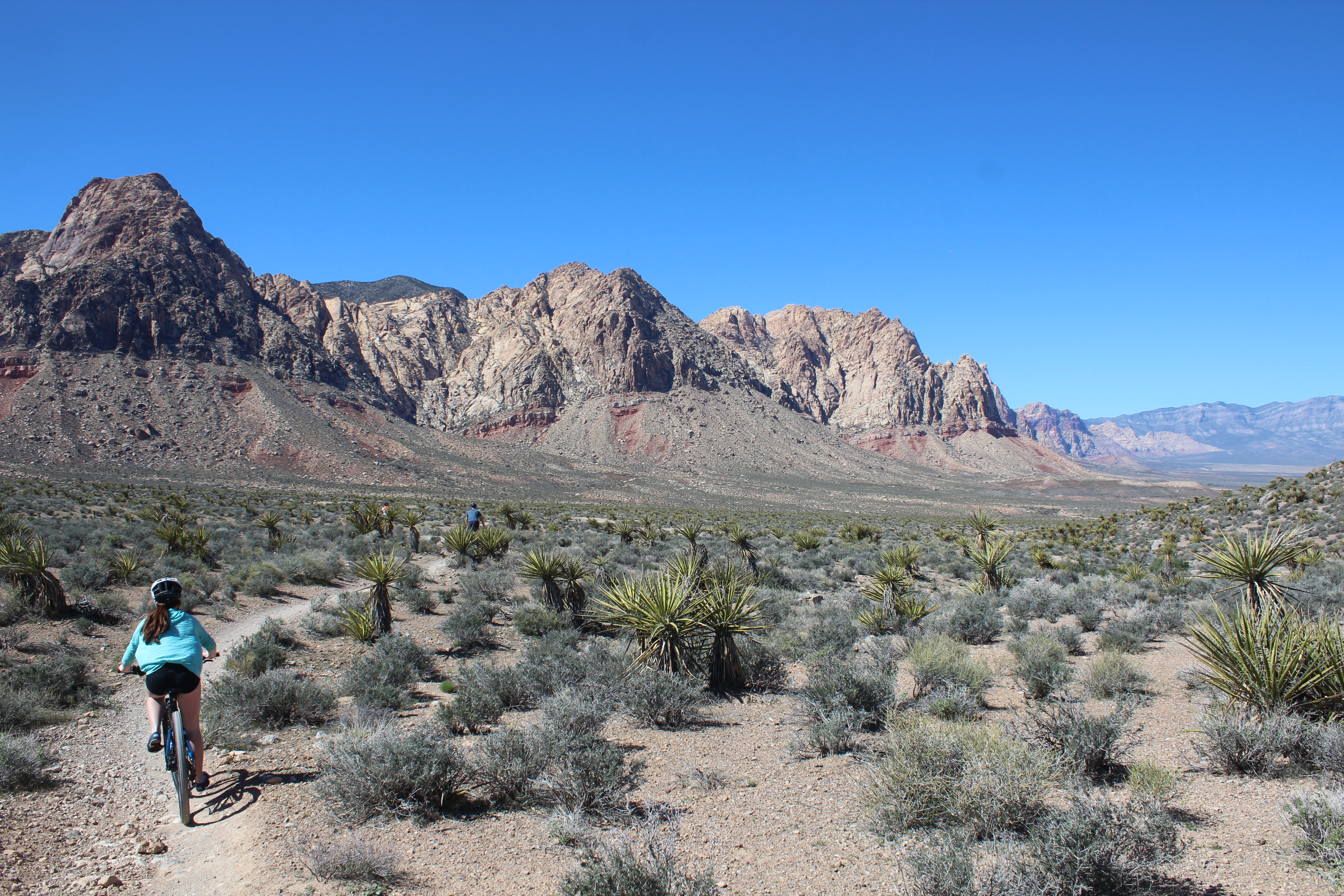
For a city synonymous with late nights, Late Night Trailhead just outside of Las Vegas is decidedly different. There are no buildings besides an outhouse, no meandering pedestrians or neon, and certainly no noise. Instead you’ll find about 200,000 acres of desert known as Red Rock Canyon, home to tarantulas, rattlesnakes, burros, bunnies and wild vegetation that can either harm or cure you.
More than 80 miles of trails lure another desert creature, namely the mountain biker – about 2,000 of them locally, according to Brandon Brizzolara. Brizzolara is a guide and mountain bike specialist for Escape Adventures and Las Vegas Cyclery. He grew up in Vegas and fondly remembers when even The Strip had its own biking scene.
“From Tropicana to Fremont we’d have BMX sessions on The Strip like it was a skate park in the 90s,” he says. “Vegas is a pretty active community, it’s just The Strip that’s a little out of shape.”
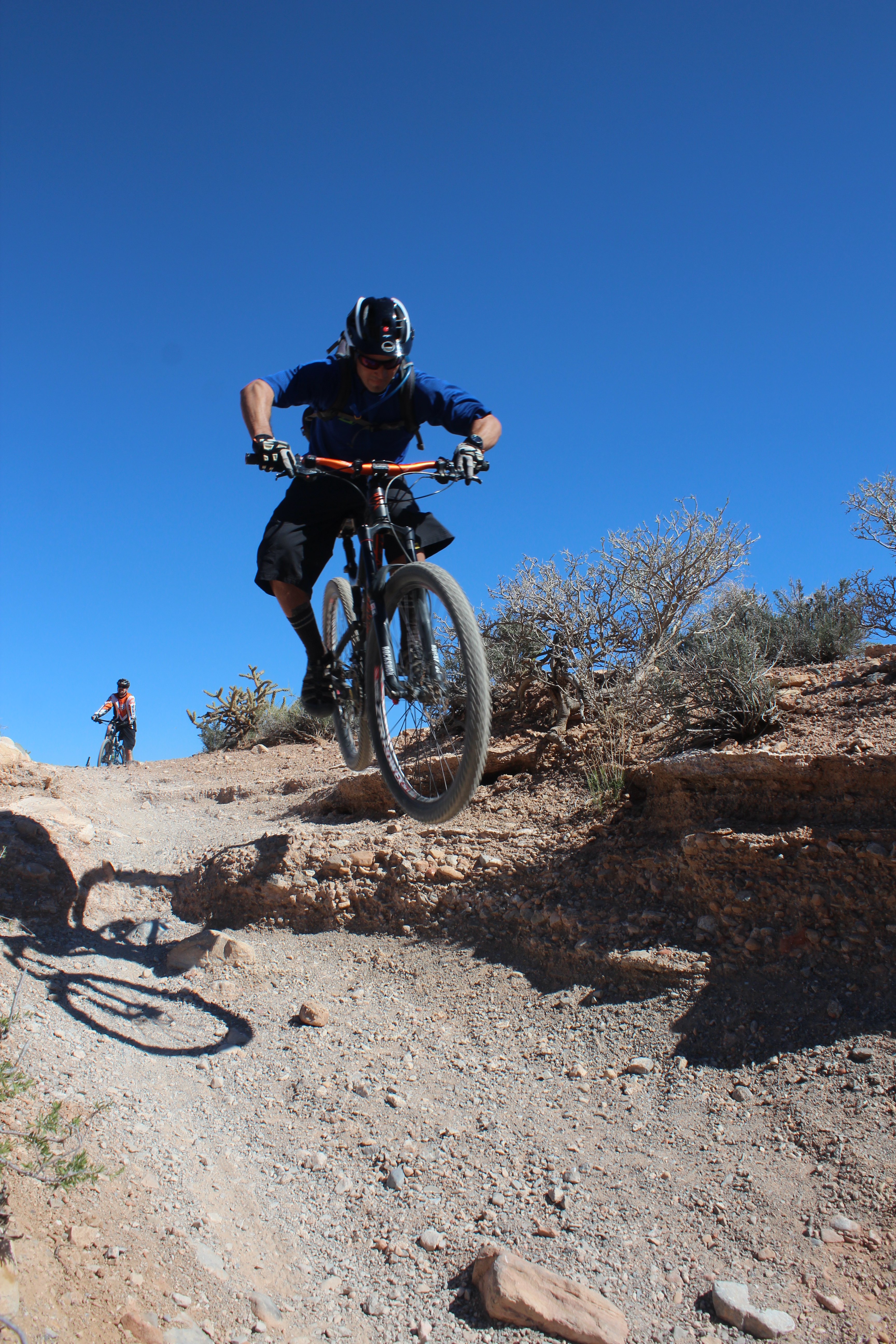
Brandon Brizzolara, guide and mountain bike specialist for Escape Adventures and Las Vegas Cyclery.
We’re here for The Strip and the desert – the beaten track and the single track: Neville and Leah and their teenagers, Ryan and Emma, all of us with contrasting wishes and expectations for our three-night stay in Las Vegas.
Shopping had been my kids’ idea. For hours we’d lost ourselves in high-octane consumerism at Miracle Mile Shops at Planet Hollywood Resort and Casino, a consumers’ paradise with 170 stores, 15 restaurants and several entertainment venues. Britney Spears has her own store here where Britney merchandise exhorts shoppers to “Work it, Bitch”.
It’s a legitimate vice in Sin City, but shopping – and Britney Spears – make me uncomfortable so I stood with a crowd and watched a guy get his belly tattooed at Club Tattoo. Leah got a manicure at Original Diva and had nails “to die for” long after returning home. Ryan and Emma blew their entire budget.
On all of our wish-lists was a Vegas show. Britney had taken March off so we chose Cirque du Soleil’s Zarkana, a celebration of circus traditions set in an abandoned theatre (but in reality at the Aria Resort and Casino). The show blends anarchic humour with the precision and grace of aerialists, acrobats, jugglers, high-wire and trapeze artists. The clowns made Ryan uncomfortable but he’s only 16; otherwise we left well entertained.
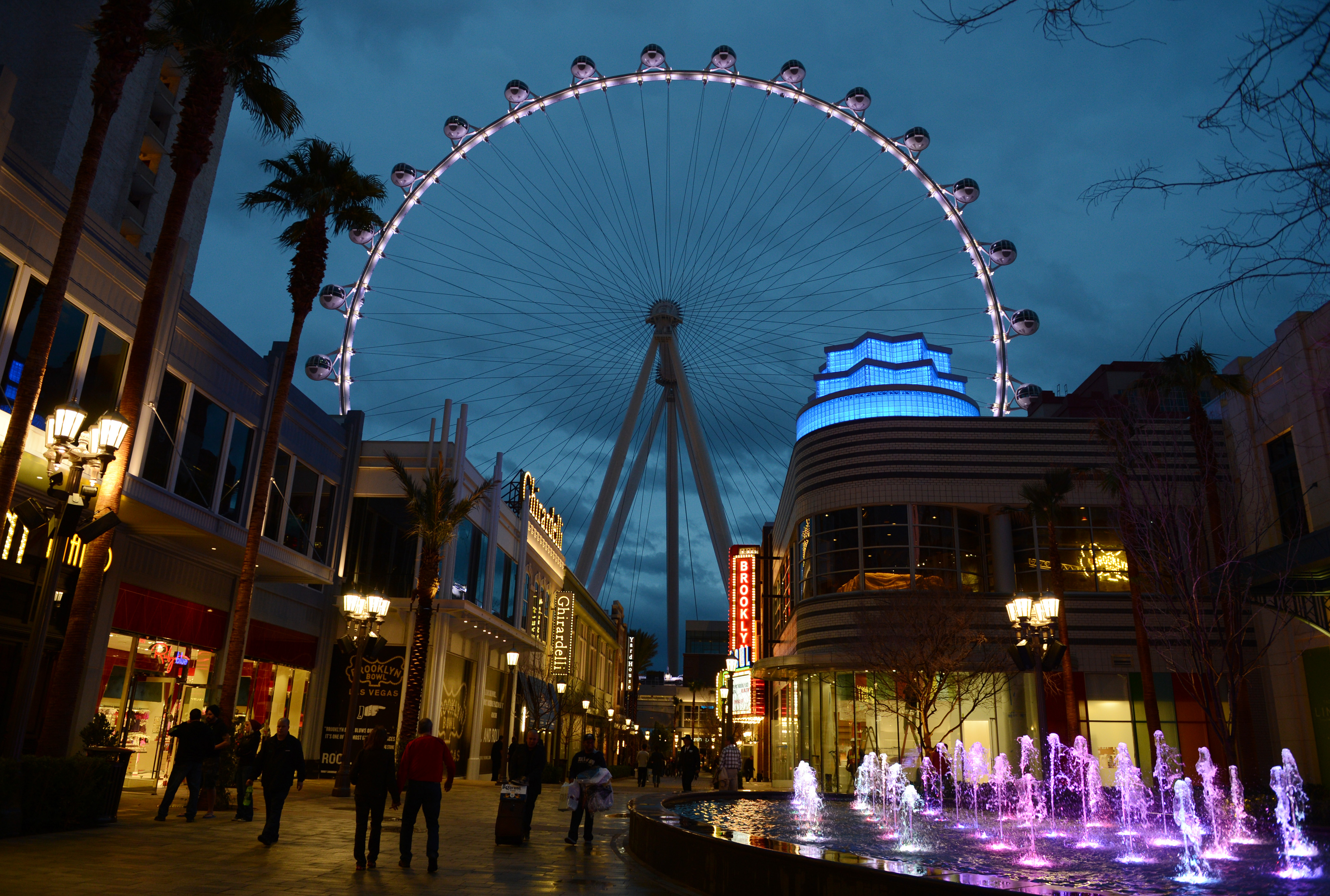
At 550 feet tall, the High Roller is the crown jewel in Caesars Entertainment Corporation’s LINQ development, a pedestrian-friendly neighbourhood on The Strip. The High Roller opened March 31. Denise Truscello photo
The spa treatment was Leah’s idea, but I was happy to tag along. For the Vegas rookie it can be tricky finding places on foot and ESPA at the Vdara Hotel was no exception. We could see it set back off The Strip, but The Strip has a way of keeping pedestrians on The Strip. We eventually got there by walking through another hotel, The Cosmopolitan. Any stress I might have felt at being late for a spa treatment soon melted away under the sensuous heat of volcanic stones, body brushing, exfoliation and a scalp massage. Beats shopping any day of the week!
Great food was on everyone’s list and the following three restaurants more than delivered. The Yard House enjoys an enviable location just a few feet from the High Roller, the world’s biggest observation wheel. At 550 feet tall, the High Roller is the crown jewel in Caesars Entertainment Corporation’s LINQ development, a pedestrian-friendly (hallelujah!) retail, dining and entertainment neighbourhood on The Strip. The High Roller opened March 31, two weeks after our visit, but we were content to admire it illuminated in green for St. Patrick’s Day from the deck of the Yard House. The beer list alone would entice me back to the Yard House, but the St. Louis-style ribs and truffle fries had me at hello.
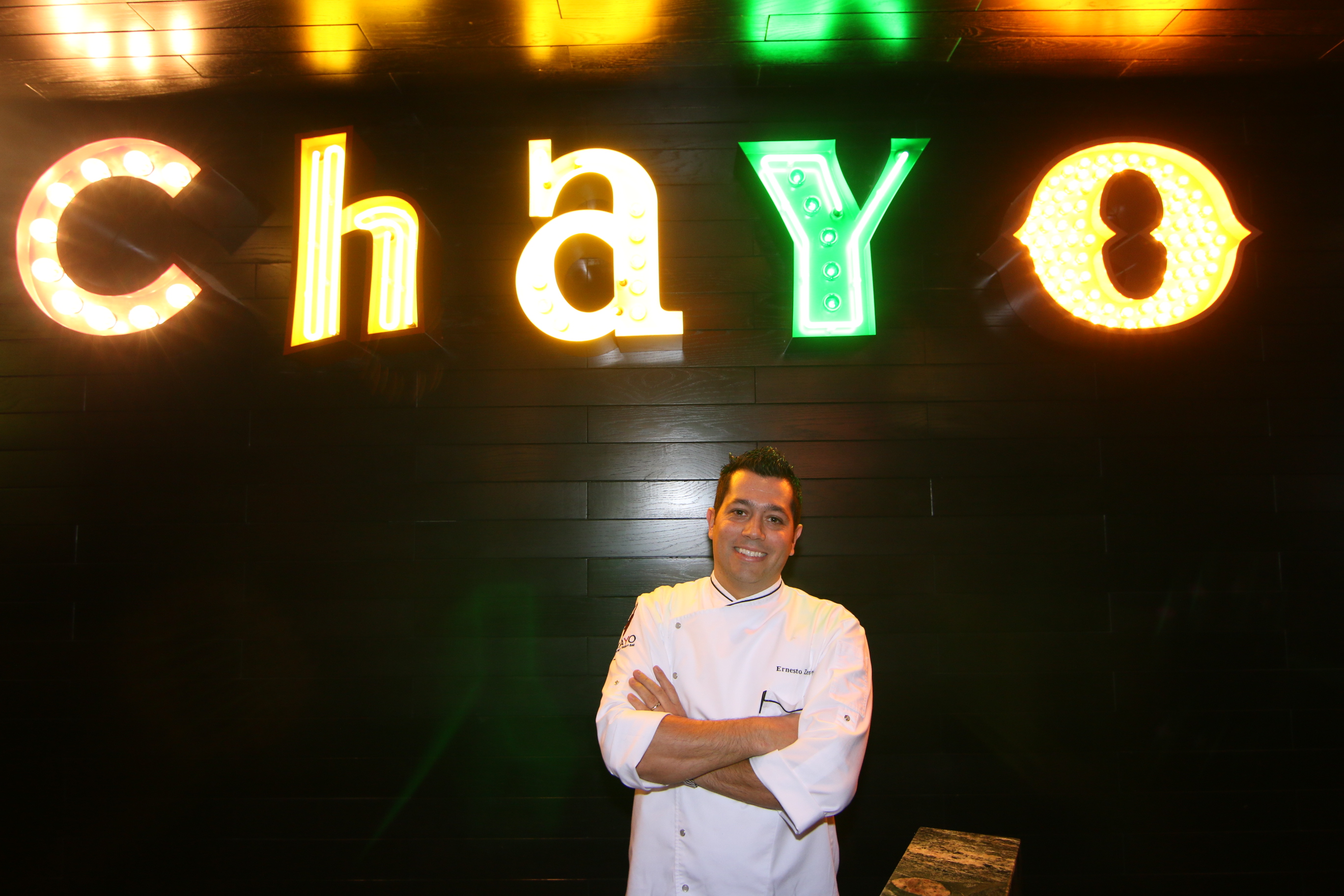
Chayo chef, Ernesto Zendejas.
Just a short stroll through the LINQ brings you to Chayo Mexican Kitchen and Tequila Bar, a two-storey fiesta in the making, anchored by a mechanical bull. Mexico City-born chef, Ernesto Zendejas, draws upon classical training in France to present an exquisite mix of flavours: Lobster tacos, bass ceviche, cilantro cream soup, shrimp fajitas – it’s tough to pick a favourite, but none of us were lining up to ride the bull afterwards. (Portions are decidedly North American – not French!)
Plates are meant to be shared at Crush, one of many dining options at the MGM Grand, but our family came close to making a scene over the sea scallop benny, comprising sunny-side quail egg, chorizo and chipotle hollandaise. Some meals are too good to be shared. The shrimp risotto and lamb sirloin with bacon brussels sprouts also didn’t last long.
Between the shopping, the show, the spa and the dining, we savoured afternoon pool time. In downtown Las Vegas, we mingled with celebrity lookalikes and body-painted models at the Fremont Street Experience, five city blocks of high-tech wizardry featuring a 550,000-watt sound system and a music and light show broadcast from an LED canopy 90 feet above the ground.

Sea scallop benny at Crush, MGM Grand. Don’t even think about sharing.
And we ventured a little off downtown’s beaten track. Further down Fremont Street, past El Cortez, the city’s first casino, we found The Beat Coffeehouse and Records, the hippest little joint for breakfast and heaven to a 16-year-old who’s just discovered vinyl.
Nowhere though seems quite so off the beaten track as the Mojave Desert and the single track of Red Rock Canyon. The mountain biking had been my idea. Only 17 miles west of Las Vegas Boulevard, Red Rock’s Mustang Trails might have been on another planet, such is the contrast with The Strip.
For two hours we mostly coast on easy trails, stopping occasionally for impromptu descriptions of the vegetation. Brizzolara says he hasn’t taken a pill in more than 10 years, and why would he with nature’s pharmacy on his doorstep? There are seemingly cures for all ailments in the numerous sage bushes and plants like Mormon’s Tea, a species of Ephedra, which is traditionally used to treat asthma, hay fever and the common cold.

Ryan Judd in his element at Red Rock Canyon.
If inducement to remain on the bike were needed, there are no shortage of plants that could make for a painful landing: cacti, whose barbs expand after piercing skin, and the Joshua Tree, whose bayonet-shaped leaves feature serrated edges – handy for cutting barbecue wieners, according to Brizzolara. We stay on our bikes. My daughter, Emma, who’s never mountain biked, struggles gamely and mostly ignores her dad telling her to relax.
It’s the same advice she gave me at the Britney Spears store.
If you go:
- Las Vegas Cyclery (lasvegascyclery.com) and Escape Adventures (escapeadventures.com) offer year-round tours (half day and full day) for mountain bikers and road cyclists, as well as hiking tours. If mountain biking, you’ll ride full suspension Santa Cruz 29ers and tours start at $129. Call 1 800-596-2953
 1 800-596-2953.
 - We divided our accommodation between the Downtown Grand Las Vegas (downtowngrand.com) and the MGM Grand (mgmgrand.com). Formerly the Lady Luck, the Grand recently reopened after a $100-million renovation. It’s steps away from the Fremont Street Experience and features PICNIC, a wonderful rooftop pool. The MGM Grand more than holds its own on the pool front with four to choose from and a lazy river. It also offers Stay Well rooms, which comprise more than a dozen health and wellness features, including aromatherapy, wake-up light therapy and Vitamin C-infused shower water.
- For more on ESPA at Vdara, visit Vdara Hotel and Spa.
- For more on Las Vegas, visit vegas.com
-
- Guide Brandon Brizzolara points out the good, bad and ugly of desert flora and fauna.
-
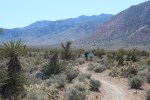
- The Las Vegas mountain bike community numbers 2,000-plus. Fortunately there’s lots of room for them all.
-

- Easy riders at Red Rock Canyon.
-
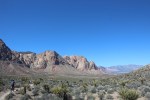
- All those trails with no rainforest in the way!
-

- High Roller at The LINQ. Denise Truscello photo
-
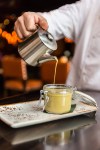
- Chayo cilantro cream soup.
-

- Chayo lobster tacos.
-
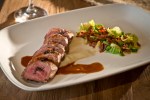
- Crush sliced sirloin.
-

- Sprinkles at The LINQ actually features a cup-cake ATM!
Creature comforters
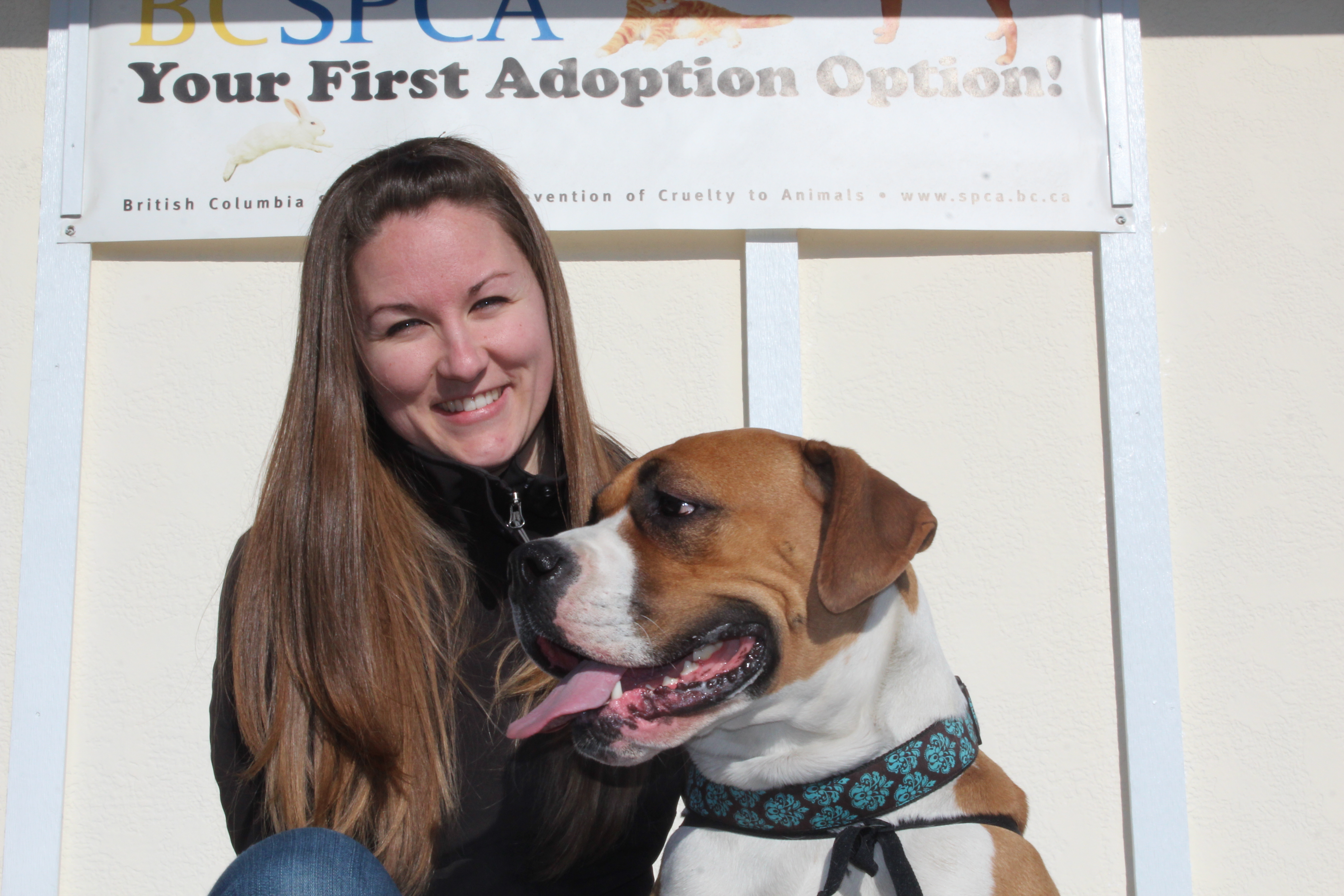
SPCA branch manager, Cindy Krapiec, with Chicklet.
“The greatness of a nation and its moral progress can be judged by the way its animals are treated.”
– Mahatma Gandhi
At three feet tall and 200 pounds, Jiggy is hard to ignore: especially when he’s hungry. He’ll nudge you if you’re in his way and he’ll wag his tail when he’s happy. Only a cruel person would say he waddled. He sashays.
Jiggy is a Vietnamese pot-bellied pig, formerly known as Jerry. A while back, Jiggy achieved local notoriety on the Sunshine Coast when the SPCA sought a permanent home for him. That search ended in West Sechelt where Jeri Patterson provides a home for some of the Coast’s unwanted animals.
“Two Jerrys would have been too weird so I renamed him Jiggy, but a lot of people remember him as Jerry,” says Patterson. “He’s considered a farm animal and most rescue properties prohibit farm animals – chickens, pigs, etc. My property is part of the Agricultural Land Reserve so after several foster homes, he came here. Now he’s home!
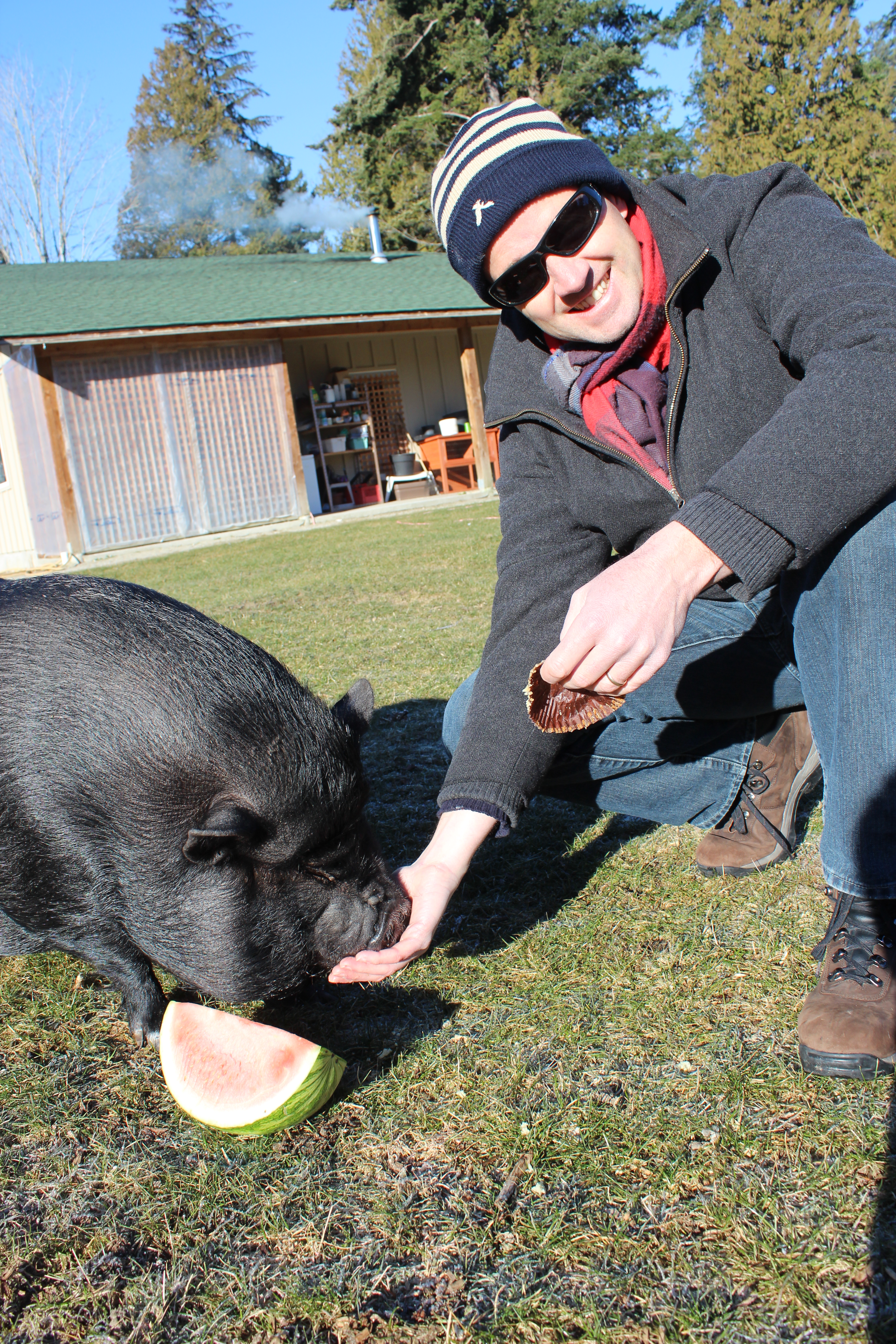
Jiggy – a hungry pig not to be truffled with.
“All of us want to be made to feel special. Animals are no different.”
Patterson loves animals. Thankfully she’s not the only one who cares. Volunteers up and down the Sunshine Coast care for unwanted animals. Some open their homes, taking in abandoned cats, dogs, bunnies and the like. Others help by knitting toy mice or by raising money via yard sales, recycling, trivia nights and sponsored dog walks. Their work is essential because on the Sunshine Coast, the number of abandoned pets is rising.
It’s a pattern repeated during economic downturns, says Patterson. “When you see food banks so busy you realize that some people are barely able to feed themselves, let alone their animals,” she says. “It’s cheaper to help people keep their pets than to care for them in a shelter.”
In 2013, the local SPCA attended more than 50 investigations of possible animal cruelty, many of them requiring multiple visits. January 2014 has already been record-setting with 13 cruelty investigations. In Gibsons the same month, 37 stray dogs were reported by the district’s animal control officer.
“Thirty-seven strays is a massive amount for a community of 5,000 people,” says SPCA manager Cindy Krapiec. “I think most animal lovers and pet owners are aware of the extent of the problem with unwanted pets, especial through social media, but otherwise people have no idea.”
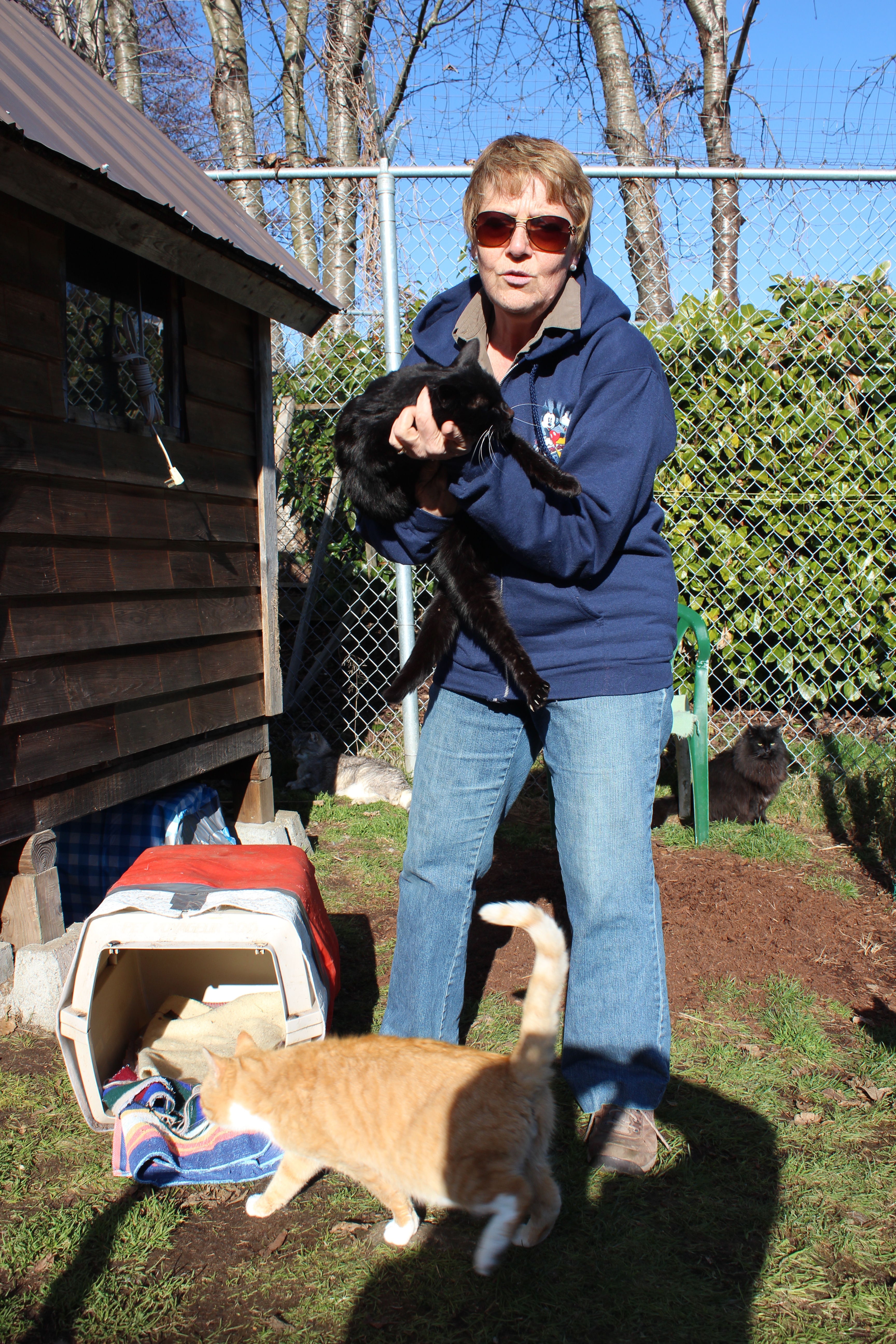
Happy Cat Haven volunteer, Marcia Timbers – aka The Cat Whisperer.
Together with her three staff, Krapiec run the SPCA in Wilson Creek, fulfilling the organization’s mandate of ‘speaking for animals’ by caring for abandoned creatures, investigating possible cases of cruelty, and educating the public about spaying, neutering and animal care. They receive no money from the government and rely almost entirely on fundraising. Far from being beleaguered though, Krapiec considers herself lucky to have “stumbled into” a job that brings something different every day.
“Even after three years, the learning curve is massive,” she says. “We spend a lot of time speaking with potential adopters, meeting animal owners and following up on cruelty cases. We try to educate first to find a solution. Litigation is a last resort.
“There’s a lot of science-based research to provide the best care for animals and that’s constantly changing, too.”
And then there’s the “never-ending” cleaning at the Solar Road facility, which last year handled 447 animals, including 196 dogs, 178 cats, 17 puppies, 36 kittens and 11 rabbits.
Krapiec acknowledges the extraordinary network of volunteers working alongside the SPCA, from business and community fundraisers to front-line animal rescuers like Clint Davy and the Gibsons Wildlife Rehab Centre, Violet Winegarden and the Happy Cat Haven, and Pam Albers of Pawprints Animal Rescue.

Violet Winegarden in her element at the Happy Cat Haven.
Then there are the veterinarians. “Local vets absorb a ton of cost,” says Krapiec. They are also among the first places she calls when homes are needed for abandoned pets. At the end of the line are people like Meghan Graves.
“I have no shame about calling Meg with a litter of animals,” laughs Krapiec.
Graves is a registered animal health technologist and the office manager at Sechelt Animal Hospital. She’s also vice-chair of the SPCA’s community council, which meets monthly to organize fundraising, community relations, and advocacy. At home with her husband and two young children, she’s fostering two rabbits (in addition to one she owns) in her living room, along with two dogs, Winnie and Gunnar, plus five cats – all abandoned at some point.
“You end up doing stuff like that,” says Graves. “All staff at the clinic fosters or have fostered. It gets very personal. It’s never ending.
“There are not many jobs where you take this kind of work home with you. You stay up all night long. It’s like having a newborn, or multiple newborns.”
As for the family dynamic, Graves admits that Winnie and Gunnar don’t get quite so many walks now she has two young children. “But they get story time now, which they both seem to really enjoy!”
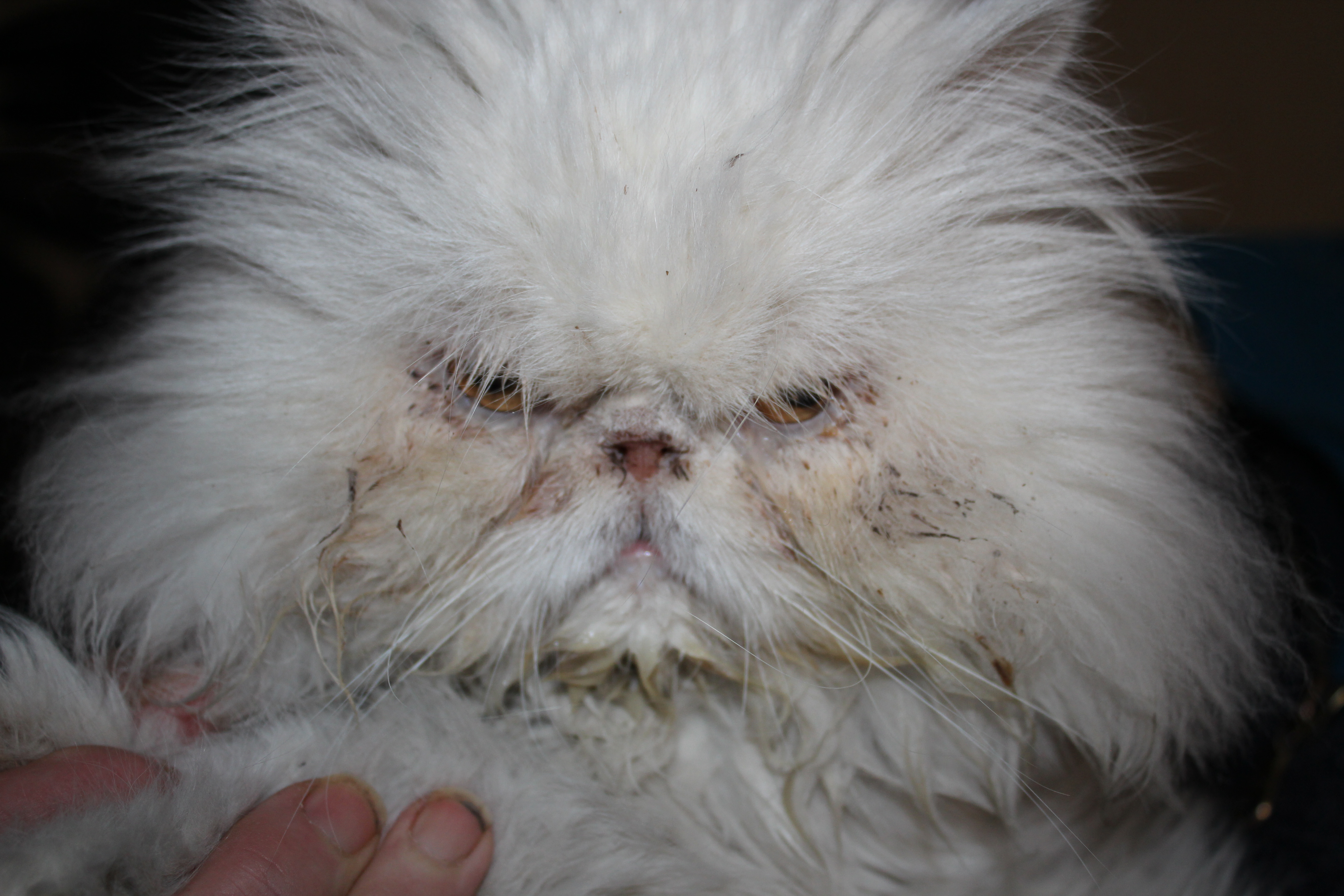
Smooshie refuses to say ‘cheese’.
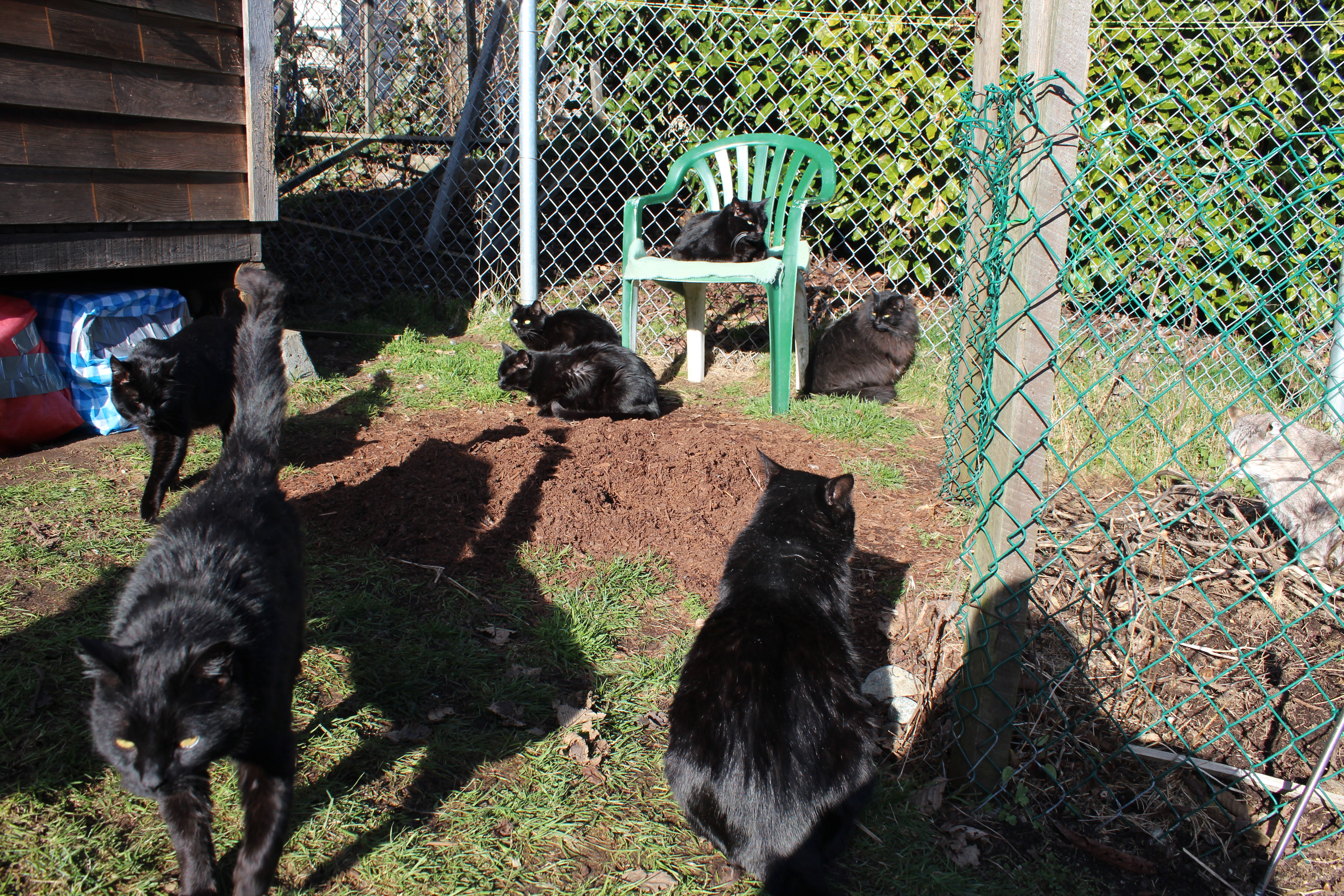
Violet Winegarden can surely relate to a home full of animals. On a tour of her Gibsons home I lose count of the number of cats but Winegarden – who knows them all by name – estimates there are 55 to 60. Outside there’s an HIV pen for Laredo, Clancy, Blue and Rebecca. In a neighbouring pen are Chamberlain, Whiskers, Tiger and half a dozen more all crowding around Marcia Timbers, a Happy Cat volunteer to whom Winegarden refers as “the cat whisperer”.
“Violet works harder than anyone I know,” says Timbers. “Her phone never stops ringing from people asking advice about spaying or neutering.
“So many people say they just want their cat to have a litter. There’s no reason for a cat to have a litter,” Timbers adds, exasperated.
Inside the home, Winegarden shows me the Seniors Room for cats as old as 26; the Forever Room for sick cats like Bijou, (“27 pounds, fat and happy,” says Winegarden) who are in their final days; and the Adoption Room for healthier cats. In between is the kitchen where two cats take up residence in my camera bag as other cats wander in and out.
Amid the clean litter boxes, medical equipment and bags of cat food I notice a Governor General’s Award hanging on the wall. Since 1992, Winegarden and her band of volunteers have cared for more than 7,000 animals. During that time she’s witnessed the effects of unspeakable acts of cruelty. She’s bonded with countless cats, including one that used to play the piano with her. And with the help of Dr. Justin McLash of the Sunshine Coast Pet Hospital, she’s ensured that cats are spared unnecessary suffering.
“I can tell when cats are going to die,” she says. “We shouldn’t have to suffer to die.”
At 85, Winegarden continues to rise at 5 each morning for long days of cleaning, caring, fundraising and managing a sanctuary with monthly expenses of $12,000. I’m tempted to ask why, but during the course of a long conversation that afternoon, I don’t have to.
“I think I was born this way,” she laughs. “I’ve been in trouble over animals all my life. I just don’t see animals as any different from us. We’re all the same beings on earth. We’re here to be together.”
It’s hard to imagine one person taking over Violet’s work, just as it’s difficult to contemplate the Sunshine Coast without the SPCA and other pet-rescue organizations. Jeri Patterson knows as well as anyone that SPCAs do close down. After Chilliwack SPCA closed, Patterson, once a resident of Agassiz, got involved with cat and rabbit rescue at her licensed kennel at the request of the municipality’s animal control officer. (Surrey’s SPCA has also closed.) She continues to look after animals from that jurisdiction.
“People need to know this about the SPCA: If you don’t value it, you may lose it.”
- There are numerous ways to help those helping abandoned animals. Visiting http://www.spca.bc.ca/branches/sunshine-coast/ is a good place to start. So is spaying and neutering your pets. If you witness animal cruelty, call 1-855-622-77221-855-622-7722.
- Drop off grocery receipts and Canadian Tire money at Happy Cat Haven collection boxes at IGA, Super-Valu and Clayton’s stores. Or drop off cans and bottles for recycling at Happy Cat Haven, 760 School Road, Gibsons, between 7 a.m. and 3 p.m. Yard sale items can also be dropped off. To volunteer, call 604 886-2407604 886-2407.
Breaking bad never felt so good

It’s not easy admitting your bad habits, but Sean Parrinder wants to know.
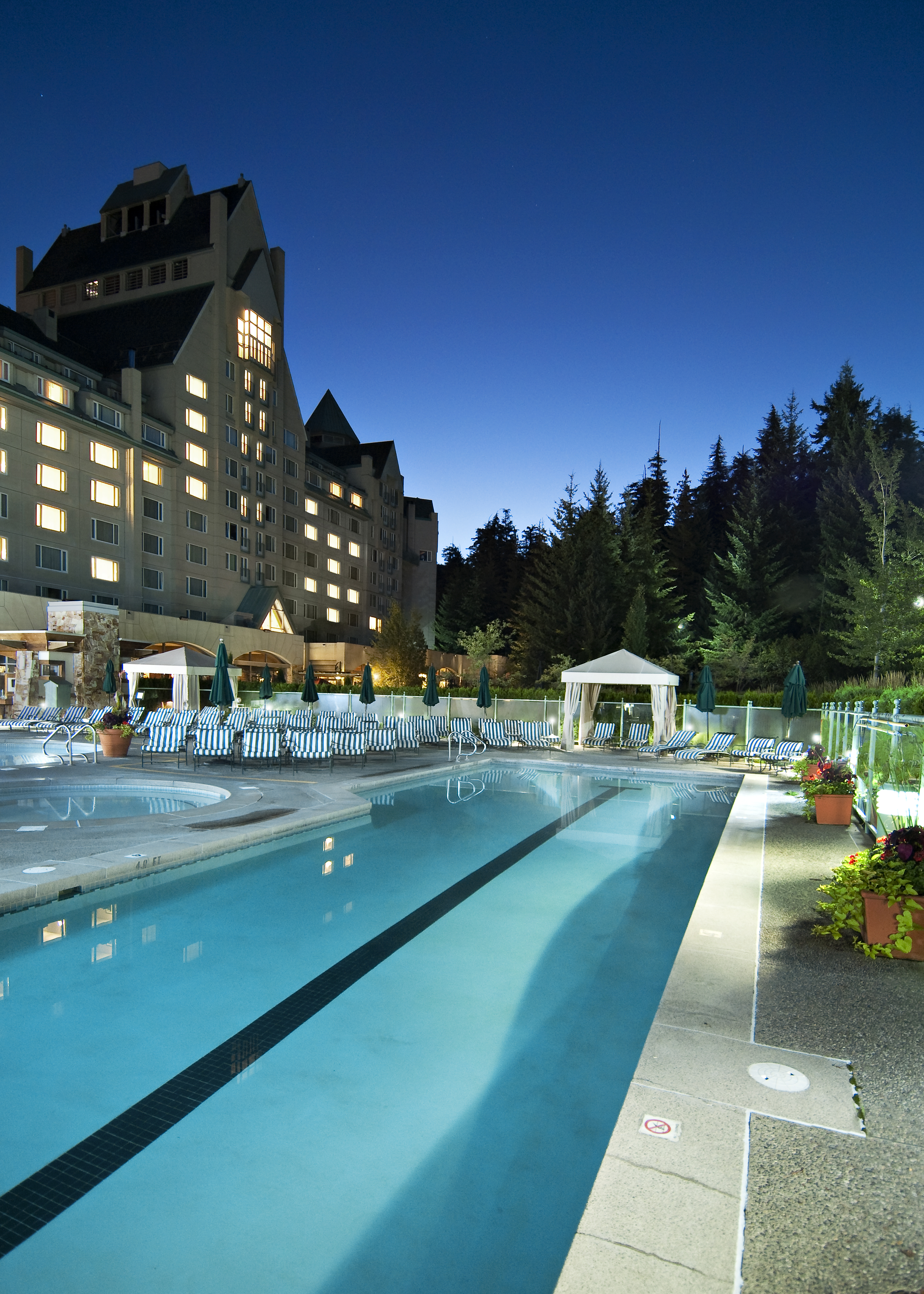
Sean is my personal trainer and confidante for the day at the Fairmont Chateau Whistler. He bears a passing resemblance to Justin Timberlake and I like that he doesn’t appear to be judging me.
“My body’s a temple,” I want to say. “A temple subjected to repeated bouts of vandalism at the hands of microbrewers and artisan bakeries.”
Instead I tell Sean: “Every year it’s the same. January rolls around and I follow my wife to the gym with extra pounds and good intentions. Trouble is I just meander from machine to machine, avoiding eye contact and wondering what the levers and pulleys do.”
Sean nods. “And then what do you do?”
“I walk the treadmill until it’s time to go.”
Sean applies his kinesiology degree and love of sport to helping kids and adults achieve fitness goals. At this time of year, his services are in demand as part of the Fairmont’s Breaking Bad Habits Whistler Getaway, a new year’s kickstart for that age-old resolution of getting fit.
Among other treats, the package includes an ‘energizer breakfast’ of strawberry and banana smoothie with dates, bee pollen, honey and orange juice, along with a toasted bagel with cream cheese. And there’s a Detox Body Wrap at the Vida Spa. But now is the hard part.
We’re in the discovery process of Sean asking me about my fitness goals and the habits I aim to break. I tell him that I need process, not procrastination; method, not mediocrity. Sean understands. He tells me to leave cardio till last and begin with tougher compound exercises, designed to work out multiple major muscle groups. We’ll focus on a lower range of repetitions – from five to eight – but increase the weight each time. Finally, we’ll monitor our rest periods and focus on breathing.
I warm up on the rowing machine and try to ignore Matt Damon staring at me from the cover of Men’s Fitness. We move on to the seated leg press – a machine I actually know how to use. You just sit down with your knees to your chest and straighten your legs by pushing away a weighted plate. The most I’ve ever pressed is 140 pounds, yet Sean starts me on eight reps of 180, eventually rising to eight at 200.

During the course of an hour, through lunges, squats, back extensions, and bar curls, Sean pushes me harder than I ever would have ever pushed myself. True, there are times when I want to punch him, but we high-five as I complete my final exercise; three sets of dips – gripping parallel bars, lowering my body so my arms are at 90 degrees before pushing my body up again. I learn which of my muscles are benefitted by each machine and feel better prepared for my next visit to the gym. But my excitement at completing the circuit is tinged with embarrassment. I realize I’ve been a bit of a wuss until now.
Ninety minutes later I’m acutely aware of the muscles I’ve worked. They’re aching, but I couldn’t be in a better place. Vida Spa claims to restore energy and promote well-being via a range of therapies, facials, wraps and exfoliations. The Breaking Bad Habits package includes an hour of the latter. As I’m rubbed down with course sea salt I can’t help thinking of an old soccer coach who used to recommend a meat pie and a pint as the best post-exercise routine.
After a quick shower I’m back on the massage table for a full-body application of shea butter and a scalp massage. My body has almost forgotten this morning’s workout. I feel like a basted turkey. Blissed out, I’m reluctant to leave the table but I’m instructed to take another quick shower. I return for a classic massage. Face down and somewhere near nirvana, I realize my body almost does feel like a temple!
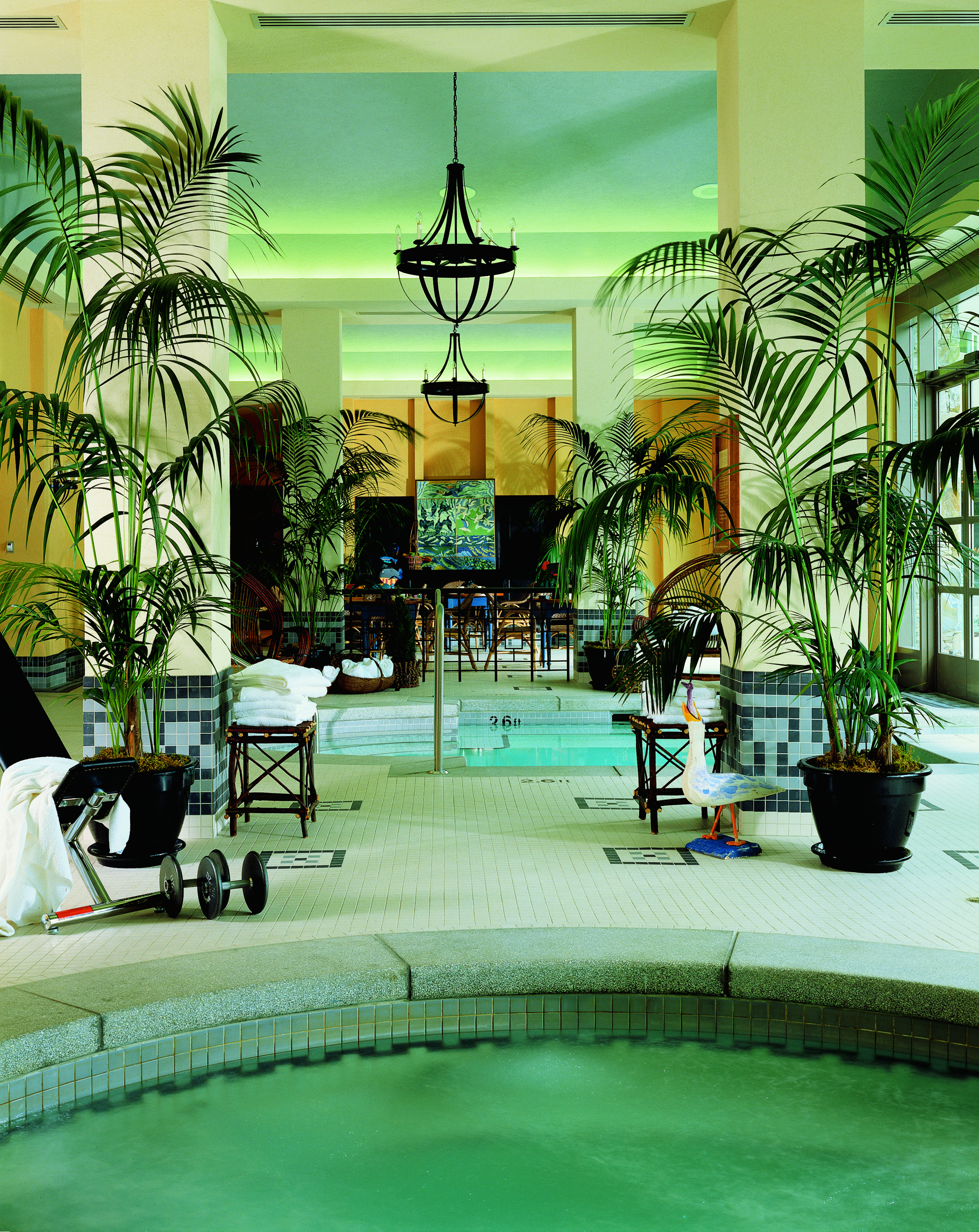
I cap my afternoon’s decadence in the Fairmont’s Health Club, alternating between the sauna, steam room, hot tub and pools. I ponder how jealous my wife will be when I tell her about the shea butter, the scalp massage …
Sean spots me and recommends that I take a cold shower after each session in the sauna and steam room. “Always finish cool,” he says.
I decide to tell my wife about the cold showers.
- The Fairmont’s Breaking Bad Habits Whistler Getaway costs $569 per person and is available all year. It includes two nights’ accommodation, a Morning Energizer breakfast, a two-course Lifestyle Cuisine dinner, a 60-minute Detox Body Wrap at Vida Spa, Fairmont fit gear, and the choice of one of the following Fairmont Chateau Whistler Health Club activities: Aquafit, yoga, personal training session, resistance stretching or a one-hour personal running session per adult. Visit www.fairmont.com/whistler/ and click on ‘special packages’ or call 1 800 606 82441 800 606 8244.
Men of Steele

Next time we’ll bring snowboards and deckchairs.
My friend Tom and I had been planning a trip to the Tetrahedron for about 10 years. This weekend we finally did it. In hindsight, hiking to Mount Steele cabin would have been easier when I was 36, not 46.
At the base of 5,114-foot Mount Steele, the cabin is one of four two-storey cabins in Tetrahedron Provincial Park, each built to accommodate 16 people – first come, first serve. The others are at Bachelor Lake, above Edwards Lake, and between McNair and Chapman Lakes. The cabins are connected via a 25-kilometre trail network and are maintained by the Tetrahedron Outdoor Club.
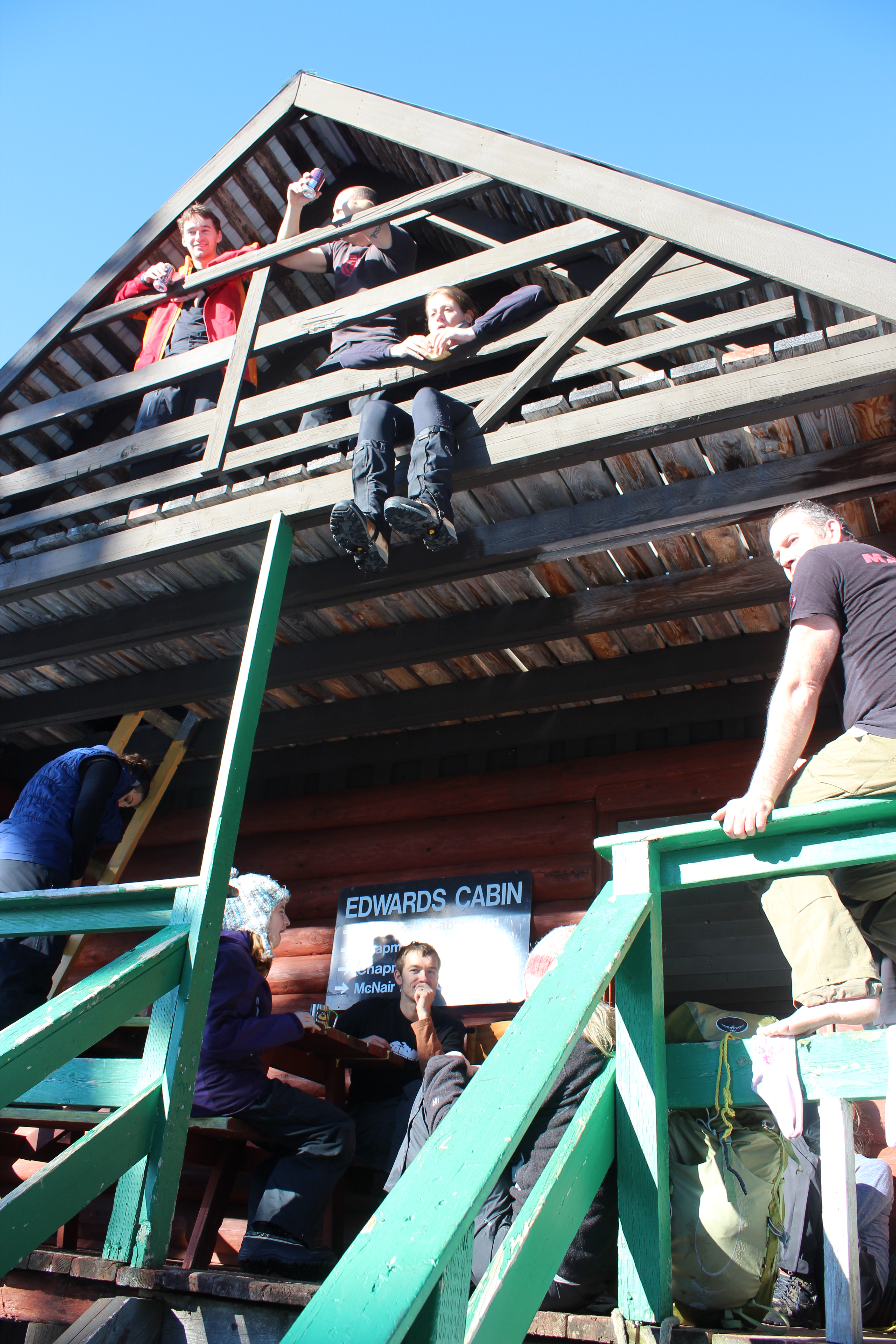
Lower Mainlanders enjoying lunch at Edwards Cabin.
We set off on snowshoes from the trailhead up Grey Creek Forest Service Road. In true Sunshine Coast fashion, the Tetrahedron is not signposted from the road, despite being a Class A provincial park. That might explain why there are only three other cars in the parking lot on a sunny January weekend.
Six thousand hectares of mountains, lakes, streams, wetlands and forest, the Tet, as it’s fondly known, has long been cherished by the backcountry enthusiasts who can actually find it. We finally meet some of those enthusiasts about two hours into our hike at Edwards Lake. They’re a group of 12 skiers and snowshoers from the Lower Mainland who are planning to stay at Edwards Cabin. We stop for lunch with them there before pushing on at 1 p.m.
So far we’ve been hiking for about two hours. There’s been no new snow for a week, temperatures are above freezing and the sun’s out. The sign at Edwards Cabin says it’s just three more kilometres to Mount Steele Cabin. It doesn’t mention the elevation gain of 1,300 feet, but that much is obvious from the contour lines on Tom’s map, which look like an intense low pressure system; that and our occasional glimpses of Mount Steele – white, jagged and way up there beneath the bright blue sky.

Downtime at Edwards Lake. We opted not to test the ice.
The climb begins almost immediately, as does the sweat, pouring off me and soaking me from head to toe. The steeper it gets the happier Tom becomes. He shouts encouragement and I try to ignore the chafing of 20-year-old longjohns and the borrowed 40-pound rucksack on my back. Following tree markers, we zig-zag our way through amabilis fir, mountain and western hemlock, yellow cedar and white pine while Tom yells to me about his merino wool base layers. “Not a drop of sweat,” he shouts. “This material wicks all the sweat away!”
I don’t say anything. I’ve stopped talking to Tom.
After an hour of this I’m resting every 10 steps. I’m eating snow to try and and conserve my water. We appear to have cleared the forested section but that brings its own problems. We can’t see any more tree markers. So Tom checks his map and his compass and we decide to climb one of Steele’s lower open slopes, figuring the cabin will surely become visible as we ascend. But with no more markers in sight, we get cold feet – actually, mine are soaking wet. (Tom’s aren’t. He has merino wool socks … or something.)
So we descend, covering the same distance in 10 minutes that took us 30 minutes to climb. It’s 3:30 p.m. and for the first time all day, I have one eye on the time. The sweat is freezing on my back and it will be dark in 90 minutes. After some searching though, Tom spots a marker and we’re off again, climbing in a different direction toward a ridge that he swears will take us to the cabin. From the ridge we’re treated to views of the Tantalus Range and the markers continue to guide our way.

Mount Steele cabin, as seen from the top of Mount Steele.
Just before 4, I hear Tom from up ahead. “I can see the cabin!”
Thank God he’s not lying, I think as I catch up a few minutes later.
There it is, its red roof standing out against so much white. We savour the last few steps. I don’t think I’ve ever seen a location quite so beautiful. We have the place to ourselves. According to the guest book, we’re only the second visitors this year. An hour later at the metal kitchen table, we’re eating curry and naam bread cooked on the wood stove, washed down with a couple of beers. The cabin is well equipped, with mattresses in the attic, firewood in the basement, a kitchen counter with utensils and a couple of sinks. We melt snow for water and turn the stove down to a slow burn. Pretty soon the entire cabin is toasty warm.
It would seem impossible to put a price on such an amazing place, but the Tetrahedron Outdoor Club came up with $10 a night, which seems more than reasonable. More than a quarter of a century ago, the club used to be known as the Tetrahedron Ski Club. Back in 1987, the club mobilized more than 200 volunteers, 45 businesses, schools, community groups and several levels of government to build the Tetrahedron’s cabins and trail network.

Beer, curry, mates – just another Saturday night.
The cabins were built at Sechelt airport before being disassembled and flown by helicopter to be reassembled on site. Forestry company, Canfor, and the Sunshine Coast Regional District donated timber, Sechelt Creek Contracting provided logging service, Airspan donated some air time, Gibsons Building Supplies provided crane trucks and the Outdoor Recreation Council pitched in with chainsaws. For one of the few times in Sunshine Coast history, one great idea united governments, businesses, and local volunteers – in the midst of a recession, no less.
For all the day’s exertions, I can’t sleep. After midnight I set up my tripod outside and try and capture Mount Steele by moonlight with varying results. Fog covers Georgia Strait but I can see lights twinkling on Vancouver Island. There’s no bite to the breeze blowing and I feel like the last person on Earth. I may be delusional. I go back to bed.

The moon over Mount Steele. Sometimes not sleeping isn’t so bad.
In the morning under clear skies we hike to the top of Mount Steele. It’s difficult to reconcile this rugged terrain and such epic landscapes with the place I call home. For me, the Sunshine Coast typically conjures images of rainforest and beaches, not jagged peaks and frozen lakes. But then visiting this place would surely alter anyone’s perceptions.
Tom vows to bring his snowboard next time. I’m thinking a deck chair. We pack up, sweep up, and head out for the descent to civilization. Yesterday, it took us six hours to get here. Today we’re back at the car in just over two hours.
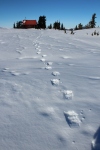
I relish every step of our tracks with a smile.
- For more information about the Tetrahedron Outdoor Club, visit www.tetoutdoor.ca
- Four-wheel drive and chains are essential for visiting the Tetrahedron. For more information about the park, visit www.env.gov.bc.ca/bcparks
- There can be a significant avalanche risk on Mount Steele. Before heading out, check with www.avalanche.ca/cac/bulletins/latest
- For more on the history of the Tetrahedron Outdoor Club, visit my earlier blog post here.
- If your fitness is kind of sketchy and you’re inexperienced in the backcountry, consider taking Tom with you. I couldn’t have done it without him.


Urine Review

It’s fair to say that the coffee kicked in early on the Pemberton slow food cycle this summer.
Twas a month before Christmas
When Leah turned and said
“Here are the cards for your poem
Now I’m off to bed”
-

- Senator Mike Duffy, in happier times.
-

- Mayor Rob Ford: Never met a microphone he didn’t like.
So I searched for a highlight
Picking just one is a toughie
Like hugging Rob Ford
Or trusting Mike Duffy

Good kids, all of them.
Our year was terrific
With adventures galore
Life by the Pacific
Is exciting for sure
Ryan turned 16
And started to drive
Each night we thank God
We’re all still alive



Emma hit 14
An important milestone
Becoming the last teen on Earth
To own an iPhone


In the summer we cycled
In Canada Back East
The sights were amazing
The heat was a beast
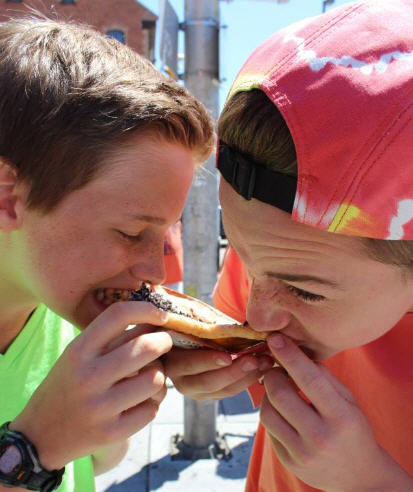
Ryan and Jordan … on a budget.
We visited the Marshalls
In Hunstville so scenic
And confirmed that they’re still
Irritatingly photogenic

Sickeningly photogenic. Again.
Through Quebec City we pedalled
Up hills steep and cobbled
The sweat was intense
My groin somewhat troubled
Toronto was flatter
Cycling old railway track
It’s a cosmopolitan city
Except for the mayor, who smokes crack

Good kids … all of them.
Ziplining above Whistler
In fear and in dread
Is how Leah and I marked
22 years wed

You wouldn’t believe how hard it is to photograph this on self-timer.
We had visitors, too
Cousin Steve and his clan
We all hit the beach
And worked on our tan

Turns out there’s another Leah!
Brother Keith arrived next
So nice he could stay
I leant him my coat
Cos it rained every day
We went to Osoyoos
And drank lots of wine
The rain turned to snow
But we got home on time

Queasy riders.
Nan and Grandad came to visit
For three weeks this Fall
With cards we slipped pressies
In Grandad’s holdall

HE’S GOT A KNIFE!
And now we look forward
To a promising New Year
England in Rio
And Three Lions to cheer

God bless Wayne.
I wish you the best
For a year full of light
God Bless Wayne Rooney
And to all a good night




Brewed Awakening: A tale with a hoppy ending
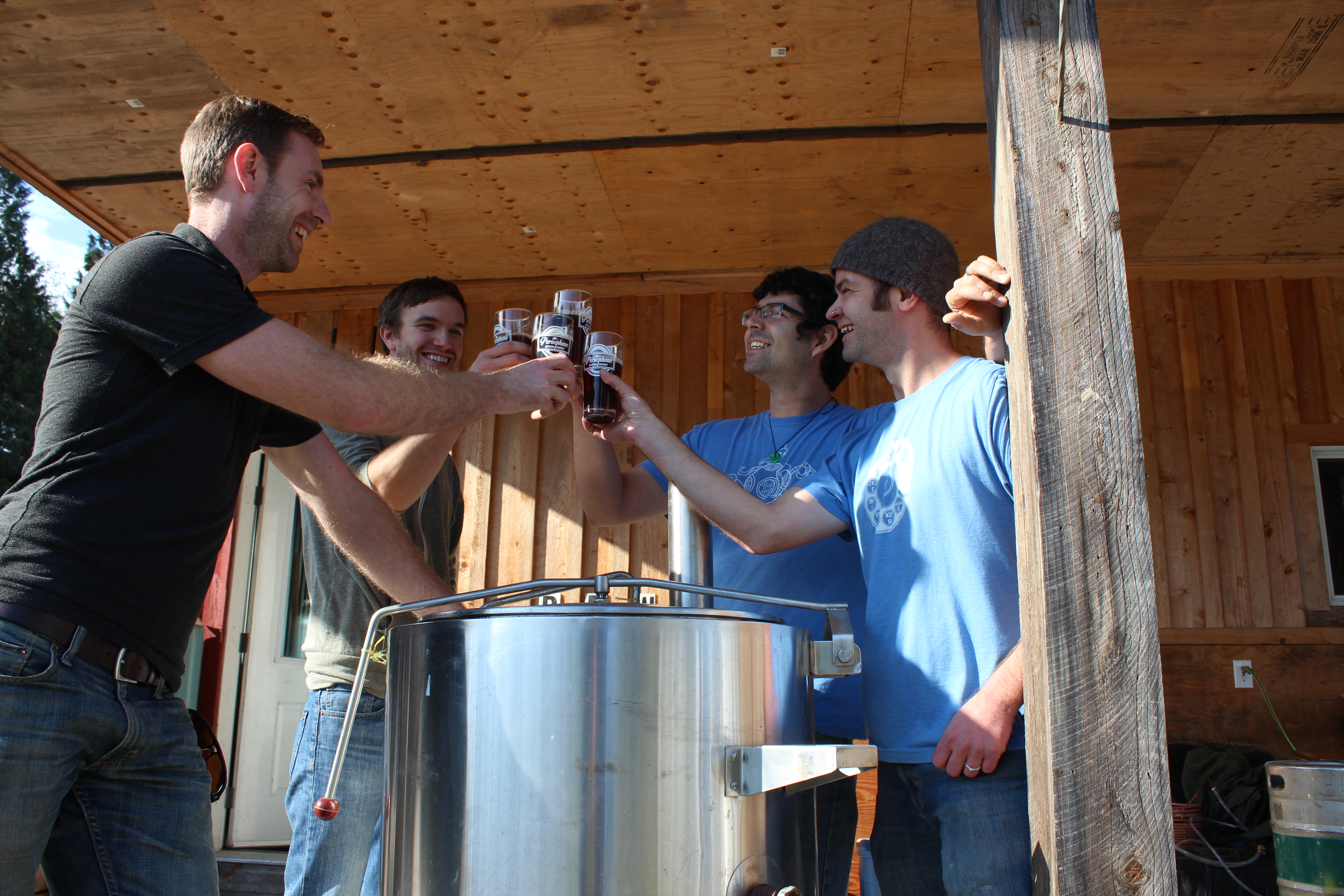
From left, Matt Cavers, Amos Harding, Monte Staats and Matt Thomson of the Gibsons Homebrewing Network are tireless in their pursuit of the perfect brew.
“Beer is proof that God loves us and wants us to be happy.”
― Benjamin Franklin
Jeff Hay-Roe’s brewery is a tribute to improvisation. On a long dining room table adjacent to the family kitchen sit a mash tun, a plastic fermentation bucket, a glass primary fermenter, a copper manifold, a grain mill, a strainer and a few packets of malt and hops. Outside is a kiddie pool, but we’ll get to that later.
“My set-up is pretty ghetto, but it works,” says Jeff, who estimates his brewery cost about $200. He started brewing from kits 10 years ago, but switched to brewing from scratch about three years ago. “My family is very supportive of me in my hobby. It’s only a couple of the kids that seem to not like the smell on brew day, but my wife likes it and most of the kids don’t mind it.”
That’s probably just as well. Jeff has nine kids.
Perhaps inspired by a wider appreciation for craft-brewed beers across B.C., (or perhaps because of the price of them) Jeff is among a growing number of homebrewers here on the Sunshine Coast and elsewhere. In an interview shortly before his death this summer, Dan Small – an icon of Vancouver’s homebrew scene and owner of Dan’s Homebrewing Supplies – had this to say about homebrewing in B.C.
“Man, in the early 90′s people just didn’t know or care anything about beer. It was tough trying to convince Kokanee drinkers to make stout. Things are much, much better now.”
On the Sunshine Coast, a thriving homebrewers’ network has quickly formed ties with the Coast’s newest craft brewer, Persephone Brewing Company in Gibsons. Persephone allows homebrewers to meet and brew on the premises and employs some of its members.
To understand the appeal of homebrewing, Jeff Hay-Roe’s two-storey Gibsons home is a good place to start. Brew day comes around once a month. For about six hours, the kitchen and dining room are requisitioned and the stove is monopolized to boil 30 litres of fluid; that’s the fluid previously separated from a porridge-like mix of grains and water with the copper manifold Jeff designed himself; the same fluid that’s been held at a high temperature for an hour so the enzymes in the grain can convert the starches to sugars. That would be the grain Jeff grinds from kernels in a converted mill operated with a drill connection, not a handle.

Prolific homebrewer Jeff Hay-Roe with his award-winning London Town Brown Ale.
“We’ve got a stove-type burner on our barbeque, so I often boil kettles for people out on the barbecue on brew day,” says Jeff.
Hops are added to the fluid boiling away in two pots on the stove, starting with bittering hops then flavor and aroma hops towards the end. An hour of boiling turns 30 litres of fluid into 24 litres of wort. “Six litres evaporate in my kitchen each time,” says Jeff.
“After the boiling’s done it’s important to cool it down immediately,” says Jeff.
A lot of people use coiled immersion chillers, says Jeff. “I put mine in a kiddie pool of cold water.”
Once cool, the wort is poured into the fermenter where yeast performs its magic and fermentation occurs. About 10 days later, Jeff bottles his brew, usually a batch of 70 bottles (each 350mls).
“I always have about eight varieties in the fridge,” says Jeff. “I always like to have a pale ale, a Belgian Blonde ale, a southern English Brown Ale …”
Jeff’s resourcefulness is by no means at the expense of quality. Earlier this year, his London Town Brown Ale won a contest run by Vancouver’s Alibi Room, Howe Sound Brewing and VanBrewers, a non-profit group of homebrewers in the big city. He won a night at the Howe Sound Brewery, participated in brewing a 2,300-litre batch and saw his beer sold in Sunshine Coast private liquor stores.
He’s won prizes for his Belgian Blondes, too. But he readily admits that he’s entered beers in other competitions without success. Winning’s satisfying, says Jeff, but so too is the brewing and the tasting.
“The process I really do enjoy,” he says. “I love the creativity; it’s interesting to see it all happen. You start with something resembling porridge; then there are the different smells all the way along and it ends with something sweet.”

So this horse walks into a bar …
Sharing the fruits of his labour is rewarding, too.
“On Fridays I’ll take some to work and at 4:30 we stop working and have a beer. For a while, I was bringing it to church and we’d have a drink afterwards.”
Matt Thomson and Matt Cavers of the Gibsons Homebrewing Network can relate to those motives. I meet them on a sunny October Saturday at Persephone where they’re brewing barley wine with fellow homebrewers Monte Staats, Amos Harding and Dion Whyte.
The group converge around a stainless steel mash tun where maintaining a specific temperature is vital.
“This is industrial chemistry,” says Matt Thomson, who gives me a crash course. “In the mash, enzymes in base grains convert starch to sugars. At the lower end of the temperature spectrum – 148 to 149 Fahrenheit – you’ll get more fermentable sugar, meaning a dryer, crisper beer.
“At the top of the mash range, close to 158 Fahrenheit, are more sugars that the yeast cannot eat – non fermentable sugars. Higher mash temperatures mean more sugars left and a sweeter beer.”
After a few minutes with the guys, I’m reminded of Jeff’s enjoyment in the process. Besides evaporation there’s enthusiasm and camaraderie in the air. I get the feeling that even a failed barley wine wouldn’t deter this group from trying to brew another. (For the record, it was a delicious success.)
“I produced my first batch, using a recipe from John Palmer’s How To Brew, in March 2007,” recalls Matt Cavers, who’s a full-time brewery assistant at Persephone. “It was miserable stuff. I boiled the specialty grains and extracted loads of astringent tannins from them. I fermented it way too hot, and as a result it tasted like bananas. Still, I drank every bottle, and my beer has only been getting better since.”
Trial and error, it seems, is part of the appeal. So too is pride in one’s own work, says Matt Thomson.
“Homebrewing is growing because it’s part of a natural reconnection to wanting to make things,” he says. “Making beer is satisfying, both in terms of process and product. It helps that most people love it, and certainly it helps that there are cost savings.
“But a really strong driving characteristic that I observe in homebrewers is wanting to be able to share something of value that they have made with a basic tool kit in their own kitchen, or backyard because they believe in it. It’s that sense of pride in something you’ve made on your own.”
Jeff Hay-Roe sees parallels in other crafts. “My wife Jacquie is more of a beer sampler than a beer drinker, but she can appreciate brewing because she’s a knitter,” he says. “Both have a long and rich history of making beautiful things from scratch.”
I’ll drink to that!
- The Gibsons Homebrewing Network is happy to welcome new members. For details, email Matt Thomson at mthomson@gmail.com

Beer’s good for you. My Dad told me so.
 Nev Judd: Online and out there